
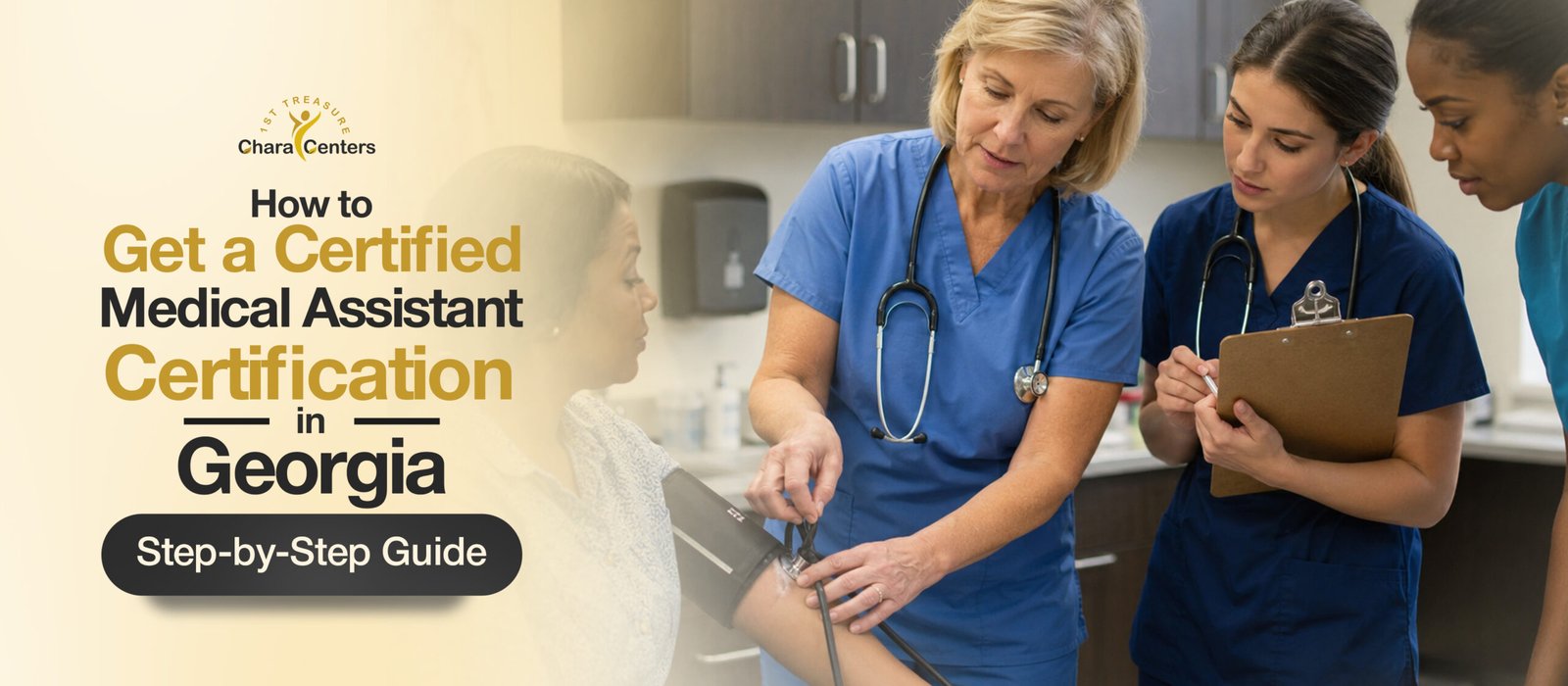
How to Get a Certified Medical Assistant Certification in Georgia: Step-by-Step Guide
July 30, 2026
There are plenty of Certified Medical Assistant programs in Georgia, and almost all of them promise the same thing. They all say they’ll prepare you for certification, help you build the right skills, and set you up for a successful healthcare career. After comparing a few, they can start to feel almost identical, making it difficult to know which one is actually worth your time and money.
If you’ve reached that point, you’re not the only one. In this guide, you’ll find everything you need to know about becoming a Certified Medical Assistant in Georgia, from training and certification to career opportunities and alternative healthcare pathways.
Step-by-Step: Becoming a Certified Medical Assistant in Georgia

At first, the process can seem like a lot to figure out. Once you break it into steps, though, it becomes much easier to see what comes next.
Step 1: Check Whether You Meet the Basic Requirements
Before you apply anywhere, most Georgia training providers are looking for the same short list:
- A high school diploma or GED
- Minimum age of 17 to 18, depending on the program
- Background check that meets clinical placement requirements; you’ll be placed in a real clinical site for your externship, so this matters
- An interest in working with patients and handling administrative responsibilities.
These are the main Certified Medical Assistant requirements most students review before starting their training journey.
Step 2: Pick the Right Healthcare Training Path
This is an important decision to make because the program you choose affects your training and future job opportunities. Before you commit to a Certified Medical Assistant Certification in Georgia, it’s worth asking a bigger question. What’s the fastest, most affordable way for you to start working in healthcare?
Medical assisting is one option, but it’s not the only path. Some students choose CNA training in Georgia, phlebotomy certification in Georgia, or Medication Aide training in Georgia. These certifications can help them start a paid healthcare job in just a few weeks or months.
Step 3: Work Through the Coursework and Skills Labs
Once you’re enrolled in a CMA program, coursework runs clinical and administrative topics side by side, because that’s how the job actually works day to day.
Clinical training generally covers:
- Vital signs and patient assessment
- Injection technique and medication administration
- Medical terminology and anatomy
- Infection control and sterile technique
- Prepping patients for exams and minor procedures
Administrative training generally covers:
- Scheduling software
- EHR documentation
- Basic insurance and billing concepts
- Patient intake and office communication
Programs that combine clinical and administrative training usually prepare students better for real-world Medical Assistant roles. Both skill sets are used every day. Before you enroll, it helps you to understand Medical Assistant training requirements. You can choose a program that provides the right balance of classroom education and hands-on practice.
Step 4: Complete Your Clinical Externship
Every legitimate Medical Assistant training program in Georgia includes a supervised externship under a licensed staff member’s supervision.
This is where classroom practice turns into real-world experience. It allows students to apply their skills while working with actual patients under professional supervision. When you’re evaluating any Medical Assistant training program, ask directly how many externship hours are guaranteed and where students typically get placed.
Step 5: Sit for a National Certification Exam
After training and clinical hours wrap up, most graduates take a national certification exam. The most recognized options:
- CMA (AAMA): Certified Medical Assistant, American Association of Medical Assistants
- RMA (AMT): Registered Medical Assistant, American Medical Technologists
- CCMA (NHA): Certified Clinical Medical Assistant, National Healthcareer Association
Georgia does not legally require Medical Assistants to hold a national certification. However, many employers strongly prefer or require certified candidates because certification demonstrates verified knowledge and competency. Skipping certification won’t shut every door, but it narrows the list considerably and usually caps your starting pay.
Step 6: Start Applying for Medical Assistant Jobs in Georgia
Once you’re certified, the usual next stops are:
- Hospitals and hospital-affiliated clinics
- Private physician offices (family medicine, pediatrics, internal medicine)
- Urgent care centers
- Specialty practices: dermatology, cardiology, OB-GYN, orthopedics
- Community health centers
Medical Assistants are needed in almost every outpatient setting. As a result, job searches for Medical Assistant positions in Georgia tend to move faster than in many other entry-level fields. Especially for candidates who already have a completed externship on their resume.
Certified Medical Assistant Certification in Georgia vs. Other Healthcare Career Paths
A Certified Medical Assistant Certification in Georgia can lead to a stable healthcare career. It also helps to compare it with other healthcare certifications so you can choose a path that matches your timeline, budget, and career goals.
Before you commit to any single training path, it helps to see the full lineup side by side.
| Career | Main Responsibilities | Typical Workplace |
|---|---|---|
| Medical Assistant | Clinical and administrative support | Clinics and physician offices |
| CNA | Direct patient care and daily living assistance | Hospitals, nursing homes, long-term care |
| Phlebotomy Technician | Blood collection and specimen handling | Hospitals, labs, clinics |
| Medication Aide | Medication assistance in approved healthcare settings | Long-term care facilities |
How Long Does a Certified Medical Assistant Path Actually Take?
Most Medical Assistant programs in Georgia run 4 to 12 months, depending on format:
- Accelerated programs: 4 to 7 months, usually full-time with a condensed schedule
- Traditional or part-time programs: 9 to 12 months, better suited to people working another job while training
The exact timeline also depends on how the externship is structured. Some programs run clinical hours alongside coursework; others schedule the externship as one final block after classroom training wraps.
Other Healthcare Training Options in Georgia
For some students, Certified Medical Assistant certification in Georgia is the right fit. Other students find that CNA, phlebotomy, or Medication Aide training offers a faster way to enter healthcare and explore different healthcare career paths in Georgia.
So before you lock in a Certified Medical Assistant program, it’s worth knowing what else is out there.
1. CNA Training in Georgia (A Direct Patient Care Career)
A Certified Nursing Assistant spends the day doing the work that keeps patients comfortable and safe. They help patients bathe, walk to the bathroom, or simply feel less alone during a hard stretch in a hospital or nursing home. CNAs are also one of the most in-demand certifications in Georgia healthcare right now, because facilities are chronically short-staffed and CNAs are the backbone of daily patient care.
Where CNAs end up working:
- Hospitals
- Nursing homes
- Assisted living communities
The Certified Medical Assistant (CMA) credential is one of the most widely recognised certifications for medical assistants and is offered by the American Association of Medical Assistants (AAMA). Many employers value this credential because it demonstrates that a candidate has met national standards for knowledge and skills.
Also Read: CNA Programs in GA vs Medical Degrees: Which One Is Best?
2. Phlebotomy Certification (Build Specialized Clinical Skills)
A Phlebotomist focuses on laboratory-related patient care rather than bedside care. Phlebotomy technicians are responsible for drawing blood, labeling specimens correctly, and ensuring samples are handled properly for testing. It’s a precise role that’s in demand across hospitals, laboratories, and outpatient clinics. Phlebotomy certification is genuinely a good fit for someone who wants hands-on clinical experience without the broader scope a CMA role covers.
A lot of people use phlebotomy as a stepping stone. Get certified, get some real lab experience under your belt, and decide later whether nursing, Medical Assisting, or another specialty is worth pursuing.
3. Medication Aide Certification (Expand Your Healthcare Skills)
Medication Aide certification is designed primarily for CNAs who want to expand their responsibilities and advance their careers. A Certified Medication Aide handles medication administration in approved settings like long-term care facilities, under the supervision of licensed nursing staff. It’s a natural next step once you’ve already got CNA experience and you’re ready to expand what you’re allowed to do on shift.
Our CMA training at 1st Treasure Chara Centers is built specifically for students who want practical skills, hands-on experience, and a clear path into healthcare. Students searching for CMA classes near Canton, GA can explore training options designed around real patient-care skills and healthcare expectations.
By comparison, CNA training in Georgia can be completed in 4 to 12 weeks. Phlebotomy certification typically takes a few months, while Medication Aide training is usually one of the shortest paths of all. If getting into a paying healthcare role quickly matters more to you than the specific job title, that timeline gap is worth weighing seriously. Many students compare these training timelines before deciding which healthcare career best fits their goals.
Not sure which healthcare career fits your goals? Compare CNA, Phlebotomy, and Medication Aide training programs to find the fastest path into healthcare.
Ready to Start Your Healthcare Career in Georgia?
A Certified Medical Assistant Certification in Georgia is a great fit if you like the idea of working with patients while also keeping the day organized behind the scenes. No two shifts look exactly alike, which is one of the reasons many people enjoy the role.
Honestly, medical assisting isn’t the only way to get started. If your main goal is to begin working as quickly as possible, CNA training might be a better fit. If drawing blood and working in a lab setting sounds more interesting, phlebotomy could be the direction to take. Already working as a CNA? Many students move on to Medication Aide training when they’re ready to take on more responsibility.
There isn’t one path that’s right for everyone. The best choice is the one that matches your goals, your interests, and where you see yourself a year from now.
Don’t worry if you haven’t made up your mind yet. Most students haven’t. Sometimes it just takes a quick conversation with someone who’s been through the process to figure out which program feels like the right fit.
Talk to our team, ask as many questions as you need, and we’ll help you figure out which program makes the most sense for you.
FAQs
Do Medical Assistants need certification in Georgia?
No, Georgia doesn’t require certification to work as a Medical Assistant. Most employers will lean toward candidates who’ve completed a certification program, since it shows you’ve already got the basics down.
Can I become a Medical Assistant without healthcare experience?
Yes. Plenty of people start with no healthcare experience at all. Medical Assistant programs are designed for beginners and teach you the clinical and administrative skills you’ll use on the job.
What are some short healthcare programs in Georgia?
That’s one reason many students compare different healthcare programs before enrolling. CNA training, phlebotomy certification, and Medication Aide training are all solid options, especially if you’re looking for a shorter route into the healthcare field.
Latest Posts
August 13, 2024
Is the Role of a CNA the Same as That of a Nurse?
August 13, 2024
Phlebotomists: Vital Contributors to the Healthcare System

August 13, 2024