
How much do phlebotomists make? Phlebotomist Salary & Job Description
September 18, 2026
A blood sample may fit inside a small tube, but getting it there takes far more than knowing where to place a needle. A phlebotomist must earn a patient’s trust, collect the right specimen, label it correctly, and handle it safely because even a small mistake can create problems further down the line.
That responsibility is easy to overlook when you first see how quickly you can enter the field. The phlebotomist salary can make this career appealing, especially for students looking for a healthcare job without spending years in college. But salary is only part of the decision. Knowing the phlebotomist job description, daily responsibilities, workplace expectations, and training requirements gives you a much clearer picture of what you are actually signing up for.
The right phlebotomy classes can help you build those skills before stepping into a clinical setting. Read on to see what the job pays, what the work is really like, and how to choose the right training.
What Is a Phlebotomist?
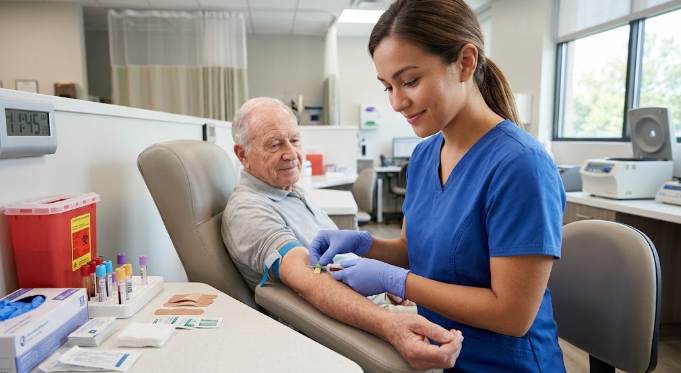
A phlebotomist is a healthcare professional who collects blood specimens for laboratory testing, transfusions, research, or donation. The role requires more than technical ability. It combines patient care, safety, accuracy, and careful specimen handling.
The job is not simply “drawing blood.” A successful phlebotomist has to identify the correct patient, select appropriate equipment, locate a suitable vein, collect the required specimen, label it correctly, dispose of equipment safely, document the collection, and maintain infection-control standards.
A mistake at any point can create a problem for the entire healthcare team. A mislabeled specimen, for example, is not a small error. Laboratory testing depends on knowing exactly whose specimen was collected and what it contains. That is why attention to detail is just as important as needle technique. For a closer look at the role and its day-to-day responsibilities, this guide on what a phlebotomist does provides another useful starting point.
Phlebotomist Salary: How Much Do Phlebotomists Make?
According to the latest BLS data, the national median phlebotomist salary was $45,230 per year, equivalent to $21.75 per hour, in May 2025. The lowest 10% earned less than $35,780, while the highest 10% earned more than $58,780.
| Salary Level | Annual Pay | Hourly Pay |
|---|---|---|
| Lowest 10% | Less than $35,780 | Less than $17.20 |
| Median | $45,230 | $21.75 |
| Highest 10% | More than $58,780 | More than $28.26 |
These numbers are useful, but students should not interpret the median as a guaranteed starting salary. Your actual income can change based on location, employer, experience, work setting, schedule, and qualifications.
For example,BLS data shows different median wages across common healthcare settings:
- Outpatient Care Centers: $48,030
- Medical and Diagnostic Laboratories: $46,670
- Physicians’ Offices: $44,500
- Hospitals: $44,220
- Other Ambulatory Healthcare Services: $39,930
So when comparing jobs, don’t look only at the number printed beside “phlebotomist.” Look at the complete position. The work environment matters, too. Hospitals may have different scheduling demands than physicians’ offices, while laboratories can bring a different patient flow. Donor centers may also involve repeated collections and additional donor-screening responsibilities.
Phlebotomist Salary in Georgia
For students planning to work in Georgia, the numbers are slightly different.
| Location | Median Annual Salary | Median Hourly Wage |
|---|---|---|
| United States | $45,230 | $21.75 |
| Georgia | $45,840 | $22.04 |
| Atlanta-Sandy Springs-Roswell | $49,370 | $23.73 |
National salary figures can tell you whether the career is worth investigating, but local wages help you understand what the opportunity may look like where you actually intend to work.
Phlebotomist Job Description: What Do Phlebotomists Actually Do?
The day-to-day work combines patient interaction, blood collection, specimen handling, documentation, and safety procedures.
Identifying and Preparing Patients
Before touching any equipment, you need to make sure you have the right patient and understand what collection is required. That means verifying patient information, explaining the procedure, answering basic questions, and preparing the patient appropriately. This becomes particularly important when patients are children, elderly, anxious, ill, or afraid of needles.
Performing Blood Collections
Venipuncture is one of the central skills of phlebotomy.
You need to understand how to:
- Select appropriate equipment
- Identify suitable veins
- Position the patient correctly
- Perform venipuncture safely
- Collect the appropriate amount of blood
- Use proper order-of-draw procedures
- Handle difficult or unsuccessful draws appropriately
- Perform capillary collections when required
This is where hands-on training becomes extremely important. Watching someone perform a blood draw is not the same as performing one yourself.
Labeling and Handling Specimens
Once the blood has been collected, the job is not finished. Specimens must be correctly labeled, documented, handled, and prepared for testing or transport. Depending on the workplace, phlebotomists may also collect urine or other specimens and enter collection information into databases.
Infection Control and Safety
This is one area students should never treat as a formality. Safe handling is essential for protecting both patients and healthcare workers.
Because phlebotomists routinely work with needles, sharps, blood, and biological specimens, following safety and infection-control procedures is essential. This makes proper safety practices particularly important. A good training program should therefore teach more than technique. It should teach why the safety procedure exists and what can happen when it is ignored.
Supporting Nervous or Faint Patients
Some patients look away when they see the needle. Others become dizzy. Some have had bad experiences with blood draws in the past. A good phlebotomist learns how to communicate calmly, position patients safely, recognize signs of a reaction, and respond appropriately. That patient interaction is a genuine clinical skill.
Where Can a Phlebotomist Work?
Phlebotomists work in several healthcare environments, including:
- Hospitals
- Medical and diagnostic laboratories
- Physicians’ offices
- Outpatient care centers
- Blood donation centers
- Other ambulatory healthcare settings
Hospitals and laboratories employ a particularly large share of phlebotomists. BLS reports that hospitals accounted for 36% of phlebotomist employment in 2025, while medical and diagnostic laboratories accounted for 33%.
The setting can significantly change your daily routine. A hospital may involve higher patient turnover and more varied situations. An outpatient laboratory may have a steady stream of scheduled patients. A physician’s office may provide a different pace and patient population. Do not choose a job solely because it offers the highest advertised phlebotomist salary. Consider the environment in which you can perform well and build experience.
For Georgia students comparing local options, understanding how phlebotomy programs near Canton can support a healthcare career can also help put different work settings into perspective.
How Long Does It Take to Become a Phlebotomist?
One of the biggest advantages of phlebotomy is the relatively short education pathway. BLS lists a postsecondary nondegree award as the typical entry-level education. Phlebotomy programs generally take less than one year and cover areas such as anatomy, physiology, medical terminology, laboratory work, and specimen handling.
That does not mean every short course is equally valuable. There is a major difference between completing an online lesson about phlebotomy and repeatedly practicing the skills required to perform blood collection safely.
What Should You Learn in Phlebotomy Classes?
When comparing phlebotomy classes, don’t start with tuition. Start with the curriculum. A serious program should give you a foundation in:
- Anatomy and physiology
- Medical terminology
- Infection control
- Blood collection procedures
- Venipuncture
- Capillary collection
- Specimen handling
- Patient identification
- Order of draw
- Safety procedures
- Equipment use
- Documentation
- Patient communication
- Managing difficult or anxious patients
Students interested in working in larger healthcare settings can also see how phlebotomy classes in Georgia prepare students for major hospitals, particularly when it comes to hands-on practice, safety, specimen handling, and certification preparation.
Choosing the Right Phlebotomy Training Program
This is where students often make their biggest mistake. They compare programs by price and duration, when they should be comparing them by training quality and career preparation. The right phlebotomist training program should give you enough repetition to build confidence and enough instructor feedback to correct mistakes before they become habits.
At 1st Treasure Chara Centers, the phlebotomy technician program is currently listed as 120 hours, with hands-on training focused on blood collection techniques, safety procedures, and patient care. The program emphasizes practical allied healthcare training, hands-on experience, and preparation for the realities of clinical work. That matters because the goal should not be to help you say, “I finished a phlebotomy course.” The goal should be to help you say, “I know what I’m doing when I walk into the workplace.”
Students comparing schools can also use this guide on how to find the best phlebotomy training specialists in Georgia to evaluate hands-on practice, instructors, clinical experience, certification preparation, and other factors before enrolling.
A Quick Checklist Before You Enroll
Before paying tuition, ask:
- Is the program hands-on?
- How many training hours are included?
- Who teaches the classes?
- Will an instructor evaluate my technique?
- Does the curriculum cover specimen handling and infection control?
- Does the program prepare students for relevant certification?
- What support is available after training?
- What equipment will I practice with?
- What additional costs should I expect?
A school that cannot clearly answer these questions deserves a second look.
Is Phlebotomy a Good Career Choice?
For the right person, phlebotomy can be a practical way to enter healthcare without committing to years of schooling. The training pathway is relatively short, the work plays a direct role in patient care and laboratory testing, and employment is projected to grow faster than average. The U.S. Bureau of Labor Statistics projects 7% employment growth from 2025 to 2035, compared with 3% for all occupations, with about 18,000 phlebotomist openings expected each year over the decade.
The career also comes with demands that should be considered before enrolling. Comfort around blood and needles is essential, but that is only part of the job. Phlebotomists must follow collection and safety procedures carefully, communicate with patients throughout the day, and stay focused even during busy shifts. Much of the work is performed on your feet, and some positions, particularly in hospitals and larger laboratories, may include nights, weekends, or holidays.
Career Advice: Phlebotomy can be a strong starting point for someone who wants hands-on healthcare experience, but it is worth considering the daily work environment before enrolling in a training program.
Can Phlebotomy Lead to Other Healthcare Careers?
It can also serve as an entry point for people who eventually want to explore other healthcare roles. Working directly with patients can help you discover whether you enjoy clinical environments before committing to a longer educational pathway.
Some students may eventually pursue nursing, laboratory careers, or other allied healthcare professions. That does not mean phlebotomy should be treated as merely a stepping stone. It is a real profession with its own responsibilities and standards. Think of it as one door into healthcare, not a waiting room for another career.
Ready to Take the Next Step
A phlebotomy career should not begin with a search for the cheapest certificate. It should begin with a clear understanding of the work. Know the phlebotomist salary; understand the responsibilities. Research the employers in your area. Learn what training they expect. Then choose a program that gives you the practical skills to meet those expectations.
For students in Georgia looking for a hands-on path into allied healthcare, 1st Treasure Chara Centers offers a phlebotomy technician program designed around blood collection, safety, patient care, and practical preparation.
The right training does more than put a certificate in your folder. It gives you the confidence to pick up the equipment, meet the patient, perform the procedure correctly, and know why every step matters. That is the difference between completing phlebotomy classes and actually preparing for a phlebotomy career.
Frequently Asked Questions About Phlebotomy
How much does a phlebotomist make?
The national median phlebotomist salary was $45,230 per year or $21.75 per hour in May 2025. Actual pay varies by location, employer, experience, and work setting.
How long are phlebotomy classes?
BLS reports that postsecondary phlebotomy programs generally take less than one year, although individual programs can have different schedules and hour requirements.
Are online phlebotomy classes enough?
Students should be cautious about programs that provide little or no hands-on practice. Blood collection is a physical clinical skill, so practical training is an important part of becoming workplace-ready. For students budgeting for training and certification, this breakdown of phlebotomy certification costs in 2026 can help you understand the expenses to consider before enrolling.
Do you need a degree to become a phlebotomist?
A four-year college degree is generally not the standard entry-level requirement. BLS lists a postsecondary nondegree award as the typical education level, although requirements vary by employer and state.
Is certification required?
Requirements vary by state and employer. BLS notes that some employers prefer professional certification and that some states have additional requirements. Always verify the requirements applicable to the location where you plan to work.
Is phlebotomy difficult to learn?
The theory can be learned relatively quickly, but becoming comfortable with blood collection requires practice. The challenging part is learning to combine technical precision, patient communication, safety, and specimen handling consistently.
Latest Posts
August 13, 2024
Is the Role of a CNA the Same as That of a Nurse?
August 13, 2024
Phlebotomists: Vital Contributors to the Healthcare System

August 13, 2024