

Certified Phlebotomy Technician: Pay, Training & Careers
September 23, 2026
Phlebotomy can be a good way to start a healthcare career. The training can take less time than many other healthcare programs. Also, it gives students hands-on patient experience. A Certified Phlebotomy Technician does more than draw blood. In fact, the job also involves patient care, safety, and careful sample handling.
A phlebotomy technician must identify each patient. Next, they must prepare the right tools. They must collect the sample and label it correctly. They also need to keep patients calm during the process.
Many students have the same questions before they enroll. How much does a phlebotomist make? How long is phlebotomy school? Are four-week classes enough? What should you look for in phlebotomy schools in GA? This guide answers those questions and more.
How Much Does a Certified Phlebotomy Technician Make?
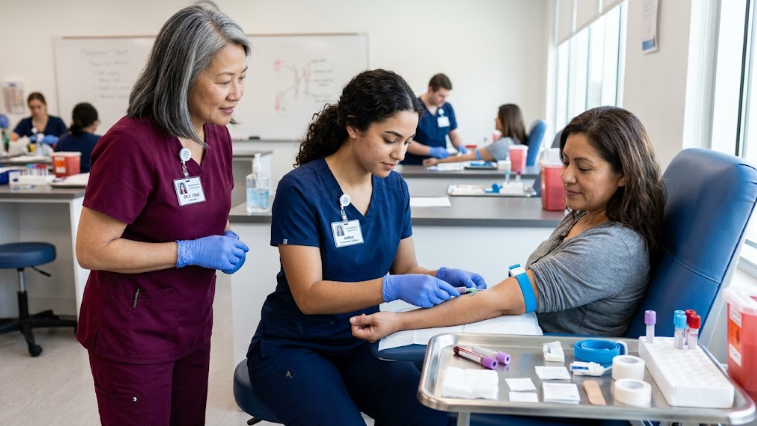
Phlebotomy pay can vary by location and employer. In addition, work setting and experience can also affect pay. The U.S. Bureau of Labor Statistics reports a median wage of $45,230 per year for phlebotomists. This figure is from May 2025. That equals about $21.75 per hour. Georgia has a slightly higher median wage.
The Atlanta-Sandy Springs-Roswell area has a higher median wage of $49,370 per year.
| Location | Median Annual Wage |
|---|---|
| United States | $45,230 |
| Georgia | $45,840 |
| Atlanta-Sandy Springs-Roswell | $49,370 |
Pay can also change based on the work setting. In May 2025, BLS reported median wages of about $48,030 in outpatient care centers. Meanwhile, medical and diagnostic labs had a median wage of about $46,670. Hospitals had a median wage of about $44,220. These numbers are useful for comparison. However, they are not guaranteed starting salaries. New graduates may earn less at first. On the other hand, experienced workers may earn more.
How Long Does Phlebotomy School Take?
There is no set length for phlebotomy school. Some programs are short. Others take longer. In general, the total time depends on the school and its course plan. Some programs focus on fast training. Others allow more time for lab work and clinical practice.
So, do not look only at the number of weeks. A four-week course may sound great. You can finish it fast. However, what will you learn during those four weeks? Before you enroll, check the total training hours. Also, check how much time you will spend in the lab.
A good program should teach skills such as:
- Venipuncture
- Capillary puncture
- Patient identification
- Blood sample collection
- Tube selection
- Sample labeling
- Infection control
- Equipment use
- Patient care
- Safety
Most importantly, hands-on work is also important. Watching a blood draw is not the same as doing one. Students need time to practice. They also need feedback from an instructor.
For more detail, read how many clinical hours a phlebotomy training program should include.
What Do Phlebotomy Classes in GA Teach?
Blood collection may look easy when an expert does it. Still, it takes more skill when you do it yourself. Students must learn each step. They also need to work with different patients. Some patients may fear needles. Others may have hard-to-find veins. For this reason, a good course should help students handle these situations. Most phlebotomy classes in GA cover blood collection and patient care.
Training may include:
- Preparing patients
- Choosing the right equipment
- Performing venipuncture
- Performing capillary puncture
- Handling blood tubes
- Labeling samples
- Transporting samples
- Following infection-control rules
- Keeping the work area clean
- Helping patients who feel unwell
Classroom lessons teach the basic knowledge. Then, lab practice lets students use that knowledge. Clinical practice can also help them work with real patients. Together, this mix can help students feel more ready for the workplace.
You can learn more about what a phlebotomist does.
Where Can Phlebotomists Work?
Phlebotomists can work in many healthcare settings.
Common workplaces include:
- Hospitals
- Medical labs
- Diagnostic labs
- Doctors’ offices
- Outpatient care centers
- Blood donation centers
- Other healthcare settings
However, the daily routine can change from one workplace to another. A hospital may have a fast pace. You may see many patients in one shift. By comparison, a doctor’s office may have a steadier routine. A lab may focus more on sample collection and handling.
There is also steady demand for phlebotomists. BLS projects 7% job growth from 2025 to 2035. The agency also projects about 18,000 openings each year. These openings include new jobs and replacement needs.
For more information, read how a phlebotomy training program prepares you for high-demand phlebotomy jobs.
Can Phlebotomy Lead to a Long-Term Healthcare Career?

Yes, it can. Some people work as phlebotomists for many years. Others, however, use phlebotomy as their first step into healthcare. The job can also help you learn what type of work you enjoy. You may like working with patients. You may prefer lab work. You may also decide to train for another healthcare role.
Most importantly, you do not need to plan your whole career before starting. Start with a program that teaches useful skills. Look for hands-on practice. Also, make sure you understand what the job involves. That can help you make a better career choice later.
What Are the Certification Requirements?
Training and certification are not the same. Training teaches you how to perform phlebotomy tasks. In contrast, certification shows that you have met the rules of a certifying body. The rules can vary. Some employers prefer certification. Others may require it. Therefore, the best approach is to check the job requirements in your area.
Before you enroll, ask the school:
- Which certification exam does the program prepare you for?
- Is the exam fee part of the tuition?
- Does the program include clinical or practical training?
- What are the eligibility rules?
- Does the course meet the certification body’s requirements?
These questions can help you avoid problems later. You can also read how to compare phlebotomy certification programs in Georgia before you enroll.
How Do You Choose Between Phlebotomy Schools in GA?
Choosing between phlebotomy schools in GA can feel confusing. Two schools may offer similar courses. Yet, the training can be very different. To start, check these key points.
Check the Total Training Hours
Do not look only at the number of weeks. Check the total number of training hours. Then, see how those hours are split. How much time is spent in class? How much time is spent in the lab? Does the program include clinical practice? These details can help you compare programs.
Look at the Hands-On Training
Phlebotomy is a hands-on skill. You need more than lectures. Ask how often students practice blood draws. Ask if an instructor watches the practice. Also, ask what tools students use. More practice can help students build skill and confidence.
Review the Curriculum
Check what the course covers. A good course should teach more than blood draws.
Look for topics such as:
- Patient identification
- Blood collection
- Sample handling
- Infection control
- Safety
- Patient care
- Documentation
Ask About Instructors
Find out who teaches the course. Ask about their work experience. You can also ask about their clinical background. An experienced instructor can explain each step. They can also show students how to deal with common problems.
Check the Certification Path
Ask what happens after you finish the course. Does the school prepare you for a certification exam? Also, are there extra requirements? Get clear answers before you pay your tuition.
Calculate the Full Cost
Tuition is not always the full cost. You may also need to pay for books, uniforms, supplies, or exam fees. For this reason, ask the school for a list of all costs.
For more help, read how to find the best phlebotomy training specialists in Georgia.
How Much Does Phlebotomy Training Cost?
Phlebotomy training costs vary by school. The price can depend on the program length and what the school includes. One school may have lower tuition. However, it may charge extra for supplies. Another school may cost more at first. Yet, more items may be included. So, compare the full cost.
Check these fees before you enroll:
- Tuition
- Registration
- Textbooks
- Workbooks
- Lab supplies
- Uniforms
- Lab kits
- Exam fees
- Other required equipment
This gives you a clearer idea of what you will spend. You can also read about ways to reduce phlebotomy training costs without sacrificing quality and phlebotomy certification costs in 2026.
Where Can You Find Phlebotomy Schools in Georgia?
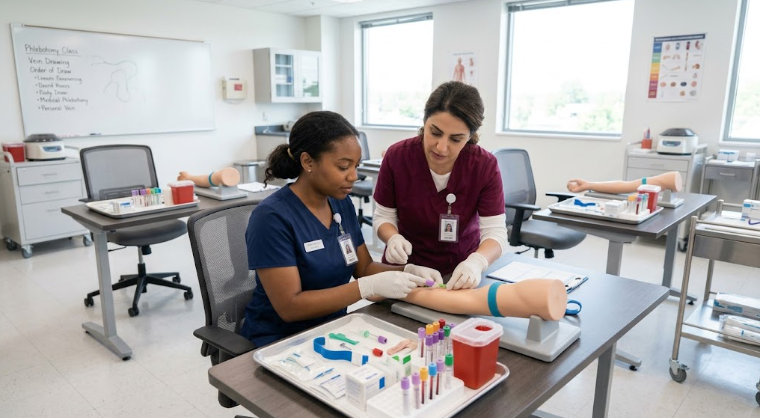
Location is another key factor. A school may have a good course. But a long commute can become hard to manage. This is even more important if you work or have family duties. Check the class schedule before you enroll. Also, check where lab and clinical sessions take place. Students in North Metro Atlanta can look at areas such as Canton, Holly Springs, and Woodstock. For example, if you are looking around Canton, read how to build a healthcare career with phlebotomy programs near Canton.
1st Treasure Chara Centers offers a Certified Phlebotomy Technician program in Holly Springs, Georgia. The program has 120 total hours.
It includes:
- 80 theory hours
- 40 lab hours
- In-person training
- Clinical practice
Students learn skills such as:
- Venipuncture
- Capillary puncture
- Sample collection
- Sample labeling
- Sample transport
- Infection control
The listed tuition is $1,350. There are also other costs. These include a $125 registration fee, lab supplies, a textbook, a workbook, a uniform, and a lab kit. The program is open to students aged 17 and older who meet the listed education and document requirements.
Is Becoming a Certified Phlebotomy Technician Worth It?
For many students, it can be a good way to enter healthcare. Training can take less time than many other healthcare programs. In addition, the job gives you direct patient experience. Phlebotomists can work in hospitals, labs, doctors’ offices, outpatient centers, and blood donation centers.
Pay is another factor. The national median wage was $45,230 in May 2025. Georgia’s median was $45,840. Still, money is not the only thing to consider. Phlebotomy involves blood and needles. You may also spend much of the day standing. You must also follow safety rules and pay close attention to detail.
Patient contact is also a big part of the job. So, if you are comfortable with these responsibilities, phlebotomy is worth exploring. Before you enroll, visit a school if possible. Talk to an instructor. Also, learn what a normal workday looks like. This can help you decide if the career fits you.
Final Thoughts
A Certified Phlebotomy Technician can enter healthcare through a short training path. The national median wage is above $45,000. Georgia’s median is a little higher. Job growth is also expected through 2035. However, the fastest program isn’t always the best.
Look at the total training hours. Check the lab work. Ask about clinical practice. Also, learn about certification. Compare the full cost. At the same time, check the schedule and location. Most of all, choose a program that gives you real practice. Good training should help you understand the job. It should also help you feel ready to work with patients.
FAQs about Certified Phlebotomy Technician
How much does a Certified Phlebotomy Technician make?
The national median wage is $45,230. Georgia’s median is $45,840. However, pay can vary by employer, location, experience, and work setting.
How long is phlebotomy school?
It depends on the school. Before enrolling, check the total training hours, lab work, and clinical practice.
Can I take 4-week phlebotomy classes in GA?
Yes, some schools, including 1st Treasure Chara Centers, offer 4-week phlebotomy classes in GA. However, check the total hours, lab work, clinical practice, and certification path before enrolling.
What do phlebotomy classes in GA include?
They may include venipuncture, capillary puncture, patient care, sample handling, infection control, and safety.
Do I need certification to work as a phlebotomist?
It depends on the employer. Some employers prefer certification, while others may require it.
How do I choose between phlebotomy schools in GA?
Compare training hours, lab work, clinical practice, instructors, course content, certification, schedule, location, and full cost.
Is phlebotomy a good career for beginners?
It can be a good starting point. However, you should be comfortable with blood, needles, and patient care.
Latest Posts
August 13, 2024
Is the Role of a CNA the Same as That of a Nurse?
August 13, 2024
Phlebotomists: Vital Contributors to the Healthcare System

August 13, 2024