
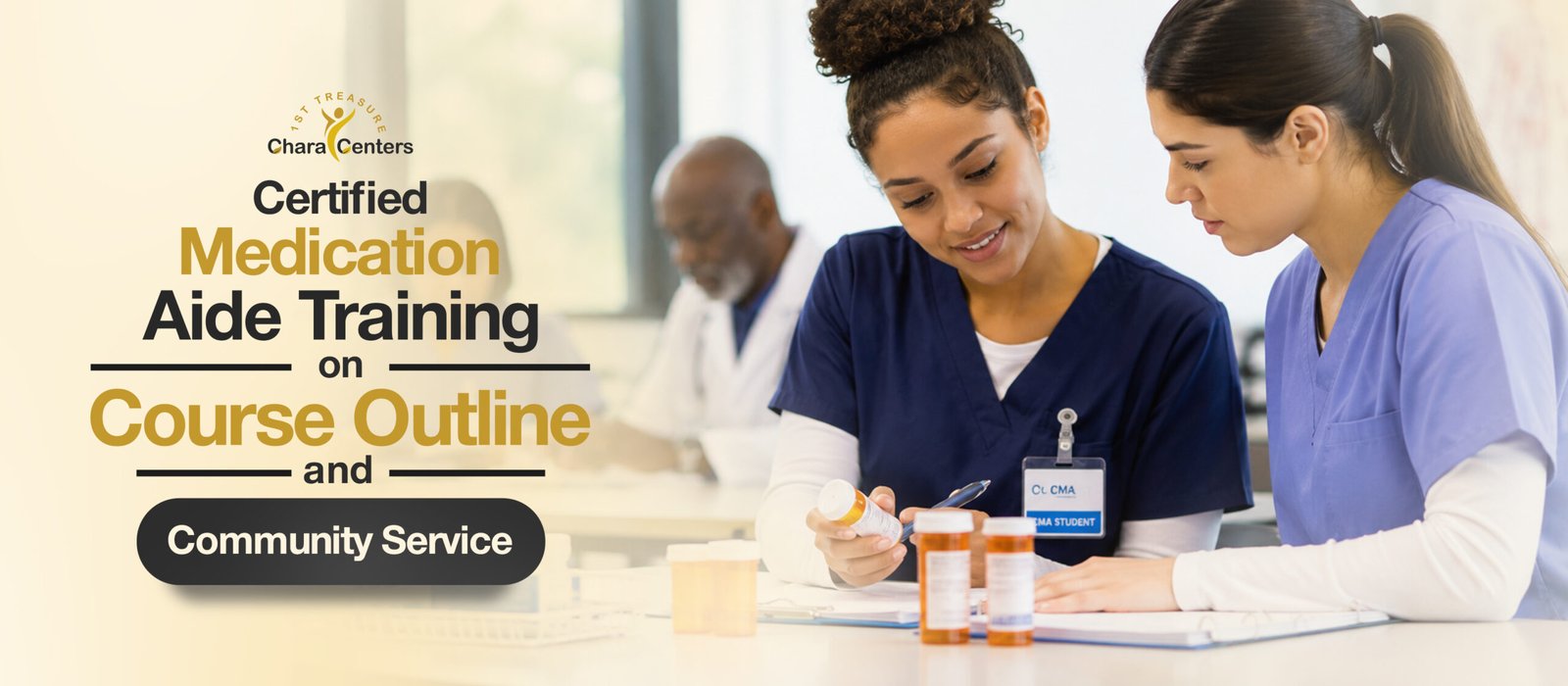
Certified Medication Aide Training: Course Outline & Community Service
July 15, 2026
If you’re thinking about becoming a Certified Medication Aide (CMA), you already know the end goal. But while every training program promises to prepare you for the job, dry course catalogs rarely explain what actually happens once class starts.
Before you enroll, it’s normal to have a few lingering questions: What exactly will I study in Certified Medication Aide training? How much hands-on practice will I get? Will this training actually make me feel ready for day one in a nursing home or assisted living facility?
This guide is here to pull back the curtain. We’ll break down what you’ll learn in the classroom, how clinical practice builds your confidence, and how to choose the right CMA program for your career.
Certified Medication Aide Training Course Outline: What to Expect
Certified Medication Aide training is intense but highly focused. Because you must already be a Certified Nursing Assistant (CNA) in most states to take this course, you won’t spend time relearning basic patient care like bathing or transferring. Instead, 100% of your energy goes toward pharmacology and safety.
Pharmacology Basics and Medication Knowledge

Most students expect the first lesson to be about giving medication. It usually isn’t.
Before you can safely give medicine, you need to know what that medicine does. During this part of the course, you’ll learn about common types of medications, why healthcare providers prescribe them, how they work in the body, and which side effects need attention. These lessons give you the knowledge you’ll use throughout your CMA training.
Relevant Guide: Common Medication Errors & How to Avoid Them
Patients and Recognize Medication Reactions
Giving medication is only one part of the job. What happens afterward matters just as much.
You’ll learn how to check vital signs, notice changes in a resident’s condition, and recognize when something doesn’t seem right. Some reactions are minor. Others need immediate attention. Knowing when to tell a supervising nurse is a skill every Medication Aide develops through training and practice.
Legal, Ethical, and Patient Safety Standards
Every Medication Aide has responsibilities beyond patient care. You’ll also learn the rules that help keep residents safe.
The course covers HIPAA, resident rights, proper documentation, and the legal responsibilities that come with administering medication. These topics may not seem exciting at first, but they’re a big part of daily work and often appear on certification exams.
Strong Healthcare Communication Skills
Good communication can make a busy shift much easier.
You’ll talk with residents who have questions, families who want updates, and nurses who rely on accurate information. Learning how to listen, explain things clearly, and report changes helps the whole care team work together. These skills become just as valuable as learning how to give medication safely.
Hands-On Clinical Experience
Reading about medication is helpful. Practicing what you’ve learned is what builds confidence.
At 1st Treasure Chara Centers, our students complete 12 hours of supervised clinical training. During this time, you’ll work with residents, practice medication administration under instructor guidance, and receive feedback that helps you improve before entering the workforce. Many of our CMA graduates say these clinical hours are the part of training that prepares them the most for their first job.
Certified Medication Aide Course Components Overview
Here’s a simple table of what the CMA course covers, and exactly why it matters for your future career.
| Course Component | Approximate Focus | Why It Matters in the Workplace |
|---|---|---|
| Theory Classes | Medication safety, regulations, documentation, and patient rights | Builds the foundation students need before entering clinical practice |
| Clinical Training | Supervised medication administration practice and resident interaction | Helps students develop confidence in real healthcare settings |
| Communication Training | Reporting changes, documenting observations, and working with nurses | Improves teamwork and supports safer patient care |
Certified Medication Aide Training in Georgia: Requirements & Choosing the Right Program
If you plan to work in Georgia, choosing the right CMA training program is an important first step.
Start by checking that the program is state-approved. Employers look for recognized certification, and training requirements can vary from one state to another.
You can review the official state guidelines on the Georgia Department of Community Health website to see exactly how these rules protect resident safety. It’s also worth comparing how much clinical experience each program offers. The more time you spend practicing under supervision, the more prepared you’ll feel for your first job.
Healthcare employers across Georgia continue to hire Medication Aides for long-term care and assisted living communities, making it a career with steady opportunities for trained professionals. This is exactly the gap 1st Treasure Chara Centers was built to fill: a Georgia-based, state-approved program that combines theory instruction with genuine clinical experience, so graduates leave ready for the job market.
What Our CMA Training Program Looks Like:

Here’s exactly what our CMA training program offers, so you know what you’re signing up for before you enroll.
- A Complete Learning Experience: Our state-approved program is led by instructors who have spent years in actual clinical settings. Your training includes 8 hours of focused theory and 12 hours of supervised clinical practice. You won’t just hear about care; you will perform it.
- Community-Focused Education: We don’t view community service as an optional extra; it is built into our identity. Our 12 hours of required clinical practice are completed directly through our community service partnerships with local care facilities, meaning you get to serve real people while fulfilling your state requirements. By connecting classroom learning with real-world service, our graduates enter the workforce as confident, grounded professionals.
- Everything You Need to Succeed: We keep our class sizes small, so you get actual individual attention. Your tuition covers your textbook, uniform, and complete certification exam prep. We also provide career guidance to help you transition smoothly from student to employee.
Before you enroll, make sure your paperwork is ready. Review our checklist on Medication Aide Certification in Georgia: Requirements Before You Enroll.
Career Outlook: Where Can a CMA License Take You?
An official Certified Medication Aide credential does more than just add a title to your resume. It shifts your day-to-day work from basic physical labor to clinical healthcare support.
Because CMAs are qualified to handle high-stakes medication distribution, they are highly sought after by facilities looking to optimize their nursing staff. Once certified, you will typically find opportunities in:
- Assisted Living Communities: Helping semi-independent seniors manage daily, ongoing prescriptions.
- Skilled Nursing Facilities & Nursing Homes: Delivering critical, scheduled medications to residents requiring long-term care.
- Memory Care Units: Providing highly structured, consistent medication routines for residents with dementia or Alzheimer’s.
- Rehabilitation Centers: Supporting short-term patients recovering from surgeries or major medical events.
Salary & Job Market Expectations
The demand for CMAs is growing rapidly, driven by an aging baby-boomer population requiring more complex daily medication management. Here is what the compensation looks like across the United States:
| Pay Rate | Annual Salary | Hourly Average |
|---|---|---|
| Starting / Entry-Level | ~$32,000 to $34,000 | ~$15.50 to $16.50/hr |
| National Median | ~$38,100 | ~$18.00 to $19.00/hr |
| Top 10% (Specialized/Urban) | ~$47,000+ | ~$23.00+/hr |
Income & Advancement At a Glance
| Role | Average Annual Salary | Entry Speed & Requirements |
|---|---|---|
| Certified Medication Aide (CMA) | $38,100 | A quick certificate program (usually just a few weeks to months) |
| Licensed Practical Nurse (LPN) | $64,150 | A 12 to 18-month practical nursing program + passing the NCLEX-PN |
| Registered Nurse (RN) | $93,600 | A 2 to 4-year college degree (ADN or BSN) + passing the NCLEX-RN |
For many graduates, this role becomes so much more than just a regular clock-in, clock-out job; it becomes the perfect stepping stone. A large number of CMAs choose to pursue LPN or RN programs down the road, using the real-world clinical experience and confidence they built on the floor to propel themselves even further in their healthcare careers.
Curious about what your day-to-day would actually look like on the job? Our guide on What Do Certified Medication Aides Do: Daily Work & Skills breaks it all down for you.
Conclusion: Take Your Next Step in Caregiving
If you’ve made it this far, you’re clearly serious about this next step, and that matters more than you might think in this field. Whether you’re searching for Certified Medication Aide training near me or already comparing programs by their clinical hours and outcomes, we’d love to walk you through what enrollment at 1st Treasure Chara Centers looks like.
Take the Next Step Toward a Meaningful Healthcare Career
Learn more about our Certified Medication Aide (CMA) program and take the next step toward a role where your work genuinely matters. Gain the knowledge, practical skills, and confidence to begin a rewarding career helping patients every day.
Frequently Asked Questions
How long does it take to become a Certified Medication Aide?
Most programs, including ours, run around 20 total hours, typically split between theory and supervised clinical practice, completed over roughly one to two weeks depending on the schedule.
How do you get a Certified Medication Aide certificate?
To earn a Certified Medication Aide certificate, you must complete an approved training program, meet eligibility requirements, complete clinical hours, and pass the required certification process.
Is a Medication Aide higher than a CNA?
A Medication Aide is not higher than a CNA. It is an additional certification that builds on CNA skills by providing specialized training in safe medication administration and patient care support.
Latest Posts
August 13, 2024
Is the Role of a CNA the Same as That of a Nurse?
August 13, 2024
Phlebotomists: Vital Contributors to the Healthcare System

August 13, 2024