

Medication Aide Certification in Georgia: Requirements Before You Enroll
June 23, 2026
Most people spend hours comparing school websites, tuition prices, and class schedules before they ever stop to ask whether they actually qualify to enroll. Then they find out mid-application that they are missing a document, or that the program they chose has a prerequisite they did not expect. And just like that, weeks of planning go sideways.
People who are genuinely motivated, genuinely ready to do the work, but nobody walked them through the front door properly. This guide is meant to fix that. We are going to cover what medication aide certification in Georgia actually involves, who it is designed for, what you need before you even think about enrolling, and how to set yourself up so nothing catches you off guard.
By the time you finish reading, you will know exactly where you stand and what your next step should be.
What Is a Medication Aide and What Do They Actually Do?
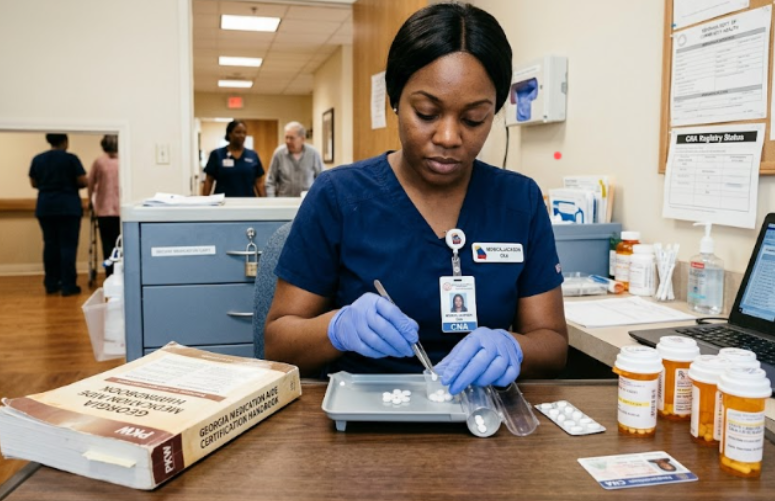
A medication aide is a trained healthcare professional who helps with administering medications to patients, working under the supervision of a licensed nurse or physician. This is not a role where you are making clinical decisions or diagnosing conditions. It is a support role, but an important one, because medication administration is one of the most safety-critical tasks in any care environment.
You will find medication aides working in places like:
- Long-term care and skilled nursing facilities
- Assisted living communities
- Rehabilitation center
- Residential care programs
- Memory care units
Day to day, the responsibilities of Certified Medication Aide usually include things like:
- Administering medications on schedule
- Recording every dose in patient documentation
- Following protocols for different medication types
- Watching for and reporting any unusual reactions
- Supporting overall patient safety routines
This is not the same as being a nurse. A medication aide does not prescribe, diagnose, or work independently. What they do is make sure medications get to patients accurately, safely, and on time. That distinction matters because the certification requirements are built around exactly that kind of responsibility.
Medication Aide Certification in Georgia: Basic Requirements Before Enrollment
This is the part most people skip over, and it is the part that causes the most headaches later.
Requirements are not identical across every program in Georgia. Individual providers may have their own additional criteria. But several core expectations show up almost universally, and understanding them now saves you from finding out the hard way.
1. Age Requirement
You need to meet a minimum age threshold before enrolling in a certified medication aide training. Medication administration involves legal and professional accountability, and programs need to know that the people they are training are eligible to hold that responsibility.
If you are planning while still in high school, the smartest move is to contact programs directly and ask about their specific age policies before you apply. Do not assume.
2. Educational Background
Most programs expect applicants to have completed at least a high school education or the equivalent.
You will typically need one of the following:
- High school diploma
- GED or state-recognized equivalency certificate
- Other documentation confirming academic completion
The reason for this is practical, not gatekeeping. Training involves reading medication instructions accurately, filling out documentation correctly, understanding safety procedures, and communicating with supervisors. These are things that require solid reading comprehension and attention to detail. Programs want to know you have that foundation before day one.
3. CNA or Healthcare Experience Requirements
This is where things get genuinely confusing for a lot of applicants, so let’s take a little extra time here.
Some medication aide training pathways in Georgia do expect prior nursing assistant experience or at least some exposure to patient care before enrollment. The reasoning behind this is straightforward. Students who have already worked as CNAs come in understanding infection control, patient communication, basic care routines, and documentation. They do not have to learn the fundamentals of healthcare while simultaneously learning medication administration.
But not every program requires this. It depends on the program structure and, often, the employment context. If you are enrolling through an employer or a facility that already knows your background, the expectation may look different than if you are enrolling independently.
Expert Insight: Leading institutions, such as 1st Treasure Chara Centers, allow enrollment if you are an active CNA in good standing or a recent graduate from their own approved CNA program. However, be aware that some employers or specific long-term care facilities may separately look for a minimum of 6 months of clinical work experience before onboarding you into a CMA role.
Cost of Medication Aide Certification in Georgia
Cost planning should account for more than just tuition. Here is a realistic breakdown of what you might need to budget for:
| Expense Category | What It May Include |
|---|---|
| Program tuition | Enrollment fee for training |
| Study materials | Textbooks, printed resources, online tools |
| Background screening | Required documentation costs |
| Health requirements | TB test, immunization records |
| Certification exam fees | Assessment and testing costs |
| Miscellaneous | Uniforms, transportation, supplies |
Pro Tip: Look for premier CMA training programs that maximize the value of your dollar. For example, comprehensive educational providers pack their tuition fees into an all-inclusive structure that covers your textbook, uniform scrubs, program resource kit, and even your state certification examination fee upfront.
Additionally, if you are currently working as a CNA in a long-term care facility, ask your employer about tuition support or sponsorship. Under federal and state guidelines managed by the Georgia Department of Community Health, certain Medicare or Medicaid-certified long-term care facilities are required to reimburse training costs if they employ you within a specific window of completing your competency evaluation.
How Long Does Medication Aide Certification Take in Georgia?
Program length varies depending on the provider, the format, and how you structure your schedule.
Full-time programs may complete classroom and clinical components more quickly. Programs designed for working adults with flexible schedules may spread the same material over a longer period. Clinical components add time beyond classroom instruction.
A few things that affect completion timelines:
- Whether you are enrolled full-time or part-time
- How the program structures classroom versus hands-on training
- Any prerequisites you need to meet before starting
- How quickly background checks and health documentation are processed
One thing worth saying directly: choosing the fastest program is not always the smartest move. A program that gives you strong preparation for the certification exam and real clinical confidence tends to produce better outcomes than one that just gets you through the doors quickly.
How to Choose the Right Medication Aide Program in Georgia
When evaluating CMA training programs, look at:
- Whether the program is recognized by the Georgia state requirements
- Whether the curriculum aligns perfectly with the Alliant Health Solutions state competency exam blueprint.
- The quality and experience of the instructors
- What clinical learning opportunities are included
- How the program prepares students for the certification exam
- Schedule flexibility and support for working students
A slightly longer or more structured program with strong instructor support often leads to better exam outcomes and a smoother transition into employment. That is worth more than saving a couple of weeks.
Career Opportunities After Medication Aide Certification
Once you have your certification, the most immediate opportunities are in facilities that rely heavily on consistent, daily medication support.
| Work Setting | Potential Role |
|---|---|
| Assisted living facility | Medication aide providing daily administration |
| Long-term care or skilled nursing | Certified medication aide on the care team |
| Rehabilitation center | Medication support during patient recovery |
| Memory care unit | Specialized medication aide role |
| Residential care home | Aide supporting small residential populations |
Beyond the immediate placement, a medication aide experience is a legitimate stepping stone. Many people use it as a foundation before pursuing LPN or RN licensure. The clinical habits, documentation skills, and patient interaction experience you build in this role do not disappear when you advance.
If you already hold an active Georgia CNA license and are ready to take on more clinical responsibility, we can help. Contact our admissions team today to check your eligibility!
Final Thoughts
Medication aide certification in Georgia is a real pathway into healthcare. Not a shortcut, not a workaround, but a legitimate credential that opens doors in environments that genuinely need skilled, reliable people supporting patient care. Know whether you meet the age and education criteria. Understand where you stand on the CNA experience question for the specific programs you are considering. Get your documentation together early. And choose a program based on preparation quality.
Frequently Asked Questions
How often does certification need to be renewed?
Renewal requirements depend on the specific certification and any applicable state or employer standards. Ask your program provider about continuing education expectations and renewal timelines when you enroll.
Is medication aide training worth it?
For people who want hands-on clinical responsibility without a multi-year degree program, yes. It offers a genuine credential, real patient interaction, and a foundation for further advancement. It is worth it if you go in prepared and choose the right program.
Can you become a medication aide without any healthcare experience in Georgia?
No. In Georgia, you must first complete a nursing assistant program, pass the state competency exam, and register as a CNA. You cannot skip this step to jump straight into medication administration.
Latest Posts
August 13, 2024
Is the Role of a CNA the Same as That of a Nurse?
August 13, 2024
Phlebotomists: Vital Contributors to the Healthcare System

August 13, 2024