

Free Medication Aide Practice Test: CMA Exam Questions & Answers for Georgia
August 28, 2026
A medication pass can seem routine until something does not look right. The label shows one dose, but the MAR shows another. A resident refuses medication. A tablet looks different from what you expected. In each situation, a medication aide must know what to do next.
That same judgment matters on the Georgia CMA exam. You need to know medication safety and administration, but you also need to recognize when something is wrong and know the appropriate next step.
If you are searching for a Georgia medication aide practice test, this guide gives you a focused way to prepare. You will find Georgia-specific exam information, 50 original practice questions, an answer key, and practical study advice to help you find your weak areas before test day.
What You Need to Know About the Georgia CMA Exam
Before you start the questions, understand the basic Georgia CMA pathway. Candidates must meet the applicable CNA eligibility requirements, complete an approved medication aide training program, demonstrate the required clinical skills, pass the standardized written competency examination, and meet Georgia registry requirements.
Here are the key points to remember:
- Training: Complete an approved Georgia medication aide training program.
- Skills: Complete the required medication aide skills competency checklist.
- Passing score: You need at least 80% on the written competency exam.
- Attempts: You have up to three attempts within 90 days.
- If you do not pass: After three unsuccessful attempts, you must repeat the medication aide training before continuing.
- Certification: Passing the written exam is only one part of the Georgia CMA certification process. You must also complete the required training and skills requirements.
As you study, focus on the areas you are most likely to see on the exam and use on the job. Pay close attention to medication safety, MARs, medication orders, routes and abbreviations, documentation, infection control, medication errors, adverse reactions, and resident safety.
On this 50-question practice test, 40 correct answers equals 80%, which matches Georgia’s minimum passing score. Use your result as a starting point, then review every question you missed so you know exactly what to work on before test day.
What Topics Does the Medication Aide Test Cover?
A medication aide test can cover several areas related to safe medication administration and resident care. Before starting, make sure you’re familiar with these core topics:
- Medication safety
- Medication administration
- Rights of medication administration
- Medication routes
- Dosage and measurement
- Documentation
- Infection control
- Medication errors
- Side effects and adverse reactions
- Resident safety
Now let’s see how well you know them.
Georgia CMA Practice Test: 50 Challenging Medication Aide Questions
Instructions: Choose the best answer for each question. Write down your answers before checking the answer key.
Question 1
A resident is scheduled to receive medication at 8:00 a.m. Before administering it, the CMA notices the resident’s name on the medication package does not match the MAR. What should the CMA do?
A. Administer the medication because the room number matches
B. Ask another resident whether the medication belongs to the resident
C. Stop and resolve the discrepancy before administering the medication
D. Administer it and document the discrepancy afterward
Question 2
A medication order states, “Give 1 tablet PO daily.” Which route does PO indicate?
A. Sublingual
B. Oral
C. Topical
D. Rectal
Question 3
A resident refuses a prescribed medication. What is the most appropriate action?
A. Force the resident to take it
B. Hide the medication in food without authorization
C. Document the refusal and follow facility procedures for notification
D. Mark the medication as administered because it was offered
Question 4
Before administering a medication, which source should the CMA use to verify the medication order?
A. Another resident’s MAR
B. The resident’s current medication record and authorized order
C. Memory from the previous medication pass
D. The medication package alone
Question 5
A resident develops difficulty breathing shortly after receiving medication. What should the CMA do first?
A. Wait 30 minutes to see whether symptoms improve
B. Recognize the situation as potentially urgent and follow emergency and reporting procedures
C. Document the reaction at the end of the shift
D. Give the resident another medication without an order
Question 6
Which situation is most likely to require the CMA to stop before administering a medication?
A. Medication is in a unit-dose package
B. The resident’s name and medication information are correct
C. The label and medication order contain conflicting information
D. Medication is scheduled during the normal medication pass
Question 7
A prescription label states “qhs.” What does this abbreviation mean?
A. Every morning
B. At bedtime
C. Every four hours
D. Before meals
Question 8
A Georgia Certified Medication Aide is preparing to administer medication in an assisted living community. Which type of packaging is permitted for medications administered by a CMA?
A. Loose tablets kept in a personal container
B. Unit-dose or multidose packaging
C. Any container chosen by the CMA
D. Unlabeled containers prepared by the resident
Question 9
A CMA realizes that the wrong medication was administered. What is the best response?
A. Hide the error if the resident has no immediate symptoms
B. Alter the MAR to make the administration appear correct
C. Immediately follow facility procedures for reporting and resident assessment
D. Wait until the next medication pass to report it
Question 10
Which abbreviation means “as needed”?
A. PRN
B. STAT
C. BID
D. QHS
Question 11
A medication is ordered “SL.” Where should the medication be administered?
A. Into the ear
B. Under the tongue
C. Into the rectum
D. Onto the skin
Question 12
Which statement best describes a Georgia CMA’s authority regarding medication orders?
A. A CMA may change a medication order when a resident reports side effects
B. A CMA may increase or decrease a dose based on the resident’s symptoms
C. The CMA must follow authorized medication orders and cannot independently change them
D. A CMA may discontinue a medication when the resident refuses it
Question 13
Which information is most important when documenting medication administration?
A. The CMA’s personal opinion of the medication
B. Required administration information according to the MAR and facility procedure
C. The resident’s favorite food
D. The resident’s family history
Question 14
A resident’s medication is ordered to be given with food. What should the CMA do?
A. Administer it whenever convenient
B. Follow the medication order and facility procedure regarding timing with food
C. Give it on an empty stomach instead
D. Skip the medication if the resident is not hungry
Question 15
Which action represents appropriate infection-control practice during medication administration?
A. Reusing equipment between residents without cleaning
B. Performing appropriate hand hygiene and maintaining clean technique
C. Touching medication directly with bare fingers
D. Carrying loose medications in a pocket
Question 16
Before a Georgia CMA can administer medications independently, which requirement is important?
A. The CMA only needs to complete a CPR course
B. A CMA must be listed in good standing on the Georgia Certified Medication Aide Registry
C. The CMA only needs permission from the resident
D. A CMA can begin after submitting an employment application
Question 17
Why is medication storage important?
A. It only affects the appearance of medications
B. Proper storage helps maintain medication integrity and safety
C. Storage requirements apply only to controlled substances
D. Medications can always be stored together
Question 18
A resident vomits shortly after receiving an oral medication. What should the CMA do?
A. Automatically repeat the dose
B. Ignore the event
C. Follow facility procedures and notify the appropriate licensed professional
D. Give twice the next scheduled dose
Question 19
Which situation is most concerning for a potential adverse medication reaction?
A. Resident asks what the medication is for
B. A resident develops sudden swelling and difficulty breathing
C. A resident takes medication with water
D. Resident requests privacy during administration
Question 20
Which of the following is an authorized medication-related task for a Georgia CMA when performed according to applicable requirements?
A. Diagnosing a medication reaction
B. Changing a physician’s medication order
C. Administering certain physician-ordered oral medications
D. Prescribing a replacement medication
Question 21
Which is the safest way to verify a resident before medication administration?
A. Use the room number alone
B. Use required resident identifiers according to facility policy
C. Ask another resident
D. Identify the resident by appearance only
Question 22
A CMA discovers that a medication scheduled for 9:00 a.m. was not administered. What should the CMA do?
A. Pretend it was administered
B. Follow facility policy for a missed dose and notify the appropriate person
C. Automatically double the next dose
D. Give it at any time without checking the order
Question 23
What does “STAT” generally indicate?
A. Immediately
B. At bedtime
C. Every other day
D. Before meals
Question 24
A Georgia CMA is asked to administer insulin. Which statement is most accurate?
A. A CMA may change the insulin dose based on the resident’s symptoms
B. The CMA may administer insulin when permitted under physician direction and established protocol
C. A CMA may prescribe insulin when the resident’s blood sugar is high
D. The CMA may administer any injectable medication without additional requirements
Question 25
A resident says, “This pill looks different from the one I usually receive.” What should the CMA do?
A. Tell the resident appearance does not matter
B. Administer it immediately
C. Stop and verify the medication before administration
D. Ask the resident to take it and report the concern later
Question 26
Which route involves administration into the eye?
A. Otic
B. Ophthalmic
C. Nasal
D. Vaginal
Question 27
Which route involves administration into the ear?
A. Otic
B. Ophthalmic
C. Topical
D. Sublingual
Question 28
A CMA is preparing a liquid medication. Which action is most appropriate?
A. Estimate the volume visually
B. Use the appropriate measuring device and follow the ordered dose
C. Fill the container to the top
D. Use a household spoon unless instructed otherwise
Question 29
Which medication administration task is specifically included among Georgia CMA-authorized tasks when applicable requirements are met?
A. Administering medications through a metered-dose inhaler
B. Giving an unapproved injectable medication
C. Changing a prescription from a tablet to a liquid
D. Increasing a medication dose without authorization
Question 30
Which statement about documentation is correct?
A. Documentation can be completed before medication administration
B. Documentation should accurately reflect what occurred
C. May document medication administration for another CMA
D. Documentation is unnecessary when the resident refuses medication
Question 31
A medication is accidentally dropped on the floor before administration. What should the CMA do?
A. Administer it if the package looks clean
B. Wipe it off and administer it
C. Follow facility policy for contaminated or compromised medication
D. Give it to another resident
Question 32
What is the purpose of the standardized clinical skills competency checklist for a Georgia CMA?
A. Allow the CMA to prescribe medications
B. Determine whether the CMA can competently perform required medication-related skills
C. Replace the written competency examination
D. Determine the resident’s medication schedule
Question 33
A resident reports dizziness after taking a newly prescribed medication. What should the CMA do?
A. Tell the resident that dizziness is harmless
B. Assess and report the concern according to facility procedure
C. Tell the resident to stop all medications permanently
D. Give an additional dose
Question 34
Which medication administration right helps confirm that the correct medication is being given?
A. The Right resident
B. Right medication
C. The Right weather
D. Right room temperature
Question 35
A Georgia CMA has completed training but is not listed in good standing on the Georgia Certified Medication Aide Registry. What should happen?
A. May administer medications independently because training is complete
B. May administer medications if another employee agrees
C. Should not administer medications independently until the applicable registry requirements are met
D. May administer medications if the resident gives permission
Question 36
Which abbreviation means “by mouth”?
A. PO
B. PR
C. SL
D. IM
Question 37
A resident has difficulty swallowing a tablet. What should the CMA do?
A. Crush every tablet automatically
B. Ask the resident to swallow it without water
C. Follow the medication order and facility procedure and seek appropriate guidance
D. Substitute a liquid medication independently
Question 38
Which medication form is placed on the skin?
A. Topical
B. Ophthalmic
C. Otic
D. Sublingual
Question 39
A Georgia CMA is asked to change a resident’s medication from one dose to another because the resident says the original dose is not working. What should the CMA do?
A. Change the dose after speaking with the resident
B. Give half the original dose
C. Follow the authorized order and seek clarification through the appropriate professional or procedure
D. Change the dose and document the change on the MAR
Question 40
Which practice helps prevent cross-contamination?
A. Using the same supplies for multiple residents
B. Performing hand hygiene between residents
C. Touching medication with bare hands
D. Placing medication on an unclean surface
Question 41
A resident refuses a medication because they believe it is causing unwanted effects. What should the CMA do?
A. Threaten the resident with consequences
B. Respect the refusal, document it, and follow notification procedures
C. Hide the medication in food
D. Administer it while the resident is distracted
Question 42
Which situation requires the CMA to seek clarification before administration?
A. Medication order is clear and matches the label
B. Resident is correctly identified
C. Dose on the label differs from the authorized order
D. Medication is properly packaged
Question 43
Which task is outside the normal authority of a Georgia CMA?
A. Administering an authorized oral medication
B. Administering certain medications through a metered-dose inhaler
C. Conducting a finger-stick blood glucose test under an established protocol
D. Independently diagnosing an adverse medication reaction
Question 44
A resident asks the CMA to give them another resident’s medication because “it is the same pill.” What should the CMA do?
A. Administer it
B. Refuse and follow medication safety procedures
C. Ask the resident to confirm the medication
D. Give half the dose
Question 45
A medication error has occurred, but the resident appears well. Which action is most appropriate?
A. No action is needed
B. Follow the facility’s medication-error procedure and report the event
C. Delete the medication entry
D. Wait for symptoms before reporting
Question 46
A Georgia CMA is working in a nursing home. Which statement about medication packaging is correct?
A. Medications administered by the CMA may be kept as loose tablets in the medication cart
B. Medications administered by the CMA must be in unit-dose or multidose packaging
C. The CMA may repackage medications into any container
D. The resident may provide an unlabeled container for administration
Question 47
Why should a CMA avoid making unauthorized changes to a medication order?
A. Could create a medication-safety risk and exceed the CMA’s role
B. Makes the medication taste different
C. Changes the resident’s room number
D. Affects only the pharmacy bill
Question 48
Which statement best describes the role of a Georgia CMA?
A. Replaces the prescribing practitioner
B. Can independently diagnose and treat medication-related conditions
C. Performs authorized medication tasks within Georgia requirements, training, and applicable protocols
D. Can change medication orders when necessary
Question 49
Which statement best describes the purpose of a Medication Administration Record?
A. Records relevant medication administration information
B. Replaces the medication order
C. Is used only for billing
D. Allows a CMA to change prescriptions
Question 50
A CMA has completed the required training and written examination but has not completed the required skills competency process. What is the best conclusion?
A. Passing the written test automatically allows the CMA to perform every medication task
B. Should complete the applicable skills requirements before performing tasks that require competency verification
C. Can perform any task if another employee is nearby
D. CMA can choose which skills to demonstrate
Georgia CMA Practice Test Answer Key
| Question | Answer | Question | Answer |
|---|---|---|---|
| 1 | C | 26 | B |
| 2 | B | 27 | A |
| 3 | C | 28 | B |
| 4 | B | 29 | A |
| 5 | B | 30 | B |
| 6 | C | 31 | C |
| 7 | B | 32 | B |
| 8 | B | 33 | B |
| 9 | C | 34 | B |
| 10 | A | 35 | C |
| 11 | B | 36 | A |
| 12 | C | 37 | C |
| 13 | B | 38 | A |
| 14 | B | 39 | C |
| 15 | B | 40 | B |
| 16 | B | 41 | B |
| 17 | B | 42 | C |
| 18 | C | 43 | D |
| 19 | B | 44 | B |
| 20 | C | 45 | B |
| 21 | B | 46 | B |
| 22 | B | 47 | A |
| 23 | A | 48 | C |
| 24 | B | 49 | A |
| 25 | C | 50 | B |
Scoring Your Georgia CMA Practice Test
Georgia’s written competency examination requires a minimum score of 80%. For this 50-question practice test, that means:
- 45–50 correct: Excellent preparation
- 40–44 correct: Good progress, but review missed topics
- 35–39 correct: Keep studying before test day
- Below 35: Focus on the fundamentals and take another practice test
40 out of 50 = 80%, which matches the minimum passing score used for the Georgia written competency examination.
Remember, this is an original practice test, not the official Georgia examination. Your score is a study benchmark, not a guarantee of your performance on the actual test.
Georgia CMA Exam Topics to Review
Your missed questions are useful clues. Instead of simply counting wrong answers, look for patterns.
If you missed several questions involving the MAR, review documentation. If you struggled with resident scenarios, focus on safety and decision-making. In case abbreviations caused problems, return to routes and medication terminology.
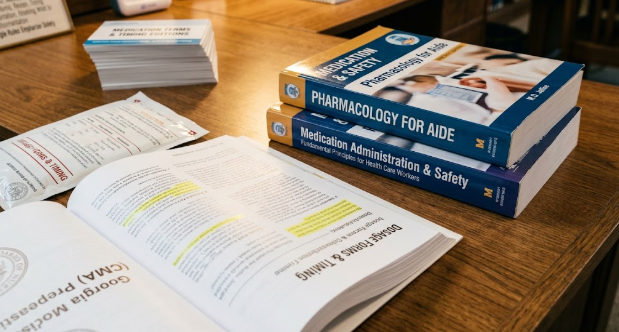
Medication Administration and Safety
Start with the fundamentals, but do not stop at memorization. Know the rights of medication administration, resident identification, medication verification, dosage forms, routes, timing, and documentation. You should also recognize when something does not match and know when administration must stop.
Georgia’s rules place strong emphasis on medication safety and define the medication-related duties CMAs may perform.
Medication Orders, Labels, and MAR
The MAR should become familiar territory. Practice reading medication names, strengths, doses, routes, frequencies, and administration instructions. Learn how to recognize discrepancies between an order, MAR, and medication package.
Also understand that documentation records what actually happened. It should never be altered simply to make a medication pass appear complete.
Routes of Administration
Know common terminology such as:
- PO: by mouth
- PRN: as needed
- STAT: immediately
- SL: sublingual
- QHS: at bedtime
- Ophthalmic: eye
- Otic: ear
- Topical: skin
But do not study abbreviations in isolation. Exam questions can place them inside a resident-care scenario.
Adverse Reactions and Medication Errors
This is where easy questions become decision questions. Know the difference between a routine side effect, a possible adverse reaction, and an urgent change in condition.
More importantly, understand when the CMA should stop, report, document, and seek assistance. Never conceal a medication error because the resident appears fine.
Infection Control and Medication Storage
Review hand hygiene, clean medication preparation, contamination prevention, medication storage, expiration dates, discontinued medications, and proper disposal.
Georgia regulations also require communities to maintain appropriate medication systems and procedures.
Georgia CMA Scope of Practice
Do not skip this section. Georgia CMAs do not have unlimited medication authority. Georgia requirements, training, facility procedures, and applicable orders define their duties.
For example, Georgia rules identify specific medication routes and tasks CMAs may perform, including certain oral, ophthalmic, topical, otic, nasal, vaginal, rectal, inhaled, and specified injectable medications. Knowing what you are not authorized to do can be just as important as knowing what you can do.
Start Preparing for Your Georgia CMA Career
A practice test can show you what you know. It cannot replace approved training or the clinical skills required for Georgia certification. Georgia requires successful completion of an approved medication aide training program, demonstration of the required clinical skills, and passage of the written competency examination.
The smartest preparation helps you learn the rules, practice the decisions, and develop the hands-on skills. For students pursuing a medication aide pathway in Georgia, choosing appropriate training is an important part of preparation. Look for instruction that helps you understand medication safety, administration procedures, documentation, resident safety, and the responsibilities of the role.
If you’re ready to explore your options, learn more about Certified Medication Aide Training in Georgia at 1st Treasure Chara Centers.
Latest Posts

August 13, 2024
Is the Role of a CNA the Same as That of a Nurse?

August 13, 2024
Phlebotomists: Vital Contributors to the Healthcare System

August 13, 2024