BLS Certification in Georgia: What It Is, Who Needs It, and How to Get Certified
October 14, 2026
A healthcare job can come with a long checklist. Sometimes, BLS certification sits near the top. Nursing students may need it before clinical training. Healthcare employers may request it during onboarding. EMS professionals have specific state requirements to follow.
However, finding a class is only half the job. First, you need to know which credential you need. Then, you need a course your employer or school accepts.
So, what does BLS certification cover? Who needs it in Georgia? How much does it cost? Can you take the course online?
This guide answers those questions without making the process harder than it needs to be.
What Is BLS Certification?
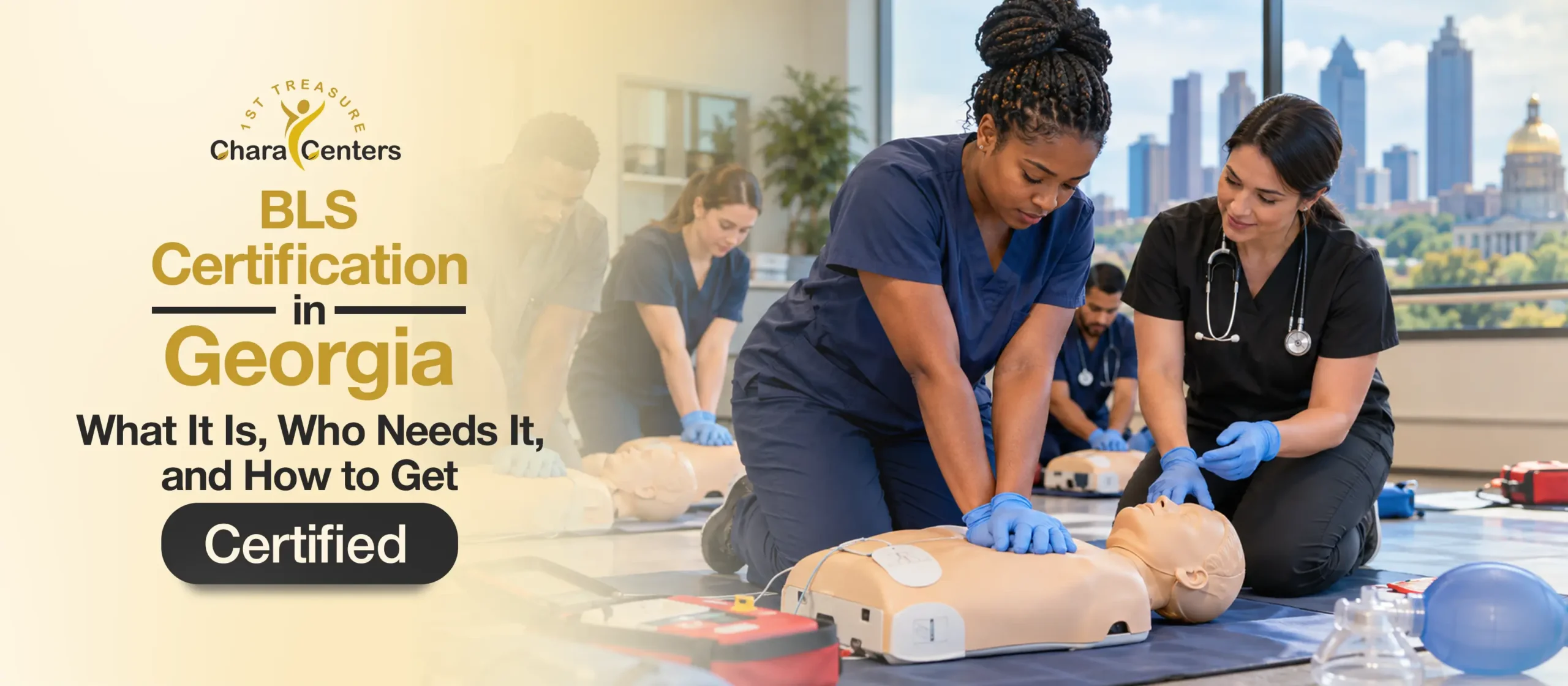
Basic Life Support (BLS) prepares people to respond to medical emergencies. The training teaches them to recognize warning signs and act quickly. Most courses cover CPR and AED use, along with rescue breathing and choking response, depending on the course.
Healthcare‑focused BLS training can also include team resuscitation. That last part matters in certain settings. A cardiac emergency may bring healthcare workers into the same room. Each person needs a role. BLS training helps learners practice those responses before a real emergency occurs.
What Does BLS Training Include?

BLS training is built around skills. BLS trainees usually learn the technique first. Then practice it with training equipment. The exact course content varies by provider. Still, several skills appear regularly in healthcare‑focused BLS programs.
CPR Skills
CPR is one of the parts of BLS training. BLS students practice chest compressions and rescue breaths. They also learn how to respond when normal breathing stops.
Proper technique matters during these emergencies. That is why hands‑on practice is useful. Reading CPR instructions feels very different from performing the skill.
AED Training
An automated external defibrillator (AED) checks the heart’s rhythm and delivers a shock when needed. During training, students learn how to use an AED and practice using it during CPR.
Rescue Breathing
BLS courses may include rescue breathing skills. BLS students learn how to provide ventilation during emergencies. They also learn how ventilation fits into CPR. The exact techniques can vary by course and age group.
Choking Response
Severe choking requires action. BLS training can cover choking response for age groups. BLS trainees learn how to recognize an airway emergency and respond appropriately. This skill can be used outside hospitals too. Healthcare workers may encounter choking emergencies in care settings.
Team Resuscitation
A healthcare emergency rarely stays a one‑person task. One person may begin compressions. Another may prepare the AED. Someone else may contact emergency services.
Therefore, communication becomes part of the response. Many BLS courses include team‑based resuscitation practice. BLS students can learn how to communicate while performing emergency skills.
BLS vs CPR: What Is the Difference?
BLS and CPR are closely related, but they are not interchangeable. The confusion usually starts because both involve life-saving skills. The difference becomes clearer when you look at who takes each course and what they need to learn.
CPR focuses on helping someone whose heart has stopped beating effectively. BLS covers CPR too, but the training goes further. Healthcare professionals also practise using an AED and responding to emergencies as a team.
Here is how the two courses compare.
| BLS Training | CPR Training |
|---|---|
| Nurses, nursing assistants, and other healthcare professionals may need BLS certification to meet workplace requirements. | Parents, teachers, childcare workers, and members of the public can take CPR training to prepare for emergencies. |
| Students learn CPR, AED use, and other emergency response skills covered by their course. | CPR classes teach the steps used to help someone in cardiac arrest. Some also include AED training. |
| Team-based practice helps healthcare workers coordinate their actions when several people respond to an emergency. | Depending on the course, students may focus on responding to an emergency as an individual rescuer. |
| Hospitals and other healthcare facilities commonly require an accepted BLS credential for certain positions. | CPR certification can be useful in schools, workplaces, childcare settings, and everyday life. |
| The certificate must meet the requirements set by the employer or healthcare facility. | A CPR certificate may not be enough for a job that specifically requires BLS certification. |
There is one thing worth checking before choosing either course. The course name alone does not tell you whether the certificate will meet your needs. Training content and certification acceptance can differ between providers and employers. Check both before paying for a class.
So, is BLS the same as CPR? No. CPR is a skill taught in BLS courses, but BLS training covers more than CPR alone. Someone taking a class for personal preparedness may only need CPR training. A healthcare worker, on the other hand, may need BLS certification to qualify for a particular role. The right choice depends on why you need the training and which credential your employer accepts.
Who Needs Basic Life Support Certification in Georgia?
There is no single BLS rule for every worker in Georgia. Instead, requirements can come from several places. Your employer may set a requirement. Your school may have another one. A state licensing agency may have its own rules. That difference is important.
Healthcare Workers
BLS training is commonly connected with patient-facing healthcare roles. CPR certification for healthcare workers may also be required depending on the role and employer.
These can include:
- Nurses
- Physicians
- EMTs
- Paramedics
- Dental professionals
- Respiratory care professionals
- Other healthcare workers
However, the requirement can differ between employers. Therefore, check your job description or onboarding paperwork.
Nursing Students
Nursing students often encounter CPR or BLS requirements before clinical placements. The timing can vary by school. Some programs request certification before students enter clinical settings. Others provide specific instructions during the program.
Medical and Allied Health Students
BLS training can also matter for students entering other healthcare fields. That includes students preparing for clinical work. Depending on the program, certification may be needed before patient contact or clinical placement.
EMTs and Paramedics
Georgia has specific requirements for EMS professionals. The Georgia Department of Public Health states that EMS providers must maintain BLS certification from a Department-approved sponsor.
Georgia also requires EMS license applicants to submit a current, signed CPR card. The state lists accepted certification organizations and courses. That makes provider verification especially important for EMS professionals. Do not assume every online BLS card meets the same requirement.
Other Professionals
BLS skills can also help people outside traditional healthcare roles. Some employers require CPR or emergency response training. Others recommend it because of the people their employees serve. Schools, childcare settings, fitness facilities, and care environments can have their own requirements.
BLS Certification Requirements in Georgia
Georgia does not have one universal BLS requirement for every profession. Instead, the requirement depends on the role and organization involved.
For EMS professionals, the state provides specific guidance. Georgia DPH says EMS providers must maintain Basic Life Support certification from a Department-approved sponsor. The state also identifies CPR documentation as part of EMS personnel licensing.
That means EMS professionals should check both requirements. Other healthcare workers should check with their employer or licensing body.
What Should You Check Before Enrolling?
Before paying for BLS training, check these details:
- Required certification type
- Accepted training provider
- Course format
- Skills assessment requirement
- Certification expiration
- Renewal requirements
- Documentation requirements
How to Get BLS Certification in Georgia
The process is usually simple. Still, start with the requirements. Do not begin with the cheapest course you find online.
Step 1: Confirm the Credential
First, find out exactly what your employer or school wants. The requirement may say CPR, BLS, or BLS for healthcare providers. Those terms are not always interchangeable. If the wording is unclear, ask the organization before registering.
Step 2: Find a BLS Training Provider
Next, look for a recognized provider. Search terms such as BLS classes Georgia or Basic Life Support certification near me can bring up local options. However, search results do not confirm acceptance. Always check the course details.
Step 3: Complete the Training
Most skills-based courses include instruction and practice. You may practice CPR on a manikin. You may also work with an AED trainer. Depending on the course, you may practice choking response and rescue breathing.
Step 4: Complete the Skills Assessment
Learning the steps during class is only part of the training. Students must also perform the required skills while the instructor watches. If they miss a step or struggle with a technique, they can ask questions and get help before moving on. This gives them a chance to correct mistakes during training.
Step 5: Get Your Certification
Once students finish the required training and assessment, they receive their BLS certification. Keep the card or certificate safe. If you apply for a healthcare job later, your employer may ask to see it.
How Much Does Basic Life Support Certification Cost in Georgia?
BLS courses in Georgia can cost between $70 and $85, depending on the provider and course format. The average advertised price is around $77.50. However, the amount you pay may change depending on the provider and what the course includes.
Online training can also come with additional costs if students need to attend a separate session for hands-on practice. Course materials may add to the final amount, too.
Before paying for a course, find out whether the fee includes:
- Instructor-led training
- Hands-on practice and the required assessment
- Your certification card
- Course materials
- A separate skills session for online training
- Renewal fees, if applicable
If you need BLS certification for work, check the requirements before paying for a course. The Georgia Department of Public Health provides official guidance on CPR certification requirements for EMS personnel. Other healthcare employers may have their own rules, so confirm which credential they accept.
A quick check of the total fee and certification requirements can help you choose a course that fits your budget without unexpected costs.
BLS Renewal in Georgia
A BLS renewal can be different from first-time certification. The right option depends on your current card and provider.
Before registering, check:
- Current expiration date
- Existing certification
- Required provider
- Skills assessment
- Employer acceptance
- Renewal format
Georgia EMS professionals should also review current state renewal rules. The Georgia Department of Public Health states that EMS providers must maintain Basic Life Support certification from a Department-approved sponsor.
The state also requires current CPR documentation during EMS license renewal. Requirements can change. So, always use the current state guidance when licensing is involved.
How to Choose BLS Classes in Georgia
Finding a class is easy. Finding the right class takes a little more checking. BLS certification classes in Georgia can vary in format, provider, location, and course requirements. Here are the details worth comparing.
Check the Certification
Start with the credential. Ask who issues it. Then, check whether your employer accepts it. This matters more than a flashy course title.
Check the Training Format
Next, look at the course format. Some learners prefer classroom training. Others prefer blended learning. However, the required skills still need proper practice.
Look for Hands-On BLS Training
BLS is not only theoretical. You need to perform the skills. Hands-on practice lets an instructor spot technique problems. It also gives learners time to build familiarity.
Compare the Total Price
Do not compare headline prices alone. Check the complete fee. Ask whether materials, testing, certification, and skills practice are included. That gives you a more useful comparison.
Check the Location
Convenience matters too. Someone searching for BLS certification near me may not want a class across the state. Local training can make scheduling easier. For Cherokee County residents, Holly Springs can be a convenient option.
Basic Life Support Certification Near Me in Holly Springs, Georgia
People searching for BLS training near me have several factors to consider. Location is one of them. So is the training format. 1st Treasure Chara Centers offers hands-on CPR training in Holly Springs, Georgia. Its current program includes CPR, AED use, airway skills, choking response, and emergency assessment.
The center lists its location at 310 Paper Trail Way, Suite 105, Holly Springs, GA 30115. The current CPR program is instructor-led and hands-on training with basic BLS and AED training included as part of the CPR course. The center also states that its training supports healthcare professionals and people seeking practical emergency response skills.
For a person comparing BLS classes in Georgia, the next step is simple. Check whether the specific credential meets your employer’s requirement. That check should come before registration.
BLS Training in Cherokee County and North Georgia
Driving into Atlanta for a training class can eat into an already busy day. For healthcare workers and students living nearby, finding a course closer to home may be much easier. Holly Springs, in Cherokee County, is one place to start looking.
Residents searching for BLS certification in Cherokee County can compare local providers based on their schedules and course requirements. If you live nearby, checking options for CPR certification in Holly Springs may help you find a class that fits your routine.
For those living farther out, searches for BLS certification in North Georgia or BLS classes near me can help narrow down nearby options. Just remember that a short drive does not guarantee the right qualification. Check whether the course includes the required hands-on skills assessment and whether your employer accepts the certificate before you enroll.
What Should You Bring to a BLS Class?
Most courses do not require much equipment from students. Still, a little preparation helps. Bring your current certification card if you are renewing BLS/CPR certification. Bring identification if the provider requests it.
Also, bring any requirements from your employer or school. That document can answer an important question before class begins.
You can also ask about:
- Course length
- Skills testing
- Certification timing
- Renewal dates
- Accepted credentials
A few questions upfront can save a second trip later.
Final Thoughts
For Georgia healthcare workers, the details can vary. EMS professionals have specific state requirements. Other workers may follow employer or school rules. So, start with the requirements. Then, compare the training provider, course format, location, price, and certification.
For people near Holly Springs, 1st Treasure Chara Centers offers hands-on CPR training with BLS-related skills. The program includes CPR, AED practice, airway support, and choking response. The center also provides healthcare education and training in Holly Springs. Its instructors include experienced nursing professionals.
Ready to start your CPR training? Check the current CPR and BLS training options at 1st Treasure Chara Centers and confirm the credential you need before enrolling.
Frequently Asked Questions
Q. What does BLS stand for?
BLS stands for Basic Life Support. It focuses on emergency response during life-threatening situations.
Q. Do EMTs need BLS certification in Georgia?
Yes. Georgia DPH states that EMS providers must maintain Basic Life Support certification from a Department-approved sponsor. EMS personnel also need current CPR documentation during the licensing process.
Q. Is BLS certification required for healthcare workers?
Not every healthcare worker has the same requirement. The employer, school, profession, or licensing body may set the rule. Therefore, check the exact position requirement.
Latest Posts
August 13, 2024
Is the Role of a CNA the Same as That of a Nurse?
August 13, 2024
Phlebotomists: Vital Contributors to the Healthcare System

August 13, 2024