

6 Rights of Medication Administration Every Med Aide Must Know
August 20, 2026
Medication administration may become a routine part of a medication aide’s work, but it should never become something you do on autopilot. Every medication pass requires careful attention to the patient, medication, dose, route, timing, and documentation.
The 6 rights of medication administration provide a simple framework for making those checks consistently. They are the right patient, right medication, right dose, right route, right time, and right documentation.
These six checks can help medication aides identify discrepancies before a medication is administered. However, they are only one part of medication safety. Facility policies, medication orders, patient identification procedures, scope of practice, and applicable regulations must also be followed.
What Are the 6 Rights of Medication Administration?
The 6 rights of medication administration are a commonly taught medication-safety framework. This framework is used to help healthcare workers verify key details before and during medication administration.
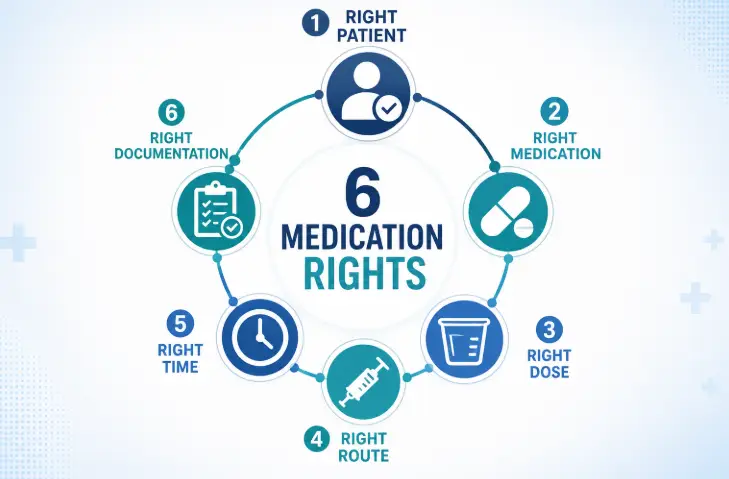
The six rights are:
- Right patient
- Right medication
- Right dose
- Right route
- Right time
- Right documentation
These are called the 6 medication rights or 6 patient rights in nursing education. The traditional nursing framework is often taught as the five rights, covering the patient, drug, route, dose, and time. Expanded versions have added documentation, reason, response, and other checks.
Because medication-rights frameworks are not completely standardized, students should follow the version required by their instructor, training program, employer, and applicable regulations.
1. Right Patient
The first question is simple: Who is supposed to receive this medication? A medication can be correctly prescribed and correctly prepared but still cause harm if it is given to the wrong person.
Patient identification is therefore one of the most important steps in medication administration. Before administering a medication, follow your facility’s approved identification procedure. Compare the appropriate patient identifiers with the medication order and medication administration record (MAR).
Do not rely only on:
- Room number
- Patient appearance
- Familiarity with the patient
- Memory
- Another person’s assumption
If the information does not match, stop and clarify the discrepancy before continuing. That brief pause can prevent a much more serious medication error.
2. Right Medication
Once you have confirmed the patient, verify the medication. Ask: Is this the medication that was ordered for this patient?
Medication names can look or sound similar. Different strengths and formulations can also make two products appear nearly identical at a quick glance. Compare the medication label with the current order and medication administration record according to your facility’s procedure.
Pay attention to:
- Medication name
- Strength
- Formulation
- Expiration date
- Relevant medication instructions
If the label does not match the order, or something feels unusual, do not guess. Stop and use the appropriate process to clarify the discrepancy. Familiarity with medication should never replace verification.
3. Right Dose
The right dose means administering the amount prescribed for the patient. This sounds simple until you encounter different medication strengths and concentrations. For example, the ordered dose may not equal the amount contained in one tablet or the volume found in a medication container. A calculation may be necessary.
Dose verification becomes particularly important when medications involve weight-based calculations, different concentrations, or other dosing considerations. Before administration, compare the ordered dose with the available medication strength.
Complete any required calculation according to your training and facility procedures. If a calculated dose appears unusually high or low, stop and verify it.
Why Do Dosage Calculation Skills Matter for Med Aides?
Medication aides need more than the ability to recognize medication names. They must understand medication strengths, dosage instructions, calculations, documentation, and the procedures that apply to their role.
That’s why dosage calculation is a core piece of CMA preparation. At 1st Treasure Chara Centers, calculation practice is included in the Certified Medication Aide curriculum alongside medication knowledge and safe administration technique. Understanding the right dose is not just an exam skill. It is an important part of safe medication administration.
4. Right Route
The right route means giving a medication exactly the way it was ordered. The route is not a minor detail. It changes how a medication enters the body and how quickly or effectively it works.
Common routes include:
- Oral
- Topical
- Inhaled
- Subcutaneous
- Intramuscular
- Intravenous
- Rectal
- Sublingual
This is where searches such as right route, right dose often appear together. Both checks are essential, but they answer different questions. The right dose asks, “How much?” and the right route asks, “How should it be given?” Switching routes because another method seems more convenient is never appropriate.
Check that the medication form matches the ordered route. Then follow the proper technique and safety steps for your role and setting. For medication aides, knowing where your scope of practice ends is just as important as knowing the administration technique itself.
5. Right Time
Medication timing matters. Is this medication due now? Some medications need to be administered at specific intervals. Others have instructions related to meals, previous doses, or other medications.
Before administration, review the medication administration record and relevant instructions. Check the timing of previous doses when required. A medication can be the right drug and the right dose but still create a problem when administered at an inappropriate time.
If you are uncertain about timing, do not improvise. Follow the appropriate process for clarification. This is another reason the 6 rights of medication administration in order can be useful. The sequence keeps your attention moving through the key safety checks instead of relying on memory alone.
6. Right Documentation
The medication pass does not end when the patient takes the medication. You still need to leave behind an accurate record. Right documentation means charting the administration in line with your workplace’s rules, the medication’s requirements, patient-specific needs, and applicable regulations. Good records let the rest of the care team know exactly what was given and when.
They also matter enormously if a dose is:
- Refused
- Held
- Delayed
- Missed
- Associated with an unexpected response
Accurate nursing assessment documentation and medication records help create a clear picture of what happened during patient care. A sloppy or incomplete record can leave the next caregiver guessing. Solid documentation closes the loop on the entire medication process.
Why Are the 6 Rights of Medication Administration Important?
Medication administration often takes place in busy environments. A patient may need assistance. A coworker may ask a question. A phone may ring. Another care task may suddenly become urgent. These interruptions can make medication administration more difficult and research has examined their relationship with medication errors.
Research continues to examine the connection between interruptions and medication errors. A 2026 scoping review examined 22 studies and found that 16 reported a statistically significant positive association between interruptions and medication administration errors. The researchers also noted differences in how studies defined interruptions and errors.
The six rights provide a consistent mental checklist:
- Who? – Right patient.
- What? – Right medication.
- How much? – Right dose.
- Where? – Right route.
- When? – Right time.
- Was it recorded? – Right documentation.
This sequence can help keep attention on the medication task. The six rights are not a guarantee against medication errors. They are one layer of a much larger medication-safety process involving communication, clinical policies, patient identification, medication knowledge, technology, staffing, and organizational systems. The WHO also notes that medication-related harm can involve human factors, high-risk situations, polypharmacy, and transitions of care.
5 Rights vs. 6 Rights vs. 7+ Rights of Medication Administration
One reason medication administration can be confusing for students is that different resources may list different numbers of “rights.”
You may encounter five, six, seven, eight, nine, or even more rights.
Here is the basic distinction:
| Framework | Common Checks | Important Note |
|---|---|---|
| 5 Rights | Patient, medication, dose, route, time | Traditional foundation |
| 6 Rights | Five rights + documentation | Common expanded version |
| 7+ Rights | Additional checks | Varies by program or organization |
Important Note:
These frameworks have developed differently across nursing education, healthcare organizations, and training programs.
So, if one textbook lists five rights while your CMA program teaches six, that does not automatically mean one source is incorrect.
Follow the framework required by your instructor, employer, training program, and applicable regulations.
How Medication Aides Apply the 6 Rights in Real Patient Care
Memorizing the six rights is only the beginning. The goal is to turn them into a consistent medication-safety routine. Before administering medication, review the medication order and MAR.
Confirm the patient’s identity and carefully compare the medication with the information in the record. Depending on the medication and your scope of practice, other information may also need attention.
This can include:
- Allergies
- Vital signs
- Laboratory information
- Patient symptoms
- Specific medication instructions
If something does not make sense, pause. That pause is not wasted time. It is part of safe practice.
Before Giving the Medication
Preparation starts with reviewing the medication order and gathering the medication according to your facility’s procedure. Confirm the patient, medication, dose, route, and time. Then review any additional information required for safe administration. Try to minimize unnecessary distractions during medication preparation.
You do not need a perfectly silent environment. You do need enough focus to recognize when something does not match. If an interruption breaks your concentration, take a moment to recheck your work rather than relying on memory.
During Medication Administration
Once the medication is prepared, continue following the required procedure. Make sure the correct patient receives the correct medication through the prescribed route and at the prescribed dose.
Communication also matters. A patient may ask what medication they are receiving. They may say the medication looks different from what they normally take. They may simply tell you that something feels wrong.
Do not automatically dismiss the concern. The WHO’s medication-safety initiative encourages patients and healthcare professionals to know, check, and ask as part of safer medication use. Stay within your scope of practice. When a question requires clinical judgment beyond your role, involve the appropriate licensed healthcare professional.
After Giving the Medication
Medication safety continues after administration. Document the medication according to applicable requirements. Monitor the patient when monitoring is required within your role and facility procedures.
Pay attention to unexpected responses and report them through the appropriate process. If the patient refuses a medication, or a dose is withheld or delayed, follow your organization’s notification and documentation procedures. The medication record should tell an accurate story of what happened.
What Is Medication Administration?
Medication administration is the process of preparing and giving medication according to an authorized order and applicable clinical procedures.
It can involve:
- Tablets
- Capsules
- Liquids
- Topical medications
- Inhaled medications
- Injections
- Other medication forms
But medication administration is much more than handing someone a pill. A healthcare professional needs to understand what medication is being given, who should receive it, how much should be given, how it should be administered, and when it should be given.
They also need to recognize when something does not look right. That combination of knowledge, attention, communication, and judgment makes medication administration a serious clinical responsibility.
Common Medication Administration Errors
Errors can creep in at different points in the process.
- Wrong-Patient Errors: Medication meant for one person is given to someone else.
- Wrong-Medication Errors: These may involve similar names, packaging, or medication appearance.
- Wrong-Dose Errors: A calculation mistake or confusion between strengths can lead to an incorrect dose.
- Wrong-Route Errors: Medication is administered through a route other than the prescribed route
- Wrong-Time Errors: Medication is administered at an incorrect time or outside applicable timing requirements.
- Documentation Errors: The medication record does not accurately reflect what occurred.
These errors do not always result from one individual simply “not paying attention.” Medication safety can also be affected by communication problems, workload, interruptions, staffing, system weaknesses, unclear procedures, and other factors.
That is why safe medication administration requires both individual attention and reliable healthcare systems. For a deeper look at prevention strategies, see our guide on common medication errors & how to avoid them.
How CMA Training Prepares You for Medication Administration
If you are already working as a CNA in Georgia, Certified Medication Aide training may be one way to build additional medication-related knowledge and skills, depending on your career goals and applicable requirements.
But choosing a program should involve more than asking, “How quickly can I finish?” Ask what you will actually learn.
- Will you practice dosage calculations?
- Will medication administration be covered?
- Will you learn proper documentation?
- Will you understand patient monitoring?
- Will instructors explain legal and ethical responsibilities?
- Will you have clinical training?
A strong training program should help students understand not only what to do, but also why each safety step matters. If you are researching how to become a Certified Medication Aide, it also helps to understand the steps before choosing a training program.
Build Practical CMA Skills at 1st Treasure Chara Centers
Understanding the 6 rights of medication administration is an important foundation for medication aide training. Applying those principles correctly in patient-care situations is even more important.
At 1st Treasure Chara Centers, the Certified Medication Aide program covers key areas such as medication knowledge, dosage calculations, safe administration, documentation, and clinical practice.
Before enrolling, look beyond the program length. Ask what skills you will actually practice.
- Will you learn dosage calculations?
- Will you practice medication administration?
- Will documentation be part of your training?
- Will you learn about patient responses?
- Will you understand your role and scope of practice?
- Does the program include clinical instruction?
The right training should prepare you for the responsibilities that come with medication administration, not simply help you complete a course. If you’re also thinking about the requirements for medication aide certification in Georgia, review our detailed guide before applying.
If you’re ready to move from CNA work toward medication aide responsibilities, explore the Certified Medication Aide program at 1st Treasure Chara Centers. Build practical medication administration skills, strengthen your confidence, and prepare for the next step in your healthcare career.
Frequently Asked Questions
What are the 7 basic medication rights?
There is no single universal seven-right framework. A commonly taught expanded version adds another check, such as the right reason, to the traditional five rights plus documentation.
What are the 5 basic rights of medication administration?
The traditional five rights are right patient, right medication, right dose, right route, and right time.
Are there more than 6 rights of medication administration?
Yes. Different nursing programs and healthcare organizations use expanded frameworks with seven, eight, nine, or more rights. Always follow the framework required by your program or workplace.
What is the 6 rights of medication administration mnemonic?
A simple 6 rights of medication administration mnemonic is:
- Patient
- Medication
- Dose
- Route Time
- Documentation
Latest Posts

August 13, 2024
Is the Role of a CNA the Same as That of a Nurse?

August 13, 2024
Phlebotomists: Vital Contributors to the Healthcare System

August 13, 2024