
What Is an ACLS Certification Course? Who Needs It and How Does It Differ From BLS?
October 9, 2026
If you are looking for an ACLS certification course, there is probably a practical reason behind it. Your employer may require it, a new position may list it as a credential, or you may be moving into a setting where cardiac emergencies are part of the job.
Whatever brought you here, one thing is worth clearing up first. ACLS is not just another CPR certification. ACLS builds on basic life-support skills. It teaches healthcare professionals how to respond to serious heart emergencies. Training covers heart rhythms, emergency medicines, airway care, and teamwork. It also explains when a patient may need electrical treatment.
ACLS makes more sense when you look at how these skills work together during an emergency. So, who actually needs ACLS? Is it different from BLS? And is an ACLS certification course worth taking if your employer has not specifically asked for it? Let’s break it down.
What Is ACLS Certification?
ACLS stands for Advanced Cardiovascular Life Support. It is advanced emergency training for healthcare professionals who may face cardiac arrest or other serious heart emergencies. The training builds on CPR and basic life support, then teaches more advanced ways to assess and treat patients.
An ACLS certification course may include:
- High-quality CPR
- Cardiac rhythm recognition
- Defibrillation
- Synchronized cardioversion
- Emergency medications
- Airway and ventilation
- Patient assessment
- Team communication and resuscitation dynamics
The exact training varies by provider. However, your workplace may have its own requirements. That detail is easy to overlook. A course can be excellent and still not meet your employer’s certification requirements. Checking that before paying for training is a small step that can save a surprisingly large headache.
What Happens During ACLS Training?
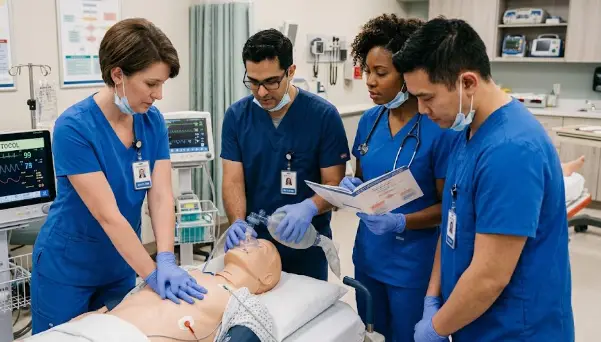
These skills make more sense when you see how they work together during an emergency.
For example, when a patient experiences cardiac arrest, the healthcare team must act quickly and work together. While CPR is underway, one team member monitors the heart rhythm, another manages the airway, and someone else prepares the required medications. Meanwhile, the team leader coordinates these actions and guides the overall response. Each team member has a role, and everyone must work together to handle the emergency.
1. High-Quality CPR Comes First
It is tempting to focus on the word advanced in ACLS. The basics still matter enormously. High-quality CPR remains a central part of cardiac arrest response. Participants learn how to give effective chest compressions, support breathing, and avoid unnecessary pauses. Advanced equipment does not make poor CPR effective.
That is why ACLS builds on BLS rather than replacing it. The foundation stays the same while the response becomes more complex.
2. Understanding Cardiac Rhythms
Reading a cardiac rhythm is another important part of ACLS training. A monitor can show a rhythm that requires urgent attention, but the screen is not the patient.
Healthcare professionals must also assess the patient’s condition by asking:
- Does the patient have a pulse?
- Are they conscious?
- Is circulation adequate?
- Is the patient stable or unstable?
- What is happening clinically alongside the rhythm?
These checks are important because a heart monitor cannot tell the whole story. Healthcare professionals must also check the patient’s pulse, symptoms, and condition before choosing a treatment.
3. Defibrillation and Cardioversion
Electrical therapy is another area covered in ACLS. Defibrillation and synchronized cardioversion are two different treatments. Each is used in specific situations. Understanding electrical therapy also means knowing how an AED works during resuscitation. ACLS training explains the difference between these treatments and when each may be used during resuscitation.
This is not a matter of spotting an abnormal rhythm and pressing a button. Healthcare professionals must consider the heart rhythm, pulse, symptoms, and the patient’s overall condition.
That is one reason hands-on practice and scenario-based learning can be useful. Emergency decisions are rarely presented as isolated multiple-choice questions when they happen in real life.
4. Medications Used During Cardiovascular Emergencies
Medications can form an important part of cardiovascular emergency management. During ACLS training, participants learn which medicines may be used during resuscitation and when they may be needed. But there is more to this than memorizing names.
A healthcare professional needs to understand the clinical situation behind the intervention. Healthcare professionals must follow current guidelines and workplace rules. They must also stay within the duties their training allows them to perform.
That distinction matters because recommendations and protocols can change over time.
5. Airway Management and Ventilation
A patient experiencing a serious cardiovascular emergency may also need support with breathing. ACLS training covers airway care and breathing support during resuscitation. The skills taught depend on the course and the person’s role. Each member of the healthcare team has different duties.
A respiratory therapist, nurse, physician, and paramedic may have different responsibilities and levels of training. Good emergency care means knowing both what you can do and what another team member is trained to handle.
ACLS training gives healthcare professionals an opportunity to practice those team dynamics. Clear instructions, assigned roles, and confirmation that messages are understood can help the team stay organized during an emergency. When the stakes are high, organization is not a cosmetic detail.
Who Needs ACLS Certification?
There is no rule saying that every healthcare professional needs ACLS. Whether someone needs ACLS depends on their job, daily duties, employer, and workplace.
Professionals who may need ACLS include:
- Physicians
- Registered nurses
- Nurse practitioners
- Physician assistants
- Paramedics
- Respiratory therapists
- Emergency department professionals
- Intensive care professionals
- Critical-care team members
Still, job titles alone do not tell the whole story. Consider two registered nurses. One works in an intensive care unit where critically ill patients are treated every day. The other works in a lower-acuity outpatient environment. Their certification requirements may be very different.
The same idea applies to paramedics and other healthcare professionals. Employers and local authorities may set different certification rules.
Ask your employer which certification you need before enrolling. Check which training providers they accept, too. This quick step can save you from paying for the wrong course.
ACLS vs. BLS: What’s the Difference?
BLS and ACLS are often mentioned together because they deal with life-threatening emergencies, but they serve different purposes.
- BLS focuses on lifesaving care, including CPR, AED use, and other basic life-support skills.
- ACLS builds on that foundation. It covers more advanced care for heart emergencies. Topics include reading heart rhythms, electrical treatment, emergency medicines, airway care, and teamwork.
BLS focuses on basic lifesaving care, while ACLS covers more advanced emergency care. For example, someone trained in BLS may recognize cardiac arrest, begin CPR, and use an AED. An ACLS-trained healthcare professional may also read the heart rhythm, coordinate advanced treatment, give appropriate medicines, and help lead the emergency response within their professional role.
Neither certification makes the other unnecessary. In fact, ACLS depends on the same basic lifesaving foundation that BLS teaches.
How Long Does ACLS Certification Last?
ACLS certification generally lasts two years. Healthcare professionals need to renew it when it expires, although some employers may ask them to renew earlier. It is worth checking the deadline with your employer so you have time to complete the process.
Renewal gives you a chance to practise skills you may not use every day. It also helps you keep up with changes in resuscitation guidelines. For healthcare professionals, continuing education helps them keep learning and stay up to date throughout their careers. After all, when a cardiac emergency happens, you want to be familiar with the steps you need to take, even if you have not used those skills in a while.
How to Get ACLS Certified
Getting ACLS certified starts with knowing what your workplace expects. A little preparation before enrolling can help you choose a course that fits your role and saves you from unnecessary costs.
1. Check Your Workplace Requirements
Start there, not with a course search. Your employer may require ACLS, prefer a particular provider, or have rules about which certifications they accept. A five-minute conversation with your supervisor or HR team can prevent you from spending money on training that does not meet the requirement.
2. Choose the Right Course
ACLS is not one-size-fits-all in practice. Consider your professional role, clinical setting, and the skills you are expected to use at work. The course should make sense for the responsibilities you will actually carry.
3. Complete the Training
This is where the theory starts connecting with the response. You may work through cardiac rhythms, CPR, emergency medications, airway management, electrical therapy, and team dynamics. Practising real-life scenarios helps participants understand how these skills work together during an emergency.
4. Complete the Assessments
Knowing an answer and knowing what to do are two different things. Depending on the course, you may have a written assessment, practical skills testing, or both. The goal is to show that you can use your skills when faced with an emergency.
5. Receive Your Certification
Once you pass, keep your certification somewhere you can actually find it. Save a digital copy, keep track of the expiration date, and check whether your employer needs proof of current certification.
Keeping your certificate accessible helps when you apply for a job, complete credentialing, or renew your certification.
Is An ACLS Certification Course Worth It?
For healthcare professionals who may deal with serious cardiovascular emergencies, ACLS can be a valuable credential. The main benefit is learning to use several skills together as a patient’s condition changes.
A cardiac emergency can demand several actions at once. The healthcare professional may need to check the patient, read the heart rhythm, and help with CPR. They must also communicate with the team and check whether the patient’s condition is improving.
Several things may need attention at once. Training gives professionals a chance to practise handling that pressure before facing it at work.
ACLS may be particularly relevant for people working in:
- Emergency departments
- Intensive care units
- Cardiac care
- Critical-care settings
- Prehospital environments
- Other high-acuity healthcare settings
For someone who rarely handles seriously ill patients, however, ACLS may not be necessary. The better question is not simply, “Do I work in healthcare?” It is, “Could my role require me to respond to a serious cardiovascular emergency?” Your employer’s requirements should ultimately guide that decision.
For Georgia healthcare professionals looking for career training, 1st Treasure Chara Centers offers healthcare training programs that help students build practical skills and professional development. Checking your workplace requirements before enrolling can help you choose training that actually fits your career path.
Final Thoughts
An ACLS certificaion course helps healthcare professionals prepare for serious cardiac emergencies and coordinate their response with other team members. For healthcare professionals pursuing continuing education, the right course depends on their job duties, workplace requirements, and career goals.
FAQs About ACLS Certification Course
1. Does every nurse need ACLS?
No. ACLS requirements depend on the nurse’s role, workplace, patient population, and employer policies. Nurses working in emergency, intensive care, cardiac care, and other high-acuity environments may be more likely to need it.
2. Do paramedics need ACLS?
Many paramedics receive advanced cardiovascular emergency training, but exact certification requirements vary. Employer policies, jurisdiction, and professional scope of practice can all affect what certification is required.
3. Is ACLS useful outside an emergency department?
Yes. Cardiovascular emergencies can happen in many healthcare settings. Whether a professional needs ACLS depends on their responsibilities and workplace requirements.
4. Can someone take ACLS without BLS?
An ACLS certification course builds on basic life-support knowledge, and specific prerequisites vary by course. Check the requirements of the training provider before registering.
Latest Posts
August 13, 2024
Is the Role of a CNA the Same as That of a Nurse?
August 13, 2024
Phlebotomists: Vital Contributors to the Healthcare System

August 13, 2024