
Allied Schools in Cherokee County: Medical Programs & How to Choose the Right Program
August 26, 2026
You don’t need a four-year degree to get your start in healthcare. But you do need to be careful about where you spend your time and money. If you’re searching for allied schools in Cherokee County, you’ll quickly find plenty of medical programs to consider. CNA, medical assistant, phlebotomy, EKG, patient care technician, medication aide.
They all sound like healthcare careers, but the actual work can be very different. So, you have to find out which one sounds more like you. That is a better place to start than choosing a program simply because it is short or inexpensive.
Healthcare is also a field with plenty of room to grow. The U.S. Bureau of Labor Statistics projects 8.4% employment growth in healthcare and social assistance from 2024 to 2034, with nearly 2 million jobs expected to be added. The opportunity is there. Reading this guide will help you find healthcare training that matches the kind of healthcare work you actually want to do.
What Are Allied Health Schools?
Allied health schools prepare students for healthcare roles that support patients and other medical professionals.
Depending on the school, programs may include:
- Certified Nursing Assistant (CNA)
- Medical Assistant
- Phlebotomy Technician
- EKG Technician
- Patient Care Technician
- Certified Medication Aide
These programs are usually focused on practical skills rather than a broad four-year degree. That can be useful if you want to enter healthcare without spending several years in college first. You learn skills connected to a particular role and can then decide where you want to go next.
But there is an important distinction here. Don’t start with, “Which healthcare program can I finish fastest?” Start with, “What do I want my workday to look like?”
If you like working closely with patients, direct-care training may suit you. If you prefer a medical office and want both clinical and administrative responsibilities, medical assisting could be worth exploring. If you’re comfortable with focused technical work, phlebotomy might be more appealing. The job should guide the training, not the other way around.
Medical Programs Near Cherokee County: Which One Fits You?
Looking through medical programs near Cherokee County can feel a little overwhelming at first. Several programs may seem similar until you look at what you’ll actually be doing after graduation.
Here’s a quick comparison:
| Program | Main Focus | May Suit Students Who Want |
|---|---|---|
| CNA | Direct patient care and nursing-assistant duties | Frequent patient interaction |
| Medical Assistant | Clinical and administrative medical-office work | A mix of patient care and office duties |
| Phlebotomy | Blood collection and specimen handling | Focused technical, patient-facing work |
| EKG Technician | EKG procedures and patient preparation | Cardiovascular diagnostic support |
| Patient Care Technician | Broader hands-on patient-care skills | More clinical responsibilities |
| Certified Medication Aide | Medication-related duties within the applicable role and setting | Medication-aide training |
You can narrow the list pretty quickly by thinking about the work itself.
- Want regular patient interaction? Start with CNA.
- Prefer a medical office setting? Look into medical assisting.
- Interested in collecting blood and handling specimens? Phlebotomy may be a better match.
- Interested in cardiovascular testing? EKG training is worth a closer look.
- Want broader patient-care skills? Compare patient care technician programs.
Your commute also deserves some attention. If you’re traveling from Holly Springs, Canton, Woodstock, or another nearby community, a long drive several times a week can become a real burden once classes and clinical training get busy.
For students comparing Allied schools in Cherokee County, the best choice isn’t necessarily the closest school. It’s the one that fits your career plans, schedule, and training needs.
CNA Schools Near Cherokee County
If helping people directly is the part of healthcare that appeals to you most, CNA training is a natural place to start looking. CNA programs commonly cover patient care, mobility, vital signs, infection prevention, safety, communication, and other nursing-assistant skills.
The hands-on side matters here. You can read about transferring a patient or checking vital signs in a textbook. Doing it correctly with a real person requires something different: practice.
So when comparing CNA schools near Cherokee County, look at the practical side of the program. How much lab time is included? Is clinical training part of the course? What does the schedule look like?
Cost matters too, but don’t stop at the tuition number. Find out what you are actually paying for. If you already have a full-time job, scheduling becomes even more important. An accelerated CNA program for working professionals in Georgia can be useful when you’re comparing programs designed for people with tighter schedules.
Medical Assistant Programs in and Around Cherokee County
Medical assisting can appeal to students who want variety. One day may involve taking vital signs and preparing patients. Another part of the role may involve scheduling, documentation, or other administrative responsibilities.
Depending on the program, medical assistant training can cover:
- Patient intake
- Vital signs
- Medical terminology
- Documentation
- EKG procedures
- Basic laboratory skills
- Scheduling
- Billing and administrative duties
Not every program covers the same material in the same way, so look at the actual curriculum before enrolling. It’s also worth asking how much time you’ll spend practicing clinical skills. If an externship is included, find out where it takes place and what students are expected to do there.
And don’t confuse completing a training program with earning professional certification. They can be separate steps. The school should be able to explain what credential you receive and whether the program prepares you for a particular certification pathway.
Phlebotomy Training Near Cherokee County
Phlebotomy is more than learning how to draw blood. You also need to identify patients correctly, choose the appropriate collection method, follow infection-control procedures, label specimens properly, and communicate with people who may be nervous about the process.
The needle gets most of the attention. The details around it are just as important. That’s why hands-on practice deserves a close look when you’re researching phlebotomy training near Cherokee County.
Find out how much venipuncture practice students receive. Ask whether the program includes supervised experience, such as an externship, and what that experience involves. It’s also smart to calculate the full cost before you enroll. Tuition may not cover everything you’ll need for training or certification. Our guide to phlebotomy certification costs breaks down some of the expenses you may encounter.
For anyone comparing allied schools in Cherokee County, the amount of real practice available can make a noticeable difference.
Patient Care Technician Programs
A Patient Care Technician (PCT) program may suit students who want broader patient-care responsibilities.
Training can build on basic patient-care skills while introducing additional clinical tasks. When comparing PCT programs, check the curriculum, lab practice, and whether clinical experience is included.
Certified Medication Aide Training
If you’re interested in medication-related responsibilities, Certified Medication Aide training may be another path to consider, depending on your eligibility and work setting.
Before enrolling, check the program’s requirements and understand what duties the credential allows you to perform in Georgia. That way, you know exactly where the training fits into your career plan.
After comparing these options, you’ll have a clearer idea of which healthcare role fits you. Then you can focus on finding a school with the right training, schedule, practical experience, and cost.
What Should You Look for in Allied Schools in Cherokee County?
Once you’ve figured out which healthcare role interests you, choosing the right healthcare training center becomes much easier. You can stop comparing everything and focus on the things that actually affect your training.
1. Find Out Who Oversees the Program
Start with the basics. Find out what authorization, approval, or oversight applies to the school and program you’re considering. GNPEC provides information about Georgia’s requirements and program guidelines.
Be careful with labels such as “approved,” “accredited,” or “certified.” Those words can mean different things depending on the context. If you see one on a school’s website, ask what the designation refers to and which organization granted it. A good school should be comfortable answering that question.
2. Don’t Underestimate Hands-On Training
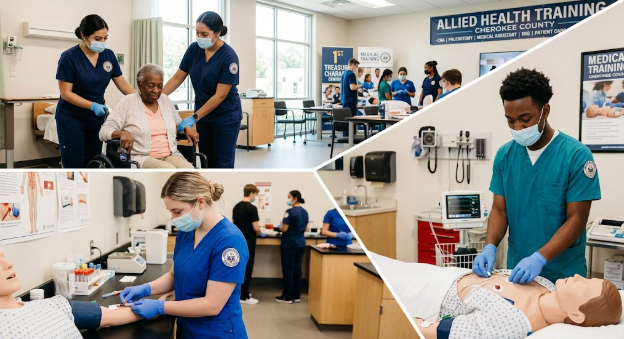
Healthcare isn’t learned entirely from a classroom. You need opportunities to practice the skills you’ll eventually use with patients. That could mean taking vital signs, performing blood collection, preparing a patient for an EKG, or practicing other clinical procedures.
Look at the balance between classroom instruction and practical training. If the program involves required lab or clinical work, find out exactly how those hours are completed and what you’ll be expected to demonstrate.
3. Look Closely at Clinical or Externship Experience
An externship can give you something a classroom cannot: experience in an actual healthcare setting. But don’t assume every externship works the same way.
Ask where students complete their experience, who supervises them, which skills they practice, and how their work is evaluated. If a school simply says “externship included,” that’s not enough information to make a decision. You want to know what the experience will actually look like.
4. Pay Attention to the Instructors
The person teaching the class can make a big difference. Look into the instructors’ healthcare backgrounds and experience. More importantly, think about how the program supports students while they’re learning.
Can you ask questions? Do instructors provide feedback during skills practice? What happens if you struggle with a particular procedure? Those details may not appear in a program brochure, but they matter once classes begin.
5. Understand What Happens After Graduation
This is one question students sometimes leave until the end. Don’t leave any questions. Before paying for a program, find out what happens when you complete it.
Does the program prepare you for a certification exam? Is there a registry or other requirement? What credential do you actually receive?
The answer will depend on the specific healthcare role and program, so get the details directly from the school. You don’t want to finish your training and then discover that you misunderstood the next step.
6. Calculate the Total Cost
Tuition is only part of the bill. Depending on the program, you may also have costs for:
- Books
- Uniforms
- Lab supplies
- Registration
- Examination fees
- Background checks
- Drug screening
- Immunizations
- CPR certification
- Other required supplies
Before enrolling, ask for a clear breakdown of the expenses. A program with a lower advertised tuition price isn’t necessarily the cheaper option once everything is added together.
How Long Do Medical Programs Take?
There isn’t one answer because program length varies by the healthcare career and the school offering the training. A shorter program can be attractive when you’re ready to start working. But speed shouldn’t be your only deciding factor.
Look at what is included in those weeks or months. Does the program provide classroom instruction? Lab practice? Clinical or externship experience? Preparation for a required examination or certification? The number of weeks tells you how long the program lasts. The curriculum tells you what you’re getting for that time.
Start Your Healthcare Career
Choosing a healthcare program gets easier when you stop trying to find the “best” program and start looking for the one that fits your situation. Maybe you want a patient-facing role and are considering CNA training. Maybe medical assisting appeals to you because you want both clinical and office responsibilities. Perhaps you would rather focus on blood collection, cardiovascular testing, or broader patient-care duties.
There isn’t one correct path for everyone. Take time to compare the training, practical experience, schedule, total cost, credentials, and requirements before you enroll.
If you’re researching allied schools in Cherokee County, you can also review the medical programs offered by 1st Treasure Chara Centers and compare the current requirements, format, costs, and credentialing information with the other programs on your list.
Related Guides
- How to Become a CNA
- How to Become a Certified Medication Aide
- CNA vs CMA: Which Certification Should You Take
- How to Become a Phlebotomist
- Phlebotomy Certification: Is It Worth the Cost?
Frequently Asked Questions about Allied Schools in Cherokee County
What are allied health programs?
Allied health programs prepare students for healthcare support roles. Common examples include CNA, medical assistant, phlebotomy, EKG, patient care technician, and medication aide training.
What medical programs are available near Cherokee County?
Depending on the school, you may find CNA, medical assistant, phlebotomy, EKG, patient care technician, and medication aide programs. Requirements, schedules, costs, and credentials can vary.
How do I choose between different allied health programs?
Start with the type of work you want to do. Then compare hands-on training, clinical experience, schedule, total cost, instructor support, and the credentialing pathway.
Is CNA a good starting point for a healthcare career?
CNA training can be a practical starting point for people who enjoy direct patient care. It can also give you experience in healthcare before deciding whether you want to pursue additional training later.
What should I check before enrolling in a healthcare program?
Look at the school’s authorization or oversight, curriculum, practical training, clinical or externship opportunities, instructors, total costs, schedule, and what credential or certification pathway follows completion.
Latest Posts
August 13, 2024
Is the Role of a CNA the Same as That of a Nurse?
August 13, 2024
Phlebotomists: Vital Contributors to the Healthcare System

August 13, 2024