Best Continuing Education Courses for Healthcare Professionals in 2026
May 21, 2026
The healthcare industry is one of the fastest-changing industries. If you work in it, you already know that. One year, you feel confident in your skills, and the next year, there’s a new guideline, a new process, or an updated standard you’re expected to follow.
That is why many healthcare workers don’t stop learning even after getting certified. They go back for continuing education for healthcare professionals because it helps them stay confident in their day-to-day responsibilities, handle patients, and keep up with changes in the field.
In this guide, we will help you choose the best continuing education courses for healthcare professionals and their career benefits. So read on!
Why Healthcare Professionals Are Choosing Continuing Education Courses in 2026
According to the U.S. Bureau of Labor Statistics, healthcare employment will grow by over 1.9 million jobs between now and 2034, faster than any other major sector in the American economy. That sounds like great news, and it is. But there’s a catch most people miss.
That growth is projected in skilled roles. Facilities aren’t simply looking to fill positions. They’re looking for healthcare professionals with current, verified, accredited credentials who can step in and perform at the level the job actually requires.
A recent AMN Healthcare Workforce Solutions survey found that over 80% of healthcare facility managers said they actively prioritize candidates with healthcare continuing education credentials over candidates whose original certifications haven’t been updated. That’s not a small preference; that’s a hiring filter. If your credentials haven’t moved since your first certification, you’re already behind the person in the same stack of resumes.
3 Most In-Demand Healthcare Continuing Education Courses For Healthcare Professionals
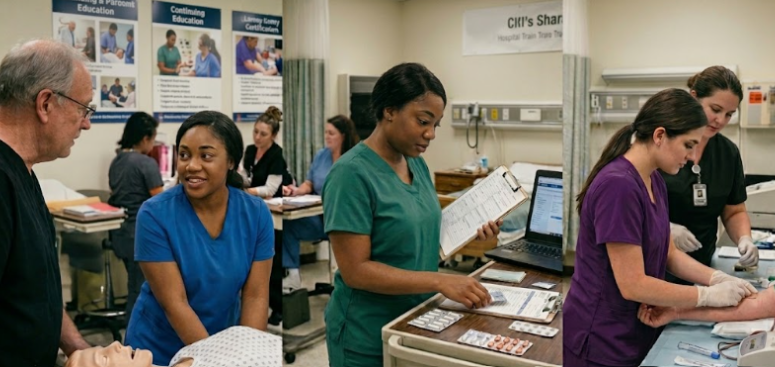
Below are the most in-demand healthcare continuing education programs you should know about.
CNA Continuing Education Courses for Better Job Opportunities
- Duration: 2 weeks to 3 months
- Format: In-person lab + clinical training + classroom learning
- Eligibility: Active CNA or healthcare certification holder
Certified Nursing Assistants are at the forefront of patient care. They are the ones who stay closest to patients in hospitals, nursing homes, rehab centers, and home care settings. The healthcare system runs on their daily support and hands-on care. But staying at the same level for years is where many CNAs start to feel stuck. The work stays hard, but the growth slows down. That is usually the point where continuing education becomes important.
CNA continuing education courses for healthcare professionals today focus on real, practical skills that matter on the floor. Things like better patient handling, dementia and Alzheimer’s communication, rehab support, and wound care basics. These are not extra topics. They are the skills that help you step into stronger roles.
In many healthcare markets across the USA, CNAs with additional training tend to move into better-paying positions, especially in specialized units. Even small skill upgrades can make a big difference in hourly pay and job options.
Certified Medication Aide (CMA) Training to Expand Patient Care Skills
- Duration: 3 weeks to 4 months
- Format: Classroom theory + lab practice + clinical training
- Eligibility: CNA or healthcare background (varies by state rules)
Certified Medication Aides work in a space where accuracy is everything. Medication is not something you “get used to” and stop updating. Rules change, safety standards get stricter, and the documentation system keeps changing. That is why CMA training is not a one-time practice anymore. It has become a skill you return to again and again.
In real healthcare settings, outdated medication knowledge is a risk. Facilities depend on CMAs to follow updated procedures correctly. If your training is not up to date, it does not just affect your job. It becomes a safety concern.
Modern CMA continuing education focuses on updated medication safety rules, controlled substance handling, electronic medication records, and changes in state-level healthcare regulations. Over time, CMAs who keep learning usually take on more responsibility. That can include patient monitoring, documentation support, and even more advanced duties within the same facility.
Phlebotomy Certification Courses for Fast Healthcare Career Growth
- Duration: 4 weeks to 3 months
- Format: Hands-on lab training + classroom instruction
- Eligibility: High school diploma or equivalent
Phlebotomy is the healthcare practice of drawing blood from patients for testing, transfusions, donations, or medical research. It is one of those healthcare roles that quietly stays essential everywhere. Hospitals, labs, clinics, blood banks, and diagnostic centers all depend on it every single day.
Updated phlebotomy certification courses in 2026 focus more on practical-world situations you actually see on the job. This includes finding veins, calming nervous patients, following infection control, and handling lab samples. These are the daily tasks phlebotomy deals with.
The healthcare job market for phlebotomy continues to grow because testing volume keeps increasing. More diagnostics mean more need for trained staff who can handle samples correctly and safely.
Another reason people choose phlebotomy is flexibility. Many training programs now combine classroom learning with lab practice, so it becomes easier to continue learning while working. For many healthcare workers, this becomes a practical way to enter or grow in the field without long delays or heavy academic requirements.
Which Healthcare Certifications Pay Off the Most?
Here is a simple comparison of the most common healthcare certifications that pay well and what they realistically offer in terms of pay, demand, and career growth in the USA.
Online vs In-Person Continuing Education Courses for Healthcare Professionals
Healthcare training in the USA looks different for everyone. Some people choose online learning because it fits their routine. They can study at home, go through lessons when they have time, and keep working alongside it. This is helpful for people taking continuing education courses for healthcare professionals while already in the field. Online learning helps you understand the basics and stay updated, but it doesn’t fully show you how real patient care feels in a hospital or clinic.
On the other hand, In-person training feels more real and practical. You don’t just read or watch videos; instead, you actually do the practical work. You practice skills in labs and training rooms, which is very important for CNA healthcare continuing education courses, CMA training programs, and phlebotomy certification courses. These medical jobs depend on hands-on work with patients, so practice builds real confidence.
Most healthcare employers in the USA trust in-person or hybrid healthcare training programs more because they show that you can handle emergencies.
How to Choose the Right Healthcare Continuing Education Course
Before enrolling, focus on these things carefully:
- Check accreditation: A healthcare continuing education course that isn’t accredited by a recognized body or that doesn’t satisfy your state’s specific renewal requirements is money spent for nothing. Before you enroll in anything, verify that the program is recognized by your state licensing board and by employers in your target job market.
- Match the course to a Real Career Goal: The healthcare workers who get the best return on their continuing education are the ones who enrolled in a course that is directly connected to a position they wanted or a salary tier they were trying to reach. Know the goal before you pick the program.
- Look at the Job Market: Before committing time and money to any healthcare professional development course, spend twenty minutes looking at job listings in your area for the role you’re training toward. If those listings are there and the salary makes sense for the investment, that’s your answer.
- Don’t Underestimate Scheduling Flexibility: A great program that you can’t actually complete because the schedule doesn’t work for your life is not a great program for you. Healthcare training programs that offer hybrid options, weekend labs, or evening coursework are specifically designed for working adults, and those design choices matter a lot.
Honestly, finding a training program that meets all these factors together is not easy. Many continuing education programs fall short in accreditation, flexibility, or real career alignment. That is why 1st Treasure Chara Centers focuses on bringing all these essentials into one structured, hands-on learning experience.
Final Thought
Continuing education has become an important part of growing and staying competitive in healthcare. of working in today’s healthcare field. It helps professionals stay current, strengthen practical skills, and move into more advanced roles with time.
Whether you want CNA advancement training, CMA continuing education, or phlebotomy certification courses, choosing the right healthcare program can help you build stronger skills and open doors to better opportunities.
If you’re ready to take the next step, 1st Treasure Chara Centers offers hands-on continuing education courses for healthcare professionals. These programs are designed to move their students from enrollment to employment.
Latest Posts
August 13, 2024
Is the Role of a CNA the Same as That of a Nurse?
August 13, 2024
Phlebotomists: Vital Contributors to the Healthcare System

August 13, 2024