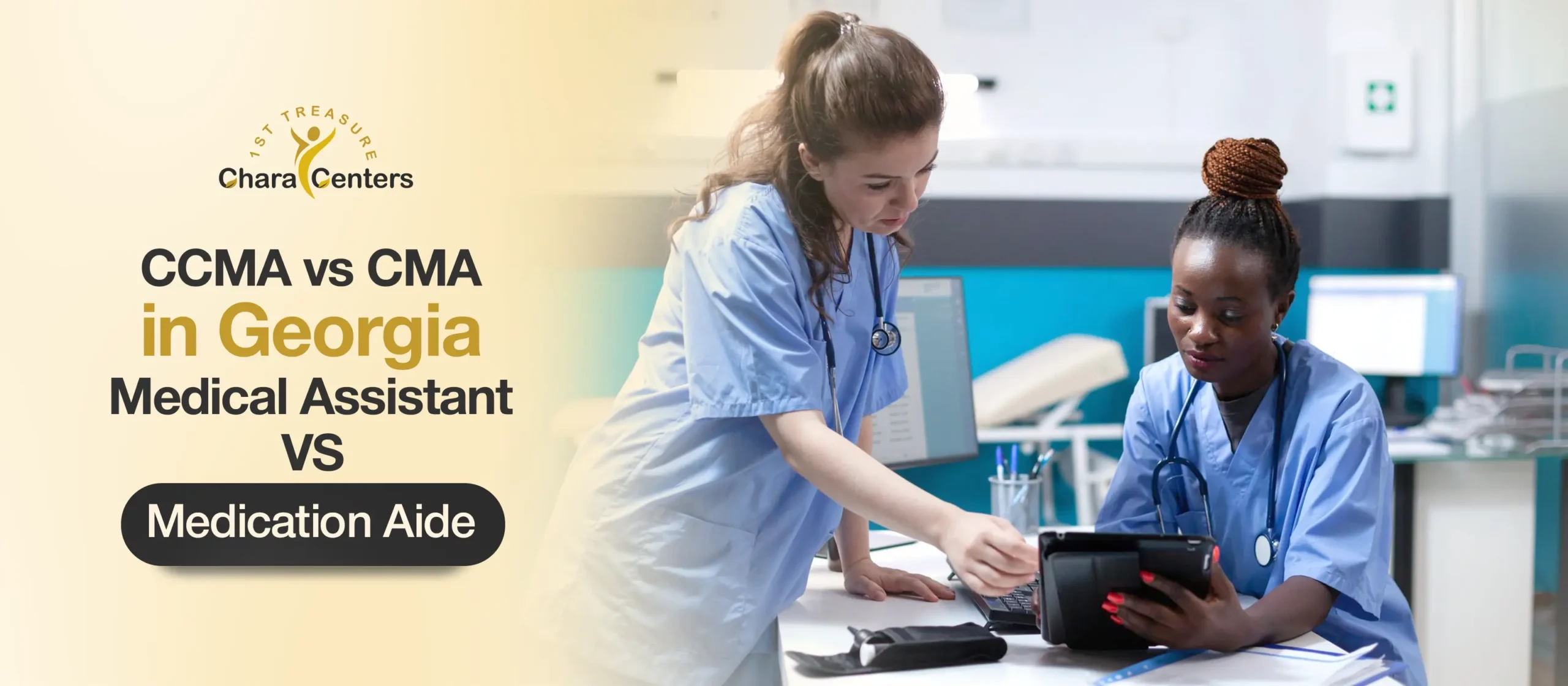
CCMA vs CMA in Georgia: Medical Assistant vs Medication Aide
October 16, 2026
CCMA vs CMA are not the same job in healthcare. CCMAs support providers with clinical and administrative duties, while Certified Medication Aides focus on authorized medication-related responsibilities within regulated care settings.
The difference is especially important in Georgia. For example, CCMAs can work in physician offices, outpatient clinics, and specialty practices. In contrast, CMAs work in approved care settings and follow Georgia’s medication rules.
The training paths are different, too. CCMA candidates usually complete medical assistant training and meet certification requirements. Meanwhile, Georgia’s CMA pathway starts with CNA status. Candidates then complete approved medication aide training and competency requirements. So, which path makes sense for you? Start with the work itself.
CCMA vs CMA: What Is the Main Difference?

The main difference between a CCMA and a CMA is their job scope. A Certified Clinical Medical Assistant (CCMA) supports healthcare providers with clinical and administrative tasks. A Certified Medication Aide (CMA) in Georgia focuses on authorized medication-related duties in approved care settings.
CCMA vs CMA at a Glance
| Training Path | Best For | What the Training Covers | Typical Training Length |
|---|---|---|---|
| CNA | If you want to start working with patients without spending several years in school. | Everyday patient-care skills, including vital signs, mobility, personal care, communication, and safety. | Around 4–8 weeks |
| LPN | Someone who wants more responsibility and is ready to work toward a licensed nursing role. | Practical nursing care, patient monitoring, clinical skills, and duties performed within the applicable scope of practice. | Around 1 year |
| RN | Students who already know that nursing is the career they want to build. | Patient assessment, clinical care, treatment, care planning, and nursing judgment. | Around 2–4 years |
| Medical Assistant | Someone interested in a doctor’s office, clinic, or outpatient setting. | Patient-care skills combined with administrative and office duties. | Around 4–12 months |
How Do Their Daily Duties Differ?
A CCMA may take vital signs, collect medical histories, prepare examination rooms, update patient records, and assist providers with certain procedures. The exact duties depend on the employer, training, and applicable rules.
A CMA focuses on medication-related responsibilities. Depending on authorization and the care setting, duties may include administering permitted medications, documenting medication tasks, performing authorized blood glucose testing, and reporting concerns.
How Do You Become a CCMA in Georgia?

The CCMA route generally starts with medical assistant education or qualifying supervised experience. For example, the National Healthcareer Association’s current CCMA eligibility requirements include completing a medical assistant training or education program within the previous five years. Certain candidates may qualify through supervised medical assisting work experience instead.
Next, candidates apply for the NHA exam and schedule a test date. They then study, take the exam, and receive their results. Anyone looking for medical assistant certification in Georgia should check the current eligibility rules of the certification body they intend to use. That small step can prevent a lot of confusion later. It also helps to compare programs before signing up. Look at the curriculum, hands‑on training, preparation for certification, and what employers expect.
How Do You Become a Certified Medication Aide in Georgia?
Georgia has state‑specific rules. Georgia regulations require certified medication aide training provided by an assisted living community or qualifying personal care home to follow a state-approved training program. Training must be administered by a Georgia-licensed registered nurse, pharmacist, or physician.
A CMA pathway includes:
- Maintaining good standing on the Georgia CNA registry
- Completing approved medication aide training
- Demonstrating the required clinical skills
- Preparing for the written competency examination
- Passing the required examination
- Completing the process for placement on the Georgia Certified Medication Aide Registry
Importantly, an aide must be listed in good standing on the medication aide registry before independently administering medications in the covered setting. Therefore, CMA training is more than a short medication class. The CNA foundation matters. Before enrolling, confirm that the certified medication aide program in Georgia follows state requirements.
Ready to take the next step toward becoming a CMA in Georgia? 1st Treasure Chara Centers offers a certified medication aide program in Georgia with training focused on the skills and competency requirements of the CMA pathway.
CCMA vs CMA: Which Takes More Training?
There is no useful one-number answer. The two pathways teach different skills.
A CCMA program can cover:
- Medical terminology
- Anatomy and physiology
- Patient care
- Vital signs
- Clinical procedures
- Examination assistance
- Patient communication
- Medical records
- Administrative duties
Medication aide training has a narrower focus. However, Georgia’s CMA pathway also requires CNA status. Candidates must meet the registry requirements. They must also complete the medication aide competency process.
So instead of asking which credential requires “more” training, look at what the training prepares you to do. Someone interested in a physician’s office has different needs from a CNA who wants to take on authorized medication responsibilities.
CCMA and CMA Salary in Georgia
Salary deserves a little context because the available data does not place both roles into neat, matching categories.
Medical Assistant Salary in Georgia
CareerOneStop’s 2025 wage data puts the Georgia median salary for medical assistants at $41,600 per year, or $20.00 per hour. The reported statewide range runs from about $34,270 to $51,430 per year. Location makes a difference.
In the Atlanta-Sandy Springs-Roswell metro area, the 2025 median wage was $46,060 per year, or $22.15 per hour. The high figure reached $58,310 annually.
Other Georgia areas reported different median wages:
- Savannah: $38,780
- Athens-Clarke County: $38,620
- Macon-Bibb County: $38,400
- Gainesville: $41,910
- Augusta-Richmond County: $38,470
- Rome: $38,240
Certified Medication Aide Salary
Certified Medication Aide (CMA) pay in Georgia varies by employer, location, experience, and shift. Although federal wage data does not report this role as a separate occupation, current job postings provide a useful reference.
According to recent Georgia medication aide salary data, the average pay was $18.17 per hour as of September 13, 2026. This estimate was based on 53 salaries from job postings over the previous 36 months. Individual offers may fall above or below this figure.
For additional context, the U.S. Bureau of Labor Statistics wage data reports a median annual wage of $37,680 for nursing assistants in Georgia in May 2025. This is a broader occupational benchmark, not a guaranteed CMA salary.
When comparing CCMA vs. CMA salary, check current job postings and compare the duties, work setting, schedule, and experience requirements. Pay can differ considerably between employers.
CCMA vs CMA: Which Career Fits You?
Ultimately, the right path depends on your preferred daily work.
A CCMA Path May Suit You If You Want To:
- Work in medical offices or clinics
- Support physicians and other providers
- Take vital signs
- Help prepare patients for examinations
- Work with electronic health records
- Combine clinical and administrative duties
- Interact with different patients throughout the day
A CMA Path May Suit You If You Want To:
- Build on CNA experience
- Work in a regulated residential care environment
- Focus on medication-related responsibilities
- Work closely with residents
- Follow medication administration procedures
- Develop medication-related skills within your authorized scope
The workplace is worth considering before the job title. For example, an outpatient clinic can have a faster pace. An assisted living community may involve more consistent resident interaction. One may involve constant patient turnover. The other may involve more ongoing interaction with the same residents. Neither is automatically the right choice for everyone.
Ready to Build Your Career Stronger?
For CNA professionals who want to take on medication‑related duties, the next step is to find a training program that meets Georgia’s rules. Check the program curriculum, hands‑on skill training, exam prep, eligibility rules, and timetable before signing up.
If you’re comparing CCMA vs CMA, understanding the difference can help you choose the path that matches your career goals. 1st Treasure Chara Centers provides a certified medication aide program in Georgia for candidates who want to pursue the state’s CMA pathway. Reviewing the program details can help you decide if CMA training fits your goals.
Frequently Asked Questions
Does a CCMA need a license in Georgia?
Certification and state licensure are not the same thing. People considering medical assistant certification in Georgia should check the requirements of the employer and certification organization. The certification pathway can vary depending on the credential selected.
How much does a Certified Medication Aide make in Georgia?
There is no separate federal wage category that reports a specific statewide median salary for Certified Medication Aides. Nursing assistant wages can provide a broader reference for CMA salary information because Georgia’s CMA pathway builds on CNA status. However, that figure should not be described as the official CMA salary.
Can a CCMA administer medication?
A medical assistant’s duties depend on training, employer policies, applicable law, and the specific task. Medical assistant medication duties can vary between healthcare settings. However, these duties should not be confused with the regulated Certified Medication Aide role in Georgia.
Can a Certified Medication Aide work in a doctor’s office?
The CMA role is designed around authorized medication-related duties in regulated care settings. Medication aide work settings can include applicable residential care environments, while medical assistants commonly work in physician offices, clinics, and outpatient healthcare settings. The job titles and scopes should not be treated as interchangeable.
Latest Posts
August 13, 2024
Is the Role of a CNA the Same as That of a Nurse?
August 13, 2024
Phlebotomists: Vital Contributors to the Healthcare System

August 13, 2024