
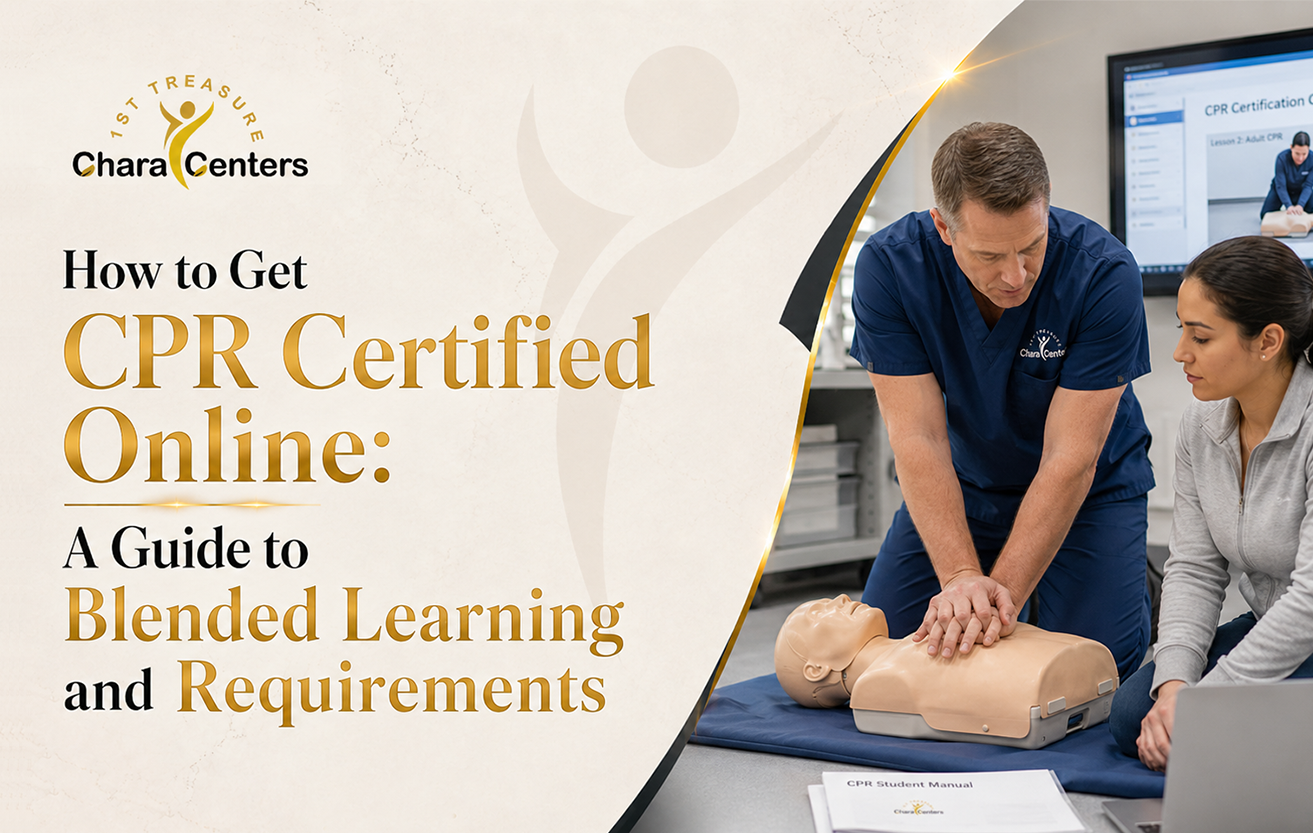
How to Get CPR Certified Online: A Guide to Blended Learning and Requirements
May 29, 2026
It usually starts with a simple situation. A job posting asks for CPR certification. Or maybe a healthcare program requires it. Or you just want to feel prepared if something unexpected happens. Whatever the reason, CPR certification has become one of the most in-demand life-saving credentials in the U.S.
But here’s what most people don’t realize at first: You cannot fully get CPR certified online. Instead, the U.S. uses a blended-learning CPR certification model that combines online training with in-person skills testing.
This guide explains exactly how it works, step by step, so you don’t waste time on the wrong CPR course.
What Is CPR Certification?
CPR (Cardiopulmonary Resuscitation) is an emergency procedure used when someone’s heart stops beating or they stop breathing.
A CPR certification proves that you can:
- Perform chest compressions correctly
- Use an AED (Automated External Defibrillator)
- Respond to choking emergencies
- Handle adult, child, and infant CPR situations
In the U.S., CPR certification is commonly required in:
- Healthcare jobs
- Schools and daycare centers
- Fitness and personal training
- Lifeguarding
- Workplace safety roles
Can You Get CPR Certified Online?
Yes, a lot of websites advertise “100% online CPR certification.” That sounds convenient, but if a CPR certification is truly recognized by employers, hospitals, schools, or OSHA-related workplaces, it always includes a hands-on skills test.
Why? Because CPR isn’t just theory. It’s physical. You can read about chest compressions all day, but performing them correctly under pressure is a completely different thing.
So when you see “online CPR certification,” what it really means is: You learn the knowledge online, then you demonstrate the skill in person. That’s blended learning.

Important Note: Some online courses may look quick and convenient, but they often don’t carry real value in workplaces. Most employers, schools, and healthcare organizations in the U.S. expect a CPR training program that follows proper standards and includes hands-on skills practice, not just theory. That’s exactly why blended learning has become the more accepted and practical choice.
Stop wasting time and money on unrecognized online CPR courses. Get your employer-accepted certification through 1st Treasure Charter Centers’ flexible blended learning program.
What Is Blended Learning CPR Certification?
Think of it like learning to drive. You can study road rules online, watch videos, and even take practice tests. But at some point, you still have to sit in a car with an instructor. CPR training works the same way.
Blended learning usually has two parts:
1. Online Training (Theory Portion)
You complete lessons at your own pace.
2. In-Person Skills Session
You physically demonstrate CPR on a mannequin with an instructor watching.
Once they are both done, you get certified.
Step-by-Step: How to Get CPR Certified Online in the U.S.
Step 1: Choose the Right CPR Certification Provider
This step matters more than people think. Not every CPR certificate is accepted everywhere. Some are basically just “online awareness courses” that look good but don’t hold value in real jobs.
If you want something recognized in the U.S., stick with trusted organizations like:
- American Heart Association
- American Red Cross
These are the names employers actually respect.
Hospitals, schools, clinics, and gyms; they all know these certifications. That alone removes a lot of stress later.
Step 2: Start the Online CPR Course (At Your Own Pace)
This is the part most people find surprisingly easy. You log into a learning portal, and the training usually feels more like guided videos than traditional studying.
You’ll go through topics like:
- What sudden cardiac arrest actually looks like
- How to recognize when someone isn’t breathing normally
- CPR steps for adults, children, and infants
- How to use an AED machine (the device you see in airports and gyms)
- What to do if someone is choking
- How to stay calm in an emergency
What’s nice here is flexibility. You can stop anytime, come back later, or finish everything in one sitting if you want. Most people complete it in a few hours, usually in the evening or over a weekend. It doesn’t feel like school; it feels like learning something practical you hope you never need, but are glad you know.
Step 3: Schedule the Hands-On Skills Session

This is the part people underestimate, and honestly, it’s the most important. After the online section, you book an in-person session at a training center. It’s usually short. You walk in, meet an instructor, and practice on a mannequin.
You’ll be asked to:
- Perform chest compressions with correct depth and rhythm
- Give rescue breaths properly
- Demonstrate CPR cycles without hesitation
- Use an AED in a simulated emergency
The instructor isn’t there to fail you. They’re there to correct you. Most people realize something here: Watching CPR and doing CPR feel completely different. Your body has to learn it, not just your brain.
Step 4: Final Evaluation and Certification
Once you complete the skills test successfully, you’re certified. You receive a CPR certification card (physical or digital, depending on the provider).
In most cases, the CPR certification remains valid for 2 years. After that, you’ll need a renewal course, which is usually shorter than the initial one.
CPR Certification Online vs Blended Learning: Actual Comparison
Here’s what actually matters when choosing a course:
| Online CPR Training (Not Recommended Alone) | Blended Learning CPR Certification | |
|---|---|---|
| Employer Acceptance | not accepted by hospitals, schools, or healthcare employers in the U.S. | Widely accepted because it meets standard training requirements. |
| Hands-on Practice | No real physical practice, only theory-based learning. | Includes real hands-on practice with instructor supervision. |
| Certification Validity | May not be recognized for job or official requirements. | Fully valid and commonly required for employment and training programs. |
| Skills Evaluation | No in-person testing or performance check. | Includes a mandatory in-person skills assessment before certification. |
| Use in Jobs | Limited use and often rejected for professional roles. | Accepted for healthcare, schools, fitness, and workplace safety jobs. |
| Real-world readiness | Knowledge only, without practical confidence in emergencies. | Builds real confidence through practice and supervised training. |
Looking at the comparison, one thing becomes pretty clear. CPR isn’t just about learning information; it’s about being able to respond correctly in a real emergency without hesitation.
That’s why blended learning is generally seen as the more reliable and practical route for anyone who actually needs certification for work or training purposes. Actually, if your goal is employment, blended learning is the only safe choice.
How Much Does CPR Certification Cost in the U.S.?
Prices vary slightly, but here’s what most people actually pay:
- Basic CPR/AED course: $50 – $120
- CPR + First Aid combo: $75 – $150
- Healthcare-level CPR: Slightly higher depending on requirements
What you’re really paying for isn’t just training, it’s the ability to respond correctly in an emergency without freezing.
Invest in yourself today, secure your spot in our CPR course for the hands-on skills and trusted certification employers require.
Who Actually Needs CPR Certification?
A lot more people than you might expect.
Common groups include:
- Teachers and school staff
- Babysitters and childcare providers
- Gym trainers and sports coaches
- Nursing and healthcare students
- Security and workplace safety staff
- Lifeguards
But there’s another group that doesn’t get mentioned enough: People who simply want to be prepared. Because emergencies don’t wait for job titles.
Why Choose the 1st Treasure Charter Centers CPR Training Program
Choosing where to get CPR certified is not something to take lightly. We’re talking about a skill that can be used in real emergencies, not just something to add to a resume. That’s why we believe the training should feel practical, clear, and actually usable when it matters.
At 1st Treasure Charter Centers, we focus on building CPR training that feels real from the start. Not rushed, not confusing, and not just something you click through online and forget.
The main focus of our CPR training:
- Blended learning that actually makes sense: We start with online learning so you can go through the basics at your own pace, then we bring it into real practice with hands-on training.
- Training that follows U.S. CPR standards: Our approach aligns with widely recognized CPR guidelines, so learners are prepared for real workplace expectations.
- A simple, guided process from start to finish: We keep things straightforward, so you’re never guessing what comes next or feeling lost in the process.
- Hands-on Practice: We make sure learners physically practice CPR techniques like compressions and AED use under supervision, because that’s what builds real confidence.
- Flexible learning for Busy Schedules: We understand people are working, studying, and managing life, so the online portion is designed to fit around your time.
What we’ve seen over time is simple: people don’t just want a certificate; they want to feel ready. And readiness doesn’t come from reading alone; it comes from doing it, even in a training environment.
That’s why our approach focuses on building comfort with the steps, so if a real emergency ever happens, the response doesn’t feel unfamiliar or frozen.
Final Takeaway
If you strip everything away, the requirements, the job applications, the certificates, CPR training comes down to one thing: Being able to help when someone else can’t help themselves.
And the truth is, most people only realize its importance after they wish they had it sooner. The good part is that getting certified today is easier than it has ever been. You can start online, finish quickly, and walk away with a skill that stays with you for years.
FAQs
1. Is it legit to get CPR certified online?
It depends on the type of course. Fully online CPR certificates are usually not accepted by employers. Legit CPR certification in the U.S. includes blended learning with an in-person skills test.
2. Can you get a CPR certification fully online?
No, not if you want an accepted certification. You can learn CPR theory online, but you must complete an in-person skills session to get certified.
3. How to get a CPR certification for free?
Some community programs or events may offer free training, but most recognized CPR certifications are paid. This is because they include instructor-led practice and official skills evaluation.
4. Which is better, BLS or Heartsaver CPR?
Neither is “better”; they serve different needs. BLS is for healthcare professionals, while Heartsaver CPR is for non-medical roles like teachers, gyms, and workplaces.
Latest Posts
August 13, 2024
Is the Role of a CNA the Same as That of a Nurse?
August 13, 2024
Phlebotomists: Vital Contributors to the Healthcare System

August 13, 2024