
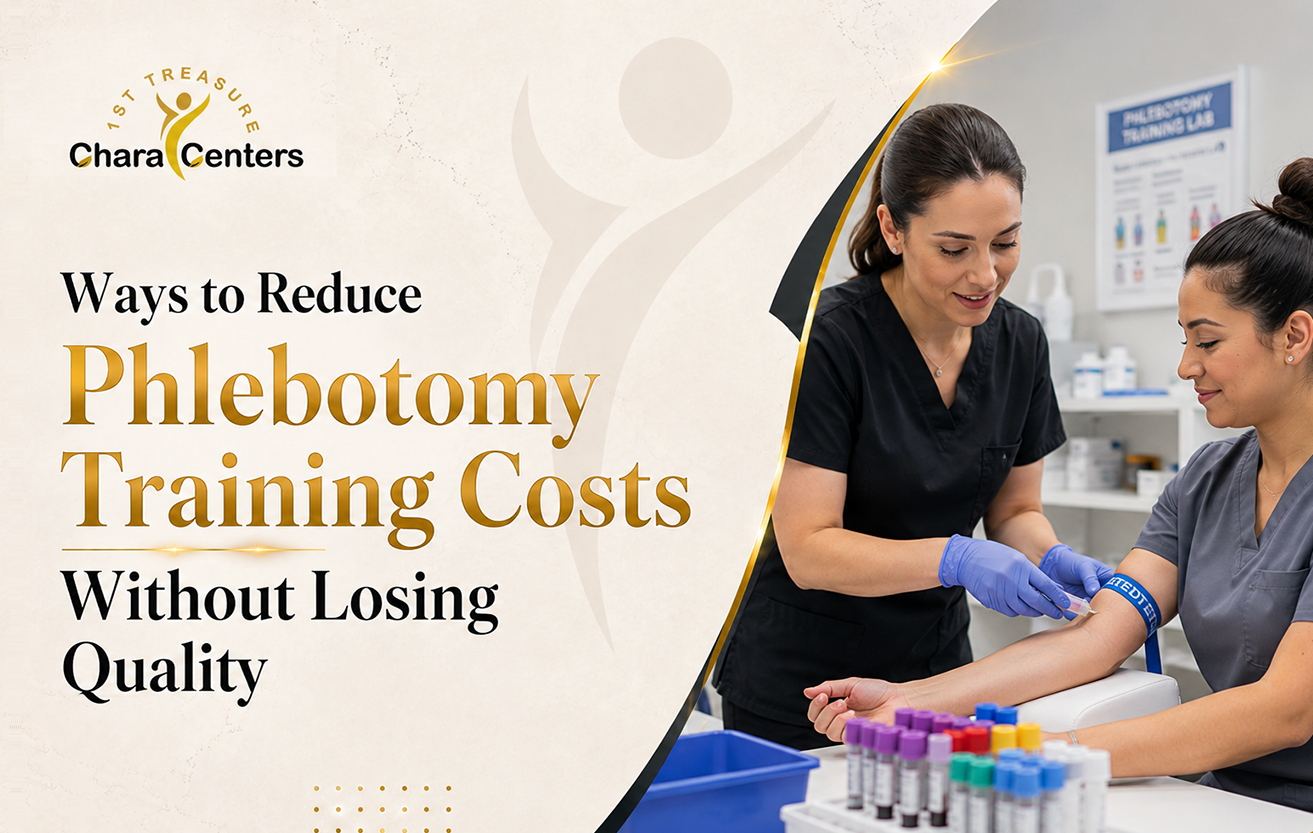
Ways to Reduce Phlebotomy Training Costs Without Sacrificing Quality
May 31, 2026
You’ve decided to become a phlebotomist, great choice. It’s one of the most accessible entry points into healthcare, and demand for skilled phlebotomists across hospitals, clinics, and diagnostic labs isn’t slowing down anytime soon.
But here’s something nobody tells you upfront: the advertised tuition is rarely the full information. Between exam fees, textbooks, lab kits, uniforms, background checks, and clinical placement costs, your total phlebotomy certification cost can climb a lot higher than expected. The good news? With a little planning, you can bring those costs way down, and still walk away with a credential that employers actually respect.
Here’s a real, practical guide to making phlebotomy training affordable without settling for a program that leaves you underprepared.
Steps To Reduce Phlebotomy Training Cost

The steps to reduce phlebotomy training costs:
Step# 1: Understand the Phlebotomy Certification Cost Before You Enroll
Before you compare programs, get clear on what the total cost really looks like. A lot of students make the mistake of comparing tuition numbers alone, and end up blindsided by add-ons after they’ve already enrolled.
Beyond tuition, your phlebotomy training cost might include:
Additional Costs to Consider
- Certification exam registration fees
- Textbooks and study guides
- Lab kits and supplies (needles, tubes, practice arms)
- Uniforms or scrubs
- Background check and drug screening fees
- CPR certification (sometimes required separately)
- Clinical or externship placement fees
Some programs bundle everything. Others list a low base price and charge for each of these individually. Neither approach is inherently bad, but you need to know which one you’re dealing with before you sign anything.
Pro tip: Email or call the admissions office and ask for a complete cost breakdown in writing. A school that’s upfront about fees is usually a good sign in general.
Step#2: Compare Community Colleges and Private Phlebotomy Schools
This is one of the first decisions you’ll face, and the answer isn’t always obvious.
Community Colleges
Community colleges get public funding, which means lower tuition, often significantly lower. Many offer accredited phlebotomy programs with experienced instructors, flexible schedules, and access to campus resources like tutoring and career services. Some programs also qualify for federal financial aid, which private short-term programs often don’t.
If you’re not in a rush and want to keep your phlebotomy school costs as low as possible, a community college is usually worth a serious look.
Private Career and Vocational Schools
Private schools often move faster. Some programs can have you certified in a matter of weeks. That speed has real value if you need to start working quickly or you’re juggling other responsibilities.
The trade-off is cost; private programs tend to be pricier, and fees are more commonly itemized separately. That said, some private schools include everything in one flat rate, making the actual difference smaller than it looks on the surface.
The move: Don’t compare tuition numbers side by side. Compare total, all-in costs. A community college program at $900 plus $200 in separate fees might end up cheaper than a private program at $1,400 that includes everything. Or it might not. Run the actual numbers.
Don’t let hidden fees hold you back. At 1st Treasure Chara Center, we believe in 100% transparency. Our premier phlebotomy program bundles your essential costs so you can focus on your training, not surprise bills.
Step# 3: Use Financial Aid to Lower Your Training Costs
A lot of students assume short certificate programs don’t qualify for financial aid. That’s not always true, and assuming it is could cost you real money.
Depending on your school and state, you might have access to:
- Federal Pell Grants: If your program qualifies under Title IV, you may be eligible for grant funding.
- State Workforce Development Grants: Many states provide funding for in-demand healthcare training programs, including phlebotomy.
- Healthcare-Specific Scholarships: Some hospitals, foundations, and professional organizations offer scholarships to aspiring healthcare professionals.
- Payment Plans: Even without grant eligibility, monthly payment options can make training costs much easier to manage.
The FAFSA is always worth filling out, even for shorter programs. You can submit your application directly through the official Federal Student Aid (FAFSA) website. A quick conversation with your school’s financial aid office can reveal options you didn’t know existed.
Step# 4: Choose Programs That Include More in Tuition
Here’s a counterintuitive piece of advice: a program with slightly higher tuition might actually cost you less overall.
Some schools keep their headline number low but charge separately for the certification exam, textbooks, lab supplies, CPR certification, and clinical placement. By the time you add everything up, that “affordable” program is anything but.
Before enrolling, ask these specific questions:
-
- Is the national certification exam fee included?
- Are textbooks and study materials covered?
- Are lab kits and supplies part of the tuition?
- Are clinical hours arranged, or am I responsible for finding a placement?
- Are there any administrative or registration fees not listed on the website?
A program that answers “yes” to most of these is often a better deal than one with a lower sticker price that charges for everything separately.
Step# 5: Save Money on Books and Training Materials
Textbooks and study guides are one of the easiest places to save money on your phlebotomy certification cost, and one of the most overlooked.
-
- Buy used when you can. Previous students often sell their course materials after finishing. Facebook groups, student forums, and platforms like eBay or ThriftBooks can be good sources for used phlebotomy textbooks at a fraction of the new price.
- Ask about eBooks. Digital versions are typically cheaper than print, and many schools now offer them as the default.
- Use free exam prep resources. There’s a solid amount of free phlebotomy study material online, practice tests, flashcard decks, and YouTube tutorials. You don’t need to spend $50 on a third-party prep course if you’re willing to put in the time researching free options.
These savings might feel small individually, but they add up. Cutting $100–$150 in textbook costs is real money.
Step# 6: Consider Employer-Sponsored Phlebotomy Training
If you’re already working in a healthcare adjacent role, as a medical assistant, hospital aide, front desk staff, or even a blood bank volunteer, your employer might offer tuition support you haven’t looked into yet.
Hospitals, clinics, and blood centers often have:
-
- Tuition reimbursement programs for employees pursuing relevant certifications
- Paid in-house training pathways
- Partnerships with local schools that offer discounted rates for staff
Even if you’re not currently in healthcare, some employers offer conditional reimbursement, meaning they’ll cover your training costs if you commit to working with them after certification.
This is one of the most underused strategies for reducing phlebotomy training costs, and it has the added bonus of sometimes fast-tracking your job placement at the same time.
Step# 6: Be Careful with Cheap Phlebotomy Programs
There’s a real difference between a program that’s affordable and one that’s just cheap.
Some low-cost phlebotomy programs cut corners in ways that hurt you later. That can mean no proper clinical training, no path to sitting for a recognized certification exam, instructors with minimal real-world experience, or credentials that employers don’t recognize.
If you complete a program that doesn’t prepare you to pass a national certification exam, or worse, one that disqualifies you from sitting for one, you’ll end up spending more to retrain. That’s not a savings, it’s a setback.
When you’re evaluating affordable programs, check for:
-
- Accreditation: Look for programs approved by organizations like NAACLS or affiliated with accredited institutions
- Certification exam eligibility: Confirm the program meets the clinical hour requirements for NHA, ASCP, or AMT exams
- Real clinical hours: Hands-on training with actual patients is non-negotiable for competency
- Student reviews: Recent graduate experiences are genuinely informative
- Employer recognition: Ask local hospitals or labs if they recognize graduates from the program
The goal is a lower phlebotomy school cost that still gets you where you’re trying to go.
Phlebotomy Training: Questions to Ask Before You Enroll
Here’s a simple checklist for evaluating any phlebotomy training program before you pay:
-
- What is the total, all-in cost, including exam fees, books, and supplies?
- Is the program accredited, and by whom?
- Does completing this program make me eligible for national certification exams?
- How many clinical hours are included, and where are they completed?
- Does the school offer any financial aid, scholarships, or payment plans?
- What do recent graduates say about the program?
- Does the school have relationships with local employers or offer job placement support?
Spending 20 minutes asking these questions before you enroll can save you hundreds of dollars and a lot of frustration down the road.
The Bottom Line
The total phlebotomy certification cost varies a lot depending on where you train, what’s included, and how you fund it. But with the right approach, it’s absolutely possible to keep costs manageable without landing in a program that leaves you underprepared.
Choosing a specialized Allied Health School, like the 1st Treasure Chara Center, compare total costs, not just tuition. Apply for every aid option available to you. Look for programs that bundle essentials together. And always, always verify accreditation and exam eligibility before you commit.
Phlebotomy is one of the most practical, in-demand healthcare certifications you can earn, and you shouldn’t have to go into serious debt to get it. Plan smart, ask the right questions, and you’ll be drawing blood (professionally) before you know it.
Ready to get certified without the financial stress? Let 1st Treasure Chara Center help you navigate your options. Our hands-on, accredited phlebotomy training is designed to fit both your budget and your schedule.
Latest Posts
August 13, 2024
Is the Role of a CNA the Same as That of a Nurse?
August 13, 2024
Phlebotomists: Vital Contributors to the Healthcare System

August 13, 2024