
CPR Certification in Georgia: Requirements, Costs, and Where to Enroll in 2026
June 10, 2026
In most sudden cardiac emergencies, the difference between life and death is a matter of mere minutes. When a heart stops, every second that ticks away pushes an individual closer to irreversible tragedy. But if someone is there to start immediate CPR, they can keep that precious life going until the ambulance arrives.
This urgency is precisely why securing a CPR certification in Georgia is no longer just a recommended skill; it is a mandatory safeguard for nurses, healthcare workers, and everyday heroes who refuse to stand by when a heartbeat is on the line.
Beyond the human stakes, Georgia’s workplace safety regulations enforce mandatory hands-on skills verification to satisfy OSHA and state licensing standards. Navigating your CPR training options can feel overwhelming, with course prices ranging from $45 to $110 depending on whether you need a Basic Life Support (BLS) credential or a standard Heartsaver certificate.
Why CPR Certification Matters in Georgia
Cardiac arrest doesn’t wait for a convenient moment. It can happen at a restaurant, in a school hallway, at the gym, or right in your living room. When it does, the people standing closest are the first responders, not paramedics, just regular people.
CPR, or Cardiopulmonary Resuscitation, keeps blood and oxygen moving to the brain until professional help arrives. Studies consistently show that bystander CPR dramatically improves survival outcomes. Even imperfect CPR is better than no CPR.
During training, students practice on a mannequin often called an Annie CPR doll (officially the Resusci Anne, developed in the 1960s and still widely used today). The doll gives realistic feedback on compression depth and technique, so by the time you finish class, the movements feel natural, not panicked.
Good to Know: A common fear is the threat of being sued if something goes wrong. In Georgia, you are legally protected. Under Georgia’s Good Samaritan Law (O.C.G.A. § 51-1-29), any person who renders emergency care in good faith at the scene of an accident or emergency cannot be held civilly liable for damages. The law is on your side, so you can act without fear.
Georgia employers know the value of these skills, too. Healthcare facilities, schools, childcare centers, dental offices, and fitness studios all commonly require active CPR certification as a condition of employment.
What Types of CPR Certification Are Available?
Not every certification is the same, and choosing the right one matters, especially if you’re in or entering a healthcare field.
To help you quickly identify what you need, use this breakdown table:
| Course Type | Best For | Key Skills Covered | Approx. Cost Range |
|---|---|---|---|
| Basic CPR & AED | Gym trainers, construction workers, volunteers, and the general public | Adult, child, & infant CPR; using an AED | $50 – $100 |
| CPR & First Aid | Teachers, daycare providers, coaches, and camp counselors | Basic CPR & AED + wound care, burns, choking, allergic reactions | $75 – $150 |
| BLS (Basic Life Support) | Nurses, doctors, EMTs, dentists, and medical/nursing students | High-quality CPR, team-based resuscitation, advanced airway/ventilation | $70 – $130 |
What Happens During CPR Training in Georgia?
If you’ve never taken a CPR training class before, here’s what to expect.
You’ll spend the first part going through instruction, either in person or via a short online module if you’re taking a blended course. Then comes the hands-on portion, which is where the real learning happens.
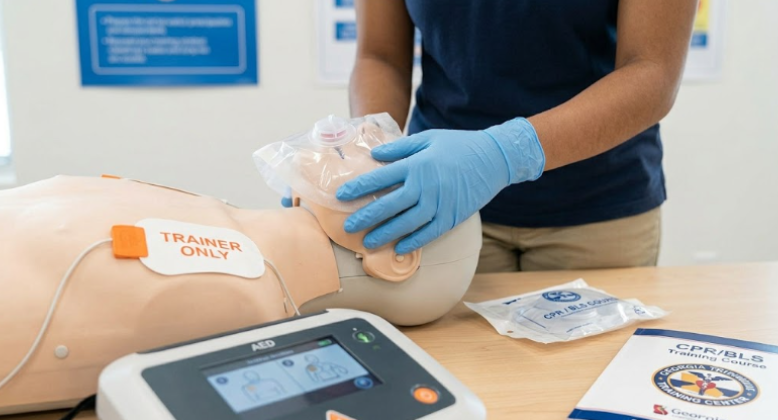
You’ll practice compressions and rescue breaths on the Annie CPR doll. Instructors will walk you through proper hand placement, compression rate (100–120 per minute), and how to check for responsiveness and breathing. You’ll also get to practice with an AED trainer, a non-electric dummy device that walks you through the real steps.
One thing students sometimes overlook: the CPR face shield. This is a small, disposable barrier device that goes over the patient’s mouth and nose during rescue breathing. It protects both the rescuer and the patient, and most certification courses include one in the course kit. It’s worth keeping one in your car, first aid kit, or workplace. They’re inexpensive, compact, and exactly the kind of thing you’ll wish you had if you ever need it.
If you’re worried about how long CPR training takes, don’t be: most classes take just 2 to 5 hours from start to finish. If you choose a blended learning format, you can even do the lectures online and drop in for a quick 30-minute skills check.
Georgia CPR Certification Requirements in 2026
The good news: the bar to enroll is low.
Most CPR and first aid classes in Georgia programs accept students aged 16 and up. Some courses allow younger participants with parental permission. There are no formal education prerequisites for basic or standard CPR certification in Georgia.
The main requirement is that you show up ready to participate physically. That means performing chest compressions during practice sessions, handling the AED trainer, and completing a skills assessment at the end of the course.
For BLS certification Georgia programs, the same general rules apply, but the skills test is more thorough, and you’ll need to demonstrate correct technique before receiving your card.
Important Warning: You will find dozens of websites offering “100% online CPR certification with no hands-on required” for low prices. Do not buy these. OSHA, corporate compliance departments, and Georgia state licensing boards (like the Georgia Board of Nursing or Bright from the Start for childcare) strictly reject 100% online cards. To be valid, your certification must include an in-person, hands-on skills verification component. Blended courses (online lecture + in-person test) are completely fine.
How Much Does CPR Certification Cost in Georgia?
Pricing depends on the certification level and provider, but here’s a general breakdown:
- Basic CPR and AED Certification typically runs between $50 and $100. This is your entry-level option for most non-clinical roles.
- CPR and First Aid Certification combined courses usually fall in the $75–$150 range, depending on course length and provider.
- BLS Certification Georgia programs, the healthcare-standard option, generally cost between $70 and $130. Renewal courses, for those recertifying before their two-year card expires, often come in on the lower end of that range.
It’s a small price for a skill that stays with you for life. Most certifications are valid for two years, after which you’ll need a renewal course to keep your credentials active.
Where to Get CPR Certified in Georgia
You have solid options across the state:
- American Heart Association Training Centers are the gold standard for healthcare employers. AHA-authorized centers offer CPR, BLS, ACLS, and PALS certification. If your employer or school program specifies AHA credentials, this is where to go.
- American Red Cross offers both in-person and blended learning formats throughout Georgia. Red Cross certifications are widely accepted for workplace and community requirements.
- Career and Healthcare Training Centers often run CPR and BLS courses specifically designed for students and working professionals who need flexible scheduling.
- Technical Colleges and Community Programs across Georgia also offer certification opportunities, sometimes at reduced cost for enrolled students.
Looking for a premier place to get certified? We highly recommend 1st Treasure Chara Centers, a top-tier Georgia School of Allied Health led by a Doctor of Nursing Practice (DNP) with 30 years of experience. Also, we offer easy career pathways into Phlebotomy, CNA, and CMA training if you want to expand your skills!
Ready to Get CPR Certified?
There’s a reason CPR training has been around since the 1960s; it works, and it saves lives every day. Whether you’re motivated by a job requirement, a school prerequisite, or the simple desire to be someone who can actually help in an emergency, the process is straightforward and the time investment is minimal.
Look into CPR certification in Georgia programs near you, confirm what certification level your employer requires, and get registered. Your future self, and maybe someone else’s future self, will thank you.
Frequently Asked Questions About CPR Certification Georgia
How much is CPR training in Georgia?
CPR certification in Georgia typically costs between $50 and $100 for a basic course. If you need BLS certification Georgia for healthcare roles, expect to pay $70–$130. CPR and First Aid combined courses usually run $75–$150, depending on the provider.
Is online CPR certification valid?
Online CPR certification can be valid, but many Georgia employers, especially in healthcare, require an in-person skills evaluation as part of the process. Always check with your employer before choosing a fully online course, since BLS certification Georgia programs almost always require hands-on testing to be accepted.
How long is CPR certification good for in Georgia?
CPR certification in Georgia is valid for two years from your completion date. After that, you’ll need to complete a CPR certification renewal course to keep your credentials active. Most employers track expiration dates closely, so don’t wait until the last minute.
What is the difference between CPR and BLS?
Standard CPR certification covers basic life-saving techniques for the general public and most workplaces. BLS certification in Georgia, or Basic Life Support, is a more advanced, healthcare-grade credential that includes team-based resuscitation, infant CPR, and higher-level skills testing. If you’re entering a clinical or medical role, BLS is almost always what your employer will require.
Latest Posts
August 13, 2024
Is the Role of a CNA the Same as That of a Nurse?
August 13, 2024
Phlebotomists: Vital Contributors to the Healthcare System

August 13, 2024