
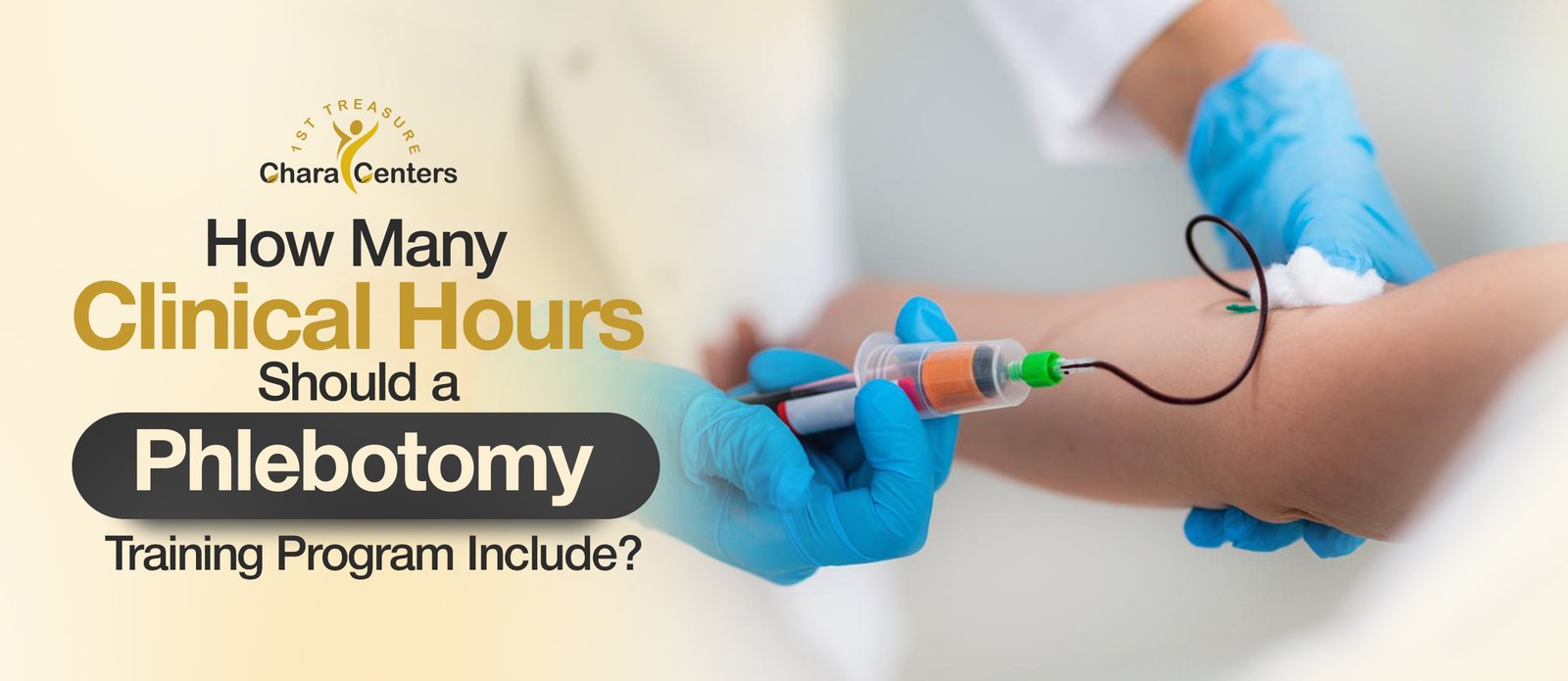
How Many Clinical Hours Should a Phlebotomy Training Program Include?
June 12, 2026
Let’s be completely honest: drawing blood on a static, plastic training arm inside a quiet classroom is easy. The arm doesn’t flinch, its veins never roll, and it doesn’t look up at you with wide, anxious eyes asking, “Would it hurt?”
The real transition into becoming a successful certified phlebotomy technician happens the moment you step out of the lecture hall and onto a live clinic floor. Suddenly, the angles matter, the patient’s hydration level matters, and your own physical confidence matters.
If you are researching how to get phlebotomy certification, your single most important consideration shouldn’t just be the total tuition cost or how short the course is. It should be the quality and volume of your hands-on clinical hours. Shortchanging your clinical training is the fastest way to fail your board exams and struggle in a fast-paced hospital or laboratory environment.
This guide breaks down the exact clinical hour benchmarks you need to look for, the specific “stick counts” required by national boards. Additionally, it explains how to spot a phlebotomy training program that sets you up for a high-paying healthcare career in Georgia.
The Golden Number: Classroom vs. Clinical Hours Breakdown
A comprehensive phlebotomy program is split into two distinct learning phases: classroom instruction and clinical (hands-on) hours.
While some states allow loose, unverified training paths, national accreditation bodies and top-tier employers look for a balanced structural framework. If you are looking at phlebotomy schools in GA, ensure their curriculum maps tightly to this standard 2026-hour matrix:
2026 Phlebotomy Training Program Hour Standards
| Training Tier | Classroom/ Lab Hours | Clinical Hours | Ideal For |
|---|---|---|---|
| Accelerated / Weekend Bootcamps | 16 – 40 Hours | 0 – 20 Hours (Often None) |
Basic refreshers; rarely accepted by major hospital networks. |
| National Benchmark Standard | 40 – 80 Hours | 40 – 120 Hours | Students seeking a national phlebotomy certification are accepted in any clinical setting. |
| Extended College/Vocational Programs | 120+ Hours | 120+ Hours | Semester-long formats; comprehensive but often unnecessarily prolonged for a single certification. |
What do you actually do during those hours?
Classroom hours give you the theoretical blueprint, covering things like cardiovascular anatomy, universal precautions, and waste disposal logic. But those hours are merely the foundation. The clinical externship hours are where you learn the actual rhythm of the job.
- In the classroom, you learn the “Order of Draw” (the exact sequence you must change blood tubes so chemical additives don’t mix and ruin lab results).
- In the clinic: You practice finding rolling veins, managing patients who are terrified of needles, and learning how to adjust a needle safely if a vein collapses.
The Stick Count Matters More Than the Clock
Here is an insider secret about the healthcare industry: an employer or board examiner doesn’t care if you spent 100 hours sitting in a breakroom at a clinic waiting for a patient to show up. They care about your verified unassisted venipunctures.
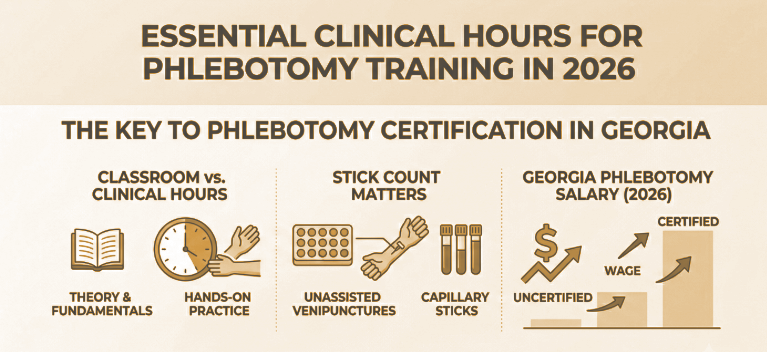
When evaluating options for a phlebotomy class nearby, look past the vague promises of “flexible hours” and ask the admissions team an explicit question: “How many live sticks am I guaranteed to perform?”
To qualify for an elite, recognized phlebotomy technician certification through major boards like the National Healthcareer Association (NHA) or American Medical Technologists (AMT), the standard clinical protocol requires:
- 30 Verified, Unassisted Venipunctures: Successfully finding, entering, and drawing blood from a vein on live human subjects.
- 10 Capillary Sticks: Correctly executing finger or heel punctures for smaller micro-collection samples.
If a program tells you that you can bypass live human sticks by practicing strictly on classmates or synthetic models, walk away. Major compliance groups and Georgia state licensing paths will not honor those credentials, and you will find yourself completely unprepared when facing a real patient.
Insider Tip: When shopping around for programs, explicitly ask admissions: “Does your tuition cover my live sticks, or do I have to find my own volunteers?” Top-tier programs handle the patient clinical placement for you; lower-quality ones ask you to find your own people to practice on.
Why You Can’t Shortchange the Clinical Externship
The clinical externship serves as your bridge from student to working professional. It forces you to master the high-stakes work responsibilities of a phlebotomist that a textbook cannot convey:
Mastering the Complex Order of Draw
It is less about sticking a needle in an arm and more about the chemistry inside the tubes. You must learn to instinctively execute the correct sequence of collection tubes, moving from your blood culture bottles down through light blue, red, gold, and lavender tops. Mistakenly switching the sequence can cross-contaminate additives, ruining the lab results and requiring a re-draw.
Managing Live Patient Complications Without Panic
What do you do when a patient’s vein collapses mid-draw? How do you react if a patient experiences syncopal episodes (fainting) or develops a sudden hematoma right under your needle? Your clinical hours teach you how to maintain your composure, protect the patient, and safely abort or adjust a draw without breaking protocol.
Conquering the National Exam
Before you can land a job, you must pass a rigorous assessment. If you haven’t logged real hours on a clinic floor, handling a comprehensive phlebotomy exam practice test becomes infinitely harder because you lack the situational context required to answer complex, scenario-based board questions.
Evaluating Phlebotomy Training Specialists Near You
As a premier Georgia School of Allied Health, 1st Treasure Chara Centers eliminates boring, dry lecture formats. The program is led by a Doctor of Nursing Practice (DNP) with 30 years of deep clinical and leadership experience. Instead of just checking off boxes on a sheet, students train on high-fidelity, hands-on simulations to build true clinical confidence and procedural mastery.
Furthermore, the school’s professional, practical approach, along with community outreach, means your clinical preparation translates into real career pathways. If you want to expand your utility and earning potential in healthcare, we offer integrated tracks into CNA and CMA training.
What is the Average Phlebotomy Salary in GA?
Investing your time in rigorous clinical hours pays off directly when you enter the job market. According to updated 2026 regional employment indexes, the average phlebotomy salary in GA scales significantly based on your level of hands-on preparation and board certifications:
- Entry-Level (Uncertified / Limited Hours): $34,000 – $38,000 / year. Typically restricted to small local clinics or repetitive blood donation drives.
- Certified Phlebotomy Technician (National Credentials + Full Clinical Hours): $40,000 – $46,000+ / year, while some institutes are willing to pay higher. These professionals secure premium roles within major hospital networks, high-end oncology centers, and mobile corporate wellness programs.
The math is simple: the more thorough your verified clinical hours are, the more valuable you are to a hiring manager on day one.
Why do employers pay more for certified hours?
Hospitals like Emory and Wellstar don’t have the time to hand-hold new hires. If your program includes a verified clinical externship, you enter the job market as a “plug-and-play” technician. That clinical confidence is exactly why certified technicians can command $5,000 to $10,000 more per year right out of the gate compared to uncertified applicants.
Also Read: Ways to Reduce Phlebotomy Training Costs Without Sacrificing Quality
Ready to Take the First Step?
There is a massive demand across Georgia for highly skilled, confident phlebotomists who know how to handle difficult draws with poise and professionalism. The process isn’t intimidating when you have the right mentorship and tools. You need a structured environment backing every single stick. Take a look at the upcoming schedules at the 1st Treasure Chara Centers right now. Verify your availability for clinical rotations and secure your spot in our Phlebotomy training program today.
FAQs
How do I get a phlebotomy certification in Georgia?
To earn your phlebotomy certification, you must complete a training program that combines classroom lectures with hands-on clinical sticks. It is a strict balance. After that, you must pass a national board exam. At 1st Treasure Chara Centers, our curriculum is engineered to walk you seamlessly through this entire pipeline. We take you from day-one basics all the way to your final clinical verification.
What is the average phlebotomy salary in GA?
In Georgia, the average phlebotomy salary in GA ranges between $40,000 and $46,000+ per year for a fully certified phlebotomy technician. Hard work pays off. Uncertified or under-trained individuals usually start much lower, with pay scales often capped right around $34,000.
Are 100% online phlebotomy certification programs valid?
No. Major Georgia employers, hospital systems, and national certification registries strictly reject cards from “100% online” diploma mills. Phlebotomy is a physical, invasive medical procedure; to be valid, your training must feature an in-person, hands-on clinical skills verification component.
How do I prepare for the national phlebotomy exam?
The best preparation is a mix of clinical experience and structured study. Your program should provide a comprehensive phlebotomy exam practice test framework to get you familiar with board questions. Because 1st Treasure Chara Centers is led by a Doctor of Nursing Practice, our students train under real-world clinical testing standards, making the board exam a natural final step rather than a hurdle.
How long does it take to become a phlebotomy technician?
A dedicated program with phlebotomy training specialists typically takes between 4 to 8 weeks. This gives you the ideal window to absorb core concepts, complete your required clinical hours, and enter the local healthcare workforce quickly.
How do I choose the best phlebotomy schools near me?
Look past the tuition cost and focus on three strict criteria:
- Is the program led by credentialed, experienced clinical professionals?
- Do they guarantee and manage your live-stick clinical placements for you?
- Do they offer clear, multi-tier healthcare career pathways (like CNA or CMA) so you can stack other credentials over time?
Latest Posts
August 13, 2024
Is the Role of a CNA the Same as That of a Nurse?
August 13, 2024
Phlebotomists: Vital Contributors to the Healthcare System

August 13, 2024