

How to Get CPR Certification in Georgia: Step-by-Step Enrollment Guide
June 18, 2026
For many students in Georgia, CPR certification is not a primary goal. It usually starts with a small moment. A nursing program sends an acceptance email and lists certification under the required documents.
A healthcare employer mentions it during an interview. A medication aide applicant reaches the enrollment page and realizes that another requirement is due between today and the first day of training. Then the questions begin. Which CPR classes count? Does online training work? Is BLS different from CPR? How long does certification last?
Most students do not struggle because the process feels difficult. They struggle because no one explains the order. Once someone understands what to take, where to enroll, and what employers actually expect, the process becomes much easier. This guide follows that path.
Why CPR Certification in Georgia Becomes an Early Step in Healthcare Careers
Healthcare careers in Georgia rarely begin with patient care. They begin with preparation. Before a student enters a clinical setting, schools and employers want proof that basic emergency skills are already in place.
That requirement shows up across many paths:
- Nursing students preparing for clinical rotations
- Medical assistant students
- Medication aide candidates
- Certified nursing assistant applicants
- EMT students
- Caregivers and patient support workers
- Childcare professionals
- Healthcare job seekers
A student applying for healthcare roles may think CPR training in Georgia simply checks a requirement. Most realize something different once training begins.
CPR classes teach decision-making under pressure, communication, and practical response skills. Those experiences matter long before someone starts working. That explains why employers often ask for certification early.
Step 1: Understand Which CPR Classes Match Your Goal
One of the most common mistakes is searching blindly for “CPR classes Georgia,” picking the first cheap option, and later discovering your employer or school won’t accept it.
To save time and money, you must understand the different certification levels. For example, standard CPR is vastly different from BLS certification Georgia courses.
| Certification Type | Common Goal | Training Focus |
|---|---|---|
| Basic CPR / AED | Workplace readiness, fitness trainers, and the general public | Adult CPR fundamentals & AED training |
| BLS Certification (Basic Life Support) | CPR classes for healthcare workers, nursing students, and EMS | High-quality CPR, AED, team dynamics, choking relief |
| Pediatric CPR | Childcare professionals, teachers, nannies | Infant and child emergency response |
Pro-Tip: If you are entering the medical field, standard CPR will rarely cut it. You will almost certainly need BLS classes approved by major providers like the American Heart Association (AHA) or the American Red Cross.
Before hitting the submit button on an enrollment page, ask yourself these four questions:
- What specific certification provider does my school or employer require?
- Does the training include a hands-on, practical skills session?
- Will a 100% online CPR certification qualify, or do I need a hybrid/in-person option?
- When does my certification expire? (Typically, it is a two-year cycle before you need a CPR card renewal.
Don’t waste time or money on a class your employer won’t accept. 1st Treasure Chara Centers offers fully accredited, healthcare-compliant AHA and Red Cross BLS and CPR training designed to fulfill your school or workplace requirements.
Step 2: Choose Your Training Format (Online vs. In-Person)
Many students ask: “Can I just get CPR certified online?” The answer depends heavily on your CPR certification requirements and Georgia guidelines. While 100% online courses exist, most healthcare employers and clinical programs in Georgia do not accept them because they lack a hands-on skills assessment. Instead, consider these three formats:
- In-Person CPR Training Georgia: Best for hands-on learners. You attend a local class, practice on manikins, and get immediate instructor feedback.
- Blended / Hybrid Learning: The perfect middle ground. You complete the cognitive, lecture portion online at your own pace, then attend a brief, in-person session for your practical skills check.
- 100% Online: Convenient, but usually restricted to non-healthcare professionals (like corporate office workers or general workplace safety compliance).
Step 3: Register Early and Prepare for Class
Once you know the exact course you need, the registration process takes less than 30 minutes. However, navigating your CPR training in Georgia with intention ensures a smooth experience.
The Registration & Preparation Checklist:
- Verify the Provider: Ensure the class is AHA or Red Cross approved if required by your program. You can review guidelines directly on the official American Red Cross CPR Training platform to cross-reference your program’s specific compliance standards.
- Factor in the Certification Cost (CPR): Prices generally range from $50 to $110, depending on the level (Basic vs. BLS) and whether it includes first aid.
- Dress Appropriately: Wear comfortable clothing. You will be on your knees practicing chest compressions on manikins.
- Bring ID: Have a valid photo ID ready for the instructor to verify your certification records.
Step 4: Attend Training and Focus on Practical Mastery
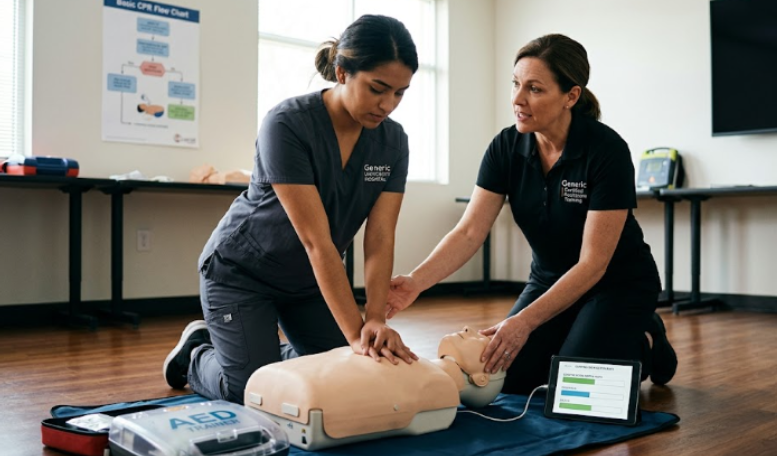
Don’t expect a dry, boring lecture. Modern CPR and BLS classes are interactive, fast-paced, and highly practical. Your time in class will focus heavily on:
- High-quality chest compressions and rescue breathing
- AED training (learning how to operate an automated external defibrillator safely)
- Team-based resuscitation scenarios
- Choking relief for adults, children, and infants
The best students aren’t the ones who memorize facts the fastest; they are the ones who ask questions and crave instructor feedback during the physical practice. Making minor adjustments to your hand placement or compression depth during training is what builds true lifesaving confidence.
Step 5: Claim Your Certification and Track Your Renewal
Upon successful completion of your course and skills test, you will receive your official certification card (usually a digital eCard sent via email within 24 hours). Georgia healthcare employers will want a copy of this document immediately upon hire.
These simple steps will save you:
- Save a PDF copy to your smartphone.
- Back up the file in a cloud storage folder (Google Drive, iCloud, etc.).
- Print a physical copy for your career portfolio.
- Set a reminder for 22 months from your course date so you can schedule your CPR certification renewal before your current card expires.
Choosing a Provider That Supports Long-Term Healthcare Goals
CPR training often becomes the first training experience in healthcare. That experience shapes confidence moving forward. Students should look for providers that support:
Before enrolling, students should look for providers that offer:
- Flexible scheduling
- Simple enrollment
- Healthcare-focused instruction
- Renewal support
- Clear communication
Students searching for CPR certification in Georgia should think beyond getting a card. The better goal is finding training that supports the next step, too.
That is why many students in Georgia choose the 1st Treasure Chara Centers. Instead of treating certification like a quick transaction, they focus on helping students understand the process, enroll with confidence, and prepare for future healthcare opportunities.
Final Thoughts
Most students begin this process feeling uncertain. They finally realize CPR certification was never the difficult part. Understanding requirements, choosing the right course, and enrolling with intention changes the experience completely.
For students preparing for healthcare careers in Georgia, CPR certification becomes the first real professional step, and choosing the right place to start can make the next steps feel much easier.
Ready to complete your requirement and kickstart your healthcare career? We at 1st Treasure Chara Centers make enrollment stress-free with flexible schedules and expert, hands-on instructions.
FAQs
How to get CPR certification in Georgia?
You can get CPR certification by taking a CPR course from an approved training center and passing the practical skills test.
Most courses can be completed in one day and provide a certificate after successful completion.
Can I look up my AHA CPR card?
Yes, you can find your AHA CPR card online through the American Heart Association’s eCards system.
Just enter your information to view, download, or print your card.
How long does CPR certification last in Georgia?
CPR certification in Georgia is usually valid for 2 years.
After it expires, you need to take a renewal course to stay certified.
Is BLS the same as CPR?
No, BLS (Basic Life Support) is not exactly the same as CPR.
BLS includes CPR skills plus additional emergency care techniques used by healthcare professionals.
Latest Posts
August 13, 2024
Is the Role of a CNA the Same as That of a Nurse?
August 13, 2024
Phlebotomists: Vital Contributors to the Healthcare System

August 13, 2024