Online vs In-Person Healthcare Training: What’s Best for Your Future?
April 29, 2026
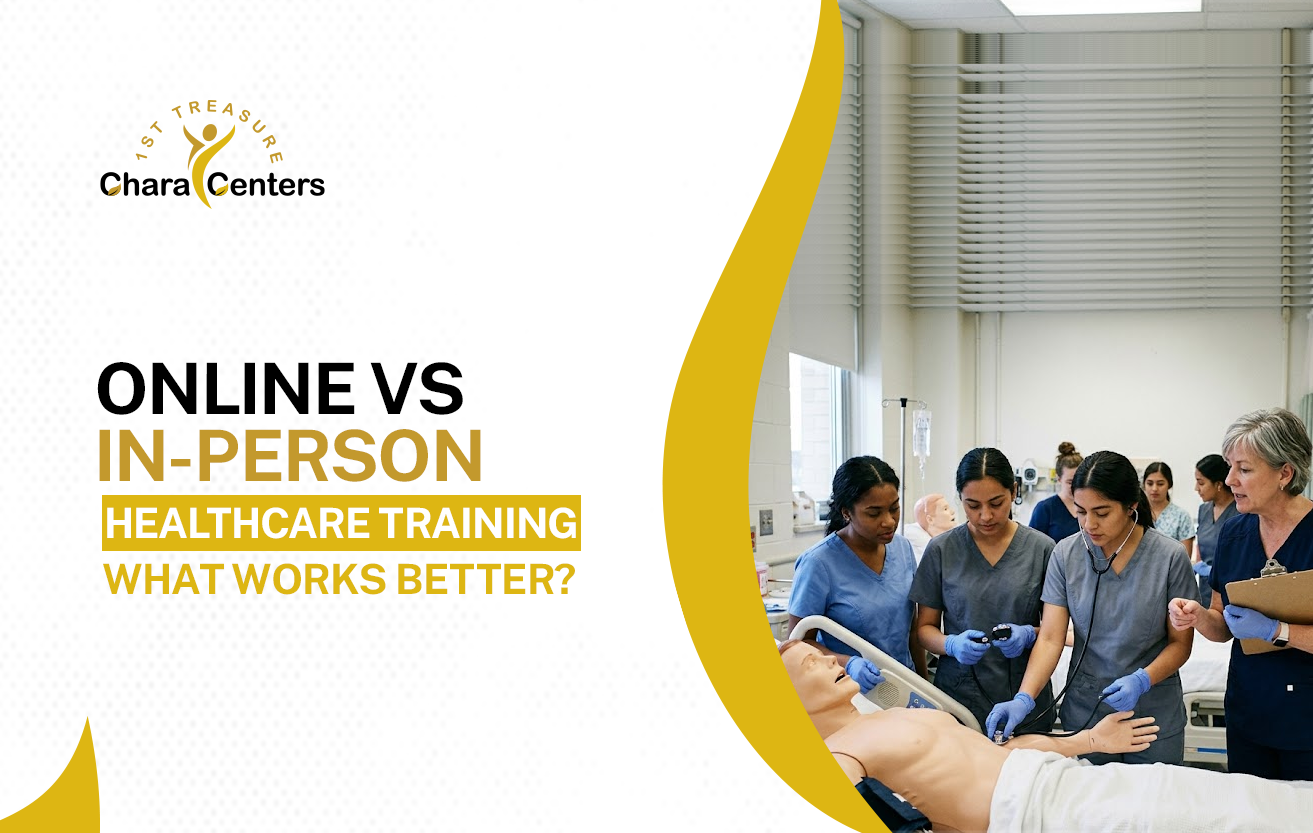
Most students compare online vs in-person healthcare training based on flexibility, affordability, and convenience. It sounds logical to choose the easiest path. But in a clinical setting, “easy” training can lead to “difficult” employment.
Many training programs look attractive up front. They promise quick results, low costs, and easy enrollment. But later, students discover weak practical training, limited employer recognition, or poor job outcomes. That is where costly mistakes happen.
In this guide, we break down the real difference between online and in-person healthcare training, which option works best for different career goals, and how to choose a program that prepares you for real healthcare jobs, not just course completion.
Online vs In-Person Healthcare Training: Which Path Secures Your Future?
In the medical studies, knowing isn’t the same as doing. If your goal is a license renewal or a theoretical foundation, online training offers the flexibility you need. However, if you are pursuing high-stakes clinical roles, then in-person healthcare training is preferable.
To help you decide, we’ve broken down the factors on both sides so you can choose the right one for you.
Key Insights!
Demand for both training formats is growing, and each has value depending on your career path. Recent research shows that 84% of employers now accept online education. However, many healthcare roles still place strong value on practical experience. Around 67% of healthcare employers prefer candidates from programs that include in-person clinical training.
That means choosing the right learning format is less about trends and more about understanding the job you want.
If your goal is an administrative, support, billing, scheduling, or remote healthcare role, online training can be a practical and flexible option. But if you are preparing for hands-on patient care, clinical assistance, or in-facility responsibilities, in-person training is often the smarter path.
What Employers Actually Care About (Most Students Ignore This)
In the medical field, managers rarely care about your GPA. On the interview floor, they are looking for one thing: Clinical Competence. They aren’t just checking your diploma; they are vetting your ability to keep a patient alive and a clinic running smoothly.
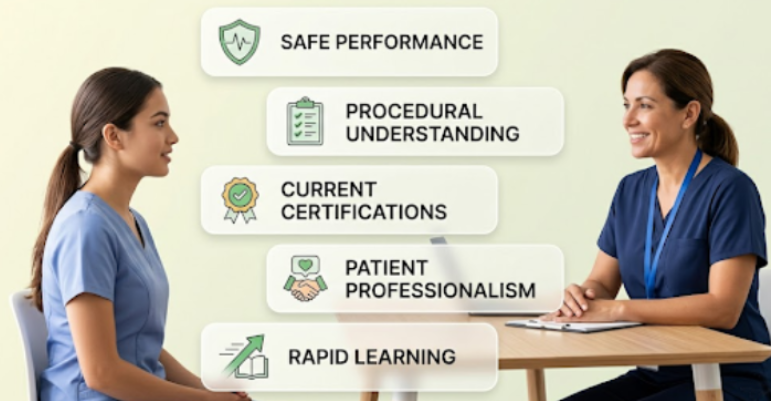
When you walk into a hospital or care center, the hiring manager is silently asking five questions:
- Can you perform safely?
- Do you understand procedures?
- Are your certifications current?
- Can you work with patients professionally?
- Can you learn quickly on the job?
These five questions drive every hiring decision in healthcare today. This is why quality training matters more than whether you studied on a laptop or in a lab. However, for entry-level healthcare careers, a certificate from a program that offers real-world simulation always beats a “discount” digital-only course.
That is also why it is smarter to choose the right healthcare training center rather than focus only on the learning format. The program behind your certification can shape your confidence, employability, and entire career launch.
When Online Healthcare Training Is the Better Choice
While hands-on practice is vital for clinical roles, forcing yourself into a classroom for theoretical knowledge can actually slow you down. Online training isn’t just a “backup” option; for specific career paths, it is the most efficient way to maintain the importance of continuing education.
Here is why thousands of professionals are choosing the online courses over in-person health care training:
Flexibility for Working Professionals
Life in the USA doesn’t pause for a classroom bell. Online training allows you to fit your studies between 12-hour shifts or around family commitments. It’s the ultimate tool for those looking to pivot into medical field jobs without losing their current income.
Rapid-Response Upskilling
When you need to renew a license or add a specialized skill, you don’t want to wait for a semester to start. Continuing education courses delivered online allow for “Just-in-Time” learning.
Learn “Theory of Safety”
Before you can prevent common medication errors in a lab, you must understand the pharmacology and math behind them. Online modules provide a distraction-free environment to replay complex lectures until the theory is second nature.
Eliminating the “Hidden Costs” of Learning
When you choose the right healthcare training center, you have to look at the total investment. Online learning removes the “invisible” expenses:
- Zero Commute: Save $50–$150/month on gas and parking.
- Digital Materials: No $200 heavy textbooks; everything is a click away.
- Time-Equity: Reclaim the 5–10 hours a week usually spent traveling.
When In-Person Healthcare Training is an Ideal Option
Medical certification is not just a piece of paper or a degree. In this training, you learn theories as well as how to perform the work properly in real situations. These are clinical skills that you have to use with patients regularly. You need practice, confidence, patience, and the right guidance to perform them correctly every day.
So if you are planning your career in healthcare for in-house services, clinics, hospitals, or patient care roles, then it is better to choose in-person training. It helps you learn practical work faster, build confidence, understand real workplace standards, and prepare for direct patient responsibilities.
Here are some other reasons as well why in-person healthcare training can be a better option.
You Need Hands-On Skill Confidence
Clinical tasks, patient interaction, and medical simulations require physical practice. Reading about a procedure is not the same as performing it correctly six times in a row. In-person training builds that muscle memory fast.
Instructor Feedback in Real Time
In an online video, you can’t ask, “Is my hand positioning right?” In-person instructors catch small mistakes before they become dangerous habits. This immediate feedback loop is why graduates of physical programs often command higher respect in medical field jobs.
Professional Accountability and Peer Momentum
Let’s be honest: Life is distracting. A scheduled class at a physical center keeps you showing up and staying sharp. Surrounding yourself with peers who share your goals creates a “Professional Character” that you simply cannot build alone in a room with a laptop.
Stronger Job Confidence
There is a massive difference between “studying” and “practicing.” Students who train in person walk into their first entry-level healthcare careers with a sense of calm. You’ve already touched the equipment; you’ve already interacted with “patients” in simulations. That confidence is exactly what hiring managers are looking for during clinical trials.
We don’t just teach the curriculum; we simulate the environment. When you choose the right healthcare training center, you are choosing to walk into your first shift with the confidence of a veteran, not the nerves of a student.
Online vs In-Person Healthcare Training: Which Training Path Fits Your Career Goal?
The healthcare field offers a massive variety of courses, making it difficult to decide between online and in-person learning. To simplify your choice, we’ve broken down the most common career paths below to help you determine which training environment is ideal for your goals.
Online Training Mistakes That Delay Careers
Before you click “enroll” on an online healthcare course, verify these four essentials. If a program fails even one of these, it will likely delay your first paycheck.
- Affordable but Unrecognized Programs: A $49 course that no employer recognizes is not a deal. It is a delay. Accreditation and employer recognition separate valuable training from wasted time.
- No Hands-On Practice Plan: Online training without any physical skills component leaves dangerous gaps in clinical roles. Plan for simulation labs or hybrid sessions when your role requires patient contact.
- Poor Time Management: Online learning gives you freedom. Freedom without a plan becomes procrastination. Set weekly goals, block study time, and treat your training like a job with deadlines.
- Ignoring Career Placement Support: The best programs offer career guidance, resume review, and job placement connections. Many students skip this support and wonder why finding work takes longer than expected.
In-Person Training Mistakes Students Make
In-person training is more demanding than clicking through a website. If you ignore the logistics, your hard work will go to waste. Avoid these “red flags” to ensure your effort leads to a high-paying role in the medical field.
- Commit to a Realistic Commute: A two-hour round trip burns energy before class even starts. Proximity to your training center affects attendance, energy, and consistency more than most students admit upfront.
- Paying More for Weak Outcomes: High tuition does not guarantee strong outcomes. Research graduate employment rates, employer partnerships, and certification pass rates before writing a check.
- Ignoring Schedule Fit: A program that runs at the wrong time is a program you will struggle to finish. Confirm that class schedules match your actual life before you enroll.
- Classroom Facilities: Not every in-person program delivers exceptional instruction. Visit the facility, meet the instructors, and review the curriculum before committing your time and money.
Success in healthcare requires more than a certificate; it requires employer trust. At 1st Treasure Character Centers, our authorized training connects you to top hospitals. Enroll today and start the march toward your successful medical career.
Real-World Example: Prevent Common Medication Errors Through Better Training
Many healthcare mistakes come from specific, preventable gaps.
Dosage confusion. Label misreading. Documentation gaps. Communication failures. These are not random accidents. They are patterns that better training eliminates.
Strong training programs reduce common medication errors by teaching repetition, accuracy systems, and patient safety habits from day one. Students practice until correct procedures become automatic responses, not conscious calculations.
How to Choose the Right Healthcare Training Center
Use this checklist before you commit to any program.
Must-Haves:
- Industry-relevant curriculum that reflects current healthcare standards
- Experienced instructors with real clinical or administrative backgrounds
- Certification preparation with strong pass rates
- Career guidance and job placement support
- Flexible scheduling that fits your actual life
- Positive outcomes from graduates already working in the field
- Support after enrollment, not just during it
How to choose the right healthcare training center starts with outcomes, not promises. Ask every program: Where are your graduates working? How many passed their certifications on the first attempt?
What Students in the USA Are Choosing in 2026
The healthcare industry moves fast, and by 2026, education has shifted to keep pace. Students across the USA now skip the “scenic route” and move toward smarter, faster training options.
- Hybrid models dominate: Enrollment thrives on the mix of digital theory and physical labs.
- Speed matters: Short, career-focused certifications attract adults who need to earn while they learn.
- Life-first schedules: Weekend and evening slots fill fast because life doesn’t pause for a classroom bell.
- Rapid entry: Workforce programs appeal to career changers who want results without a multi-year debt trap.
Which Learning Environment Guarantees Your Hire?
In healthcare, your training format dictates your day-one competence. A mismatch between your learning style and your career goal leads to “Certification Limbo”. Where you have the paper but lack the skill. Use this matrix to identify the high-ROI path for your specific life situation.
The Final Verdict: Experience Over Environment
Online training wins on flexibility, while in-person labs win on clinical confidence. However, online vs in-person healthcare training is not the only factor to look for. In the 2026 medical market, a certificate proves you finished a course, but your performance on the floor proves you deserve the paycheck.
You need a program that delivers both the legal credential and the clinical authority to handle a full workload on day one. At 1st Treasure Character Centers, we don’t just provide a curriculum; we provide a career launchpad. Join our community, climb the professional ladder, and secure your place in the nation’s top hospitals.
FAQs
Is online healthcare training respected by employers?
Yes. Employers respect online training when the program holds accreditation and builds real, testable skills. Certification quality and recognized credentials matter far more than the delivery format on your resume.
Is in-person healthcare training better?
In-person training is better for hands-on clinical roles and for students who need structure, accountability, and real-time instructor feedback. It builds physical skill confidence that online-only programs cannot fully replicate.
Can I get healthcare jobs with online training?
Yes. Thousands of healthcare professionals in the USA launch careers through online training every year. The role matters. Administrative, entry-level, and continuing education pathways work extremely well in an online format.
What healthcare jobs can I start quickly?
Many medical field jobs offer fast-entry pathways through short certifications. Caregiver roles, medical administrative positions, and entry-level clinical support roles often require only weeks of focused training before employment eligibility.
Which is cheaper: online or classroom healthcare training?
Online training typically costs less when you factor in tuition, travel, parking, and time away from work. The real measure of value is not the upfront cost. It is the speed to employment and the salary that follows your certification.
Latest Posts
August 13, 2024
Is the Role of a CNA the Same as That of a Nurse?
August 13, 2024
Phlebotomists: Vital Contributors to the Healthcare System

August 13, 2024