
Why Some Students Fail CNA Certification Course? And How to Avoid It?
April 28, 2026
A certified nursing assistant certificate is one of the fastest ways to enter the healthcare field. Every year, thousands of students enroll in CNA training programs to become certified nursing assistants and start a stable, meaningful career.
But the reality is that not everyone passes the exam on the first try. According to CNA exam data based on the NNAAP framework used by state nursing boards, the first-attempt pass rate generally falls somewhere between 70% and 85%, depending on the state and testing body. That means a noticeable number of students struggle to clear their certified nursing assistant certificate requirements on the first attempt.
And it’s not because the exam is impossible. It’s because many students prepare in ways that don’t fully match what the test actually demands.
Start By Understanding the CNA Exam Structure
After completing the CNA certification course, many students expect the test to be a simple recall. This is also where many students start questioning the worth of CNA, especially when they realize the exam focuses more on application than memorization.
The certified nursing assistant exam is divided into two main parts:
Written or Oral Exam
This part checks your understanding of real care situations, including:
- Infection control
- Patient safety
- Patient rights
- Basic nursing skills
- Communication and documentation
Even after CNA programs, students often find this section tricky because questions are based on situations, not just facts.
Skills Exam
This is the hands-on section where you perform caregiving tasks, such as:
- Hand hygiene
- Measuring vital signs
- Assisting with movement
- Basic personal care
Strong CNA exam preparation matters here because it’s not only about knowing the steps, but doing them correctly under observation.
To make sense of both parts, look at the responsibilities of a CNA in clinical situations, because the exam is really built around those daily tasks.
Top Reasons Students Fail the CNA Exam
Below are the real, practical reasons students fail, based on what actually happens during testing.
Lack of hands-on practice
One of the biggest gaps is repetition. Many students practice a skill during training, feel comfortable, and assume they’ve “got it.” But CNA skills are muscle-memory-based. That means they need repetition until steps become automatic.
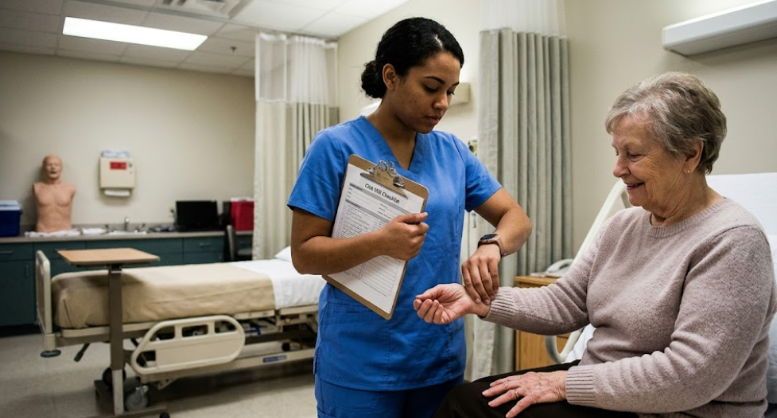
For example, a student may know how to take a pulse. But in the exam, they pause between counting because they are mentally tracking instead of physically flowing through the process. That delay often leads to lost accuracy or incomplete timing.
Memorizing instead of understanding
A lot of students learn skills like checklists. That works in early learning, but CNA tasks are not isolated steps. They are connected to patient safety and comfort.
For instance, in CNA exam preparation, a student may memorize handwashing, introduction, and procedure steps in order. But if they forget one line under stress, they get stuck and stop completely instead of continuing naturally.
Students who understand why each step exists (infection control, dignity, safety) are able to adjust without freezing when something feels off.
Ignoring the Exam Format
Many students underestimate how strict the skills evaluation is. Examiners are not just checking if the task is completed. They are checking how safely and correctly it is done throughout the entire process.
Missing any one step can affect safety scoring even if the rest of the task is correct. Even skipping hand hygiene at the right time can lead to automatic point loss.
Test Anxiety and Panic
A major reason for failure is how pressure affects execution. Students often perform perfectly in practice, then struggle during the exam because someone is silently observing every move.
A common pattern looks like this:
- Students start correctly
- Then begin rushing slightly
- Then skip the verbal communication steps
- Then, forget a safety check they normally never miss
This is not a knowledge issue. It’s a stress response that affects coordination and memory at the same time.
Poor Time Management
Time issues usually show up in two ways:
- Over-Cautious Students: Students move too slowly because they are double-checking every step. They run out of time even though they know everything.
- Over-Rushed Students: Students speed through tasks due to anxiety and miss small but important steps.
Both lead to loss of marks because the CNA exam values both accuracy and sequence, not speed alone.
How to Avoid These Mistakes in the CNA Exam
Most students don’t fail because they don’t understand the material from CNA training, CNA programs, or a CNA certification course. The real issue is how they practice for the exam.
Here’s what actually helps:
- Repeat Skills: Don’t practice once and move on. Do tasks like hand hygiene, vital signs, and patient movement again and again until they feel automatic.
- Focus on Understanding: Learn why each step is important, not just the order. This helps you stay on track even if you forget something during the exam.
- Practice Under Real Exam Conditions: Use a timer, don’t restart, and complete tasks in one go during your CNA exam prep.
- Stay Calm and Controlled During Tasks: Slow, steady steps reduce mistakes more than rushing through the procedure.
- Do Mock Sessions: Practice multiple skills together in sequence to get used to the real exam flow and pressure.
In short, the more your practice feels like the real exam, the easier it becomes to perform confidently.
A Smarter Way To Prepare For Your CNA Exam
Most students who go through a CNA training program work hard, but still feel unsure before the certified nursing assistant certificate exam. The issue is usually not effort. But how do they prepare for the CNA exam?
A better way is to keep things simple. Focus on key CNA skills like hand hygiene, vital signs, and basic patient care, and repeat them until they feel natural. This helps you move without overthinking during the certified nursing assistant exam.
It also helps to practice like the real test. Use a timer, complete skills in one go, and avoid stopping. This kind of hands-on CNA practice builds real confidence and reduces pressure on exam day.
At 1st Treasure Charter Centers, our CNA training focuses on this approach: simple repetition, hands-on practice, and clear guidance. So students feel ready for the CNA certification exam.
Ready to Pass with Confidence?
Failing a CNA exam can feel discouraging, but it usually points to something very specific. Actually, a gap in preparation, not a lack of ability. Once you understand what went wrong, and more importantly, how to fix it, you’re already much closer to passing than you think.
If you’re serious about becoming a CNA, don’t rely on trial and error. Choose a path that guides, supports, and trains you for career success. Join a CNA training program that focuses on how you perform, not just what you memorize, and give yourself the confidence to pass your CNA exam the first time.
FAQs
What do CNAs do?
The daily duties of CNAs (Certified Nursing Assistants) include basic patient care. Bathing, feeding, taking vital signs, and assisting patients with safe movement in hospitals and care facilities.
How long does CNA certification take?
Most CNA training programs take 4–12 weeks, depending on the school and schedule, including classroom and clinical practice.
Do you need experience for a CNA certification course?
No experience is required. Most CNA programs are beginner-friendly and only need basic education requirements.
What is included in the CNA exam?
The CNA exam includes a written/oral test and a skills test covering patient care, safety, infection control, communication, and vital signs.
How to become a CNA in Georgia?
To become a CNA in Georgia, you must complete a state-approved CNA Certification Course, pass the NNAAP exam, and register with the state nurse aide registry.
Latest Posts

August 13, 2024
Is the Role of a CNA the Same as That of a Nurse?

August 13, 2024
Phlebotomists: Vital Contributors to the Healthcare System

August 13, 2024