

Teamwork in Healthcare: How Real Care Teams Work Together in Hospitals and Clinics
May 5, 2026
Most people think healthcare is centered around doctors. It sounds simple when you hear it, but the reality inside hospitals and clinics looks very different. A single patient might be seen by a doctor, cared for by a nurse, supported by a CNA, assisted by a medical assistant, and tested by a phlebotomist, all in the same visit.
It sounds organized, but in reality, it only works when everyone communicates and works as one unit. That is what teamwork in healthcare actually means.
If you’re planning a career in the healthcare field, understanding how these teams function is just as important as learning clinical skills. Because every role, no matter how big or small, connects to patient care in a very real way.
Why Is Teamwork Important in Healthcare?
Teamwork in healthcare is directly connected to patient safety. According to the Agency for Healthcare Research and Quality, communication breakdowns are a major contributor to patient safety events, especially during handoffs and transitions of care between providers.
When communication between medical staff breaks down, important details about a patient can be easily missed. Without complete information, it becomes hard for CNAs or nurses to give care that actually fits the patient’s needs. Sometimes, these small gaps can turn into serious risks that can put a patient’s life in danger.
But when teams work well together, everything changes:
- Patients get treated faster
- Mistakes get caught early before they cause harm
- Staff communicate clearly without confusion
- Daily work becomes more organized and less stressful
- Patients feel safer and more cared for
Healthcare is all about working together. Doctors, nurses, CNAs, or other medical staff rely on each other. When communication between roles is strong, patients get better care and treatment.
What Makes Effective Teamwork in Healthcare?
Below are the main effective qualities of good teamwork in healthcare.
1. Clear Communication Between Healthcare Professionals
Most mistakes in healthcare don’t come from a lack of skill. They come from information that never got passed on. Research consistently shows that nearly 80% of medical errors are linked to miscommunication between healthcare professionals, highlighting how critical effective teamwork is in patient safety and care outcomes.
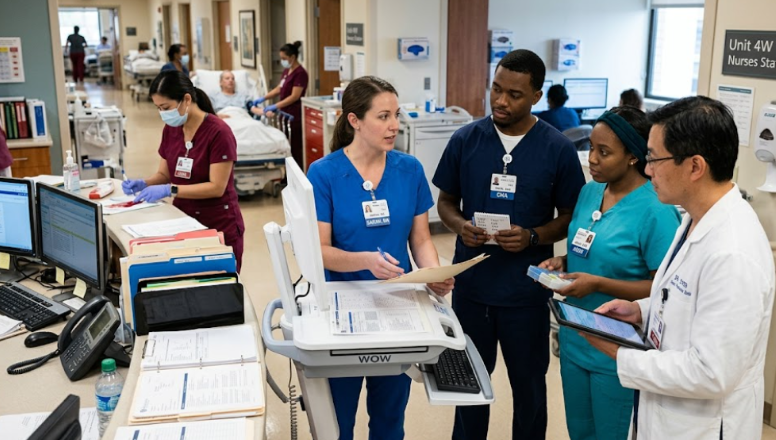
For example, if a nurse forgets to mention that a patient’s blood pressure dropped before her shift ended. This lack of communication can confuse and even delay the right treatment, putting the patient at risk. That’s why strong healthcare teams always stay in touch with each other.
2. Well-Defined Roles and Responsibilities
When roles are clear, everything runs more smoothly. The CNA handles patient care, the CMA manages medications, and the nurse coordinates. Nobody is guessing, nobody is doubling up, and nothing falls through the gaps.
The moment roles get blurry, the whole team starts working harder just to stay in place. Tasks get missed not because people are careless, but because everyone assumes someone else has it covered.
3. Mutual Respect and Trust in the Team
A CNA who has spent six straight hours with a patient knows information that nobody else on that floor knows. Even a small detail that doesn’t show up on a chart yet.
When that CNA says something feels off, the best teams listen. They don’t filter information based on job title. They know that the most important update of the shift can come from anyone.
Respect in healthcare isn’t just about being polite. It’s about making sure the right information actually reaches the right people.
4. Strong Leadership and Coordination
Good leadership in healthcare isn’t about authority. It’s about keeping the team functional when situations get stressful.
A charge nurse who stays calm during a difficult shift, communicates clearly, and makes quick decisions without panicking, that steadiness spreads to everyone around her. The team moves better. People think more clearly. Patients get better care. One grounded leader can hold an entire shift together on a hard day.
5. Continuous Learning and Adaptability
Healthcare doesn’t follow a script. Every patient and emergency can be different. That’s why healthcare teams must keep learning and adjust their approach according to the situation so that they can give the best possible care.
Honestly, the ability to be flexible without falling apart is one of the most underrated things a healthcare team can have.
The Healthcare Roles That Make Teamwork Possible
These are the following medical roles:
Certified Nursing Assistants (CNAs)
CNAs spend more time with patients than almost anyone else on the team. The daily duties of a certified nursing assistant include assisting with patients’ care tasks such as bathing, feeding, and monitoring vital signs. But more than that, they are usually the first to notice when something changes with a patient.
A patient who seems more confused than usual. These are the details CNAs catch and report to the nurse, who then acts on them.
Certified Medication Aides (CMAs)
Medication errors are one of the leading causes of patient harm in U.S. healthcare. CMAs exist to help prevent that.
They give prescribed medications, watch for reactions, keep accurate records, and support the nursing team. A CMA who spots a dosage issue and immediately tells the supervising nurse is doing exactly what good teamwork looks like.
CMA training builds on CNA certification and prepares you for one of the most responsibility-heavy support roles in patient care.
Phlebotomy Technicians
Every lab result a doctor uses to make a treatment decision starts with a phlebotomist collecting the sample correctly. Wrong label, wrong tube, or a poor draw can delay or change a diagnosis entirely.
Phlebotomy training programs in the USA typically run 4 to 8 weeks and cover blood draw techniques, specimen handling, and lab safety. Graduates can get certified through organizations like the NHA or ASCP.
Medical Assistants
Medical assistants keep clinics and physicians’ offices running. In a single shift, they might take vital signs, prepare patients for exams, assist with procedures, handle scheduling, and update records.
They work across both the clinical and administrative sides of healthcare, which makes them one of the most versatile roles on any care team.
Nurses and Physicians
Nurses are the center of most care teams. They monitor patients, make real-time decisions, coordinate with doctors, and guide the support staff around them.
Physicians lead diagnosis and treatment. But the best physicians know that the information coming from nurses, CNAs, and even phlebotomists is just as important as anything they observe themselves.
Important Note: If you are just starting your career in healthcare, exploring the best entry-level healthcare careers can help you decide which path matches your goals, whether it’s CNA, CMA, or phlebotomy.
How Healthcare Teams Work Together in Real Settings
Benefits of Teamwork in Healthcare: What Gets Better When Teams Actually Work
The benefits include:
- Better Patient Outcomes: When healthcare staff share information clearly and value each other’s input, patients get better care and recover more quickly.
- Fewer Medical Errors: Most preventable errors in healthcare trace back to a communication failure somewhere in the chain. Strong teams reduce those gaps.
- Lower Burnout Rates: Healthcare has a burnout problem. One of the things that makes it worse is working in an environment where you feel isolated, undervalued, or unsupported. Strong teams change that dynamic. They believe in genuinely sharing responsibilities and respecting every role. It can help them work better together, no matter how hard the day is.
- Clearer Career Growth: Understanding how your role connects to others on the care team can help you clearly see where it can lead. A CNA who understands how the team works is better positioned to move into a CMA role, an LPN program, or a specialized clinical support position.
- A Better Experience for Patients: People can tell when a team is functioning well. It shows in the communication, in the handoffs, in whether anyone seems to know what’s going on. Patients in coordinated care environments report higher satisfaction because they feel safe.
Skills Every Healthcare Team Member Needs
Regardless of your specific role, these are the competencies that matter across every medical care setting:
How the Right Healthcare Training Prepares You for Real Teamwork
Before enrolling, it’s important to know how to choose the right healthcare training center, as your training directly affects how well you perform in emergencies.
The right healthcare training helps you in:
- Understanding how your role connects to every other role on the floor
- Practicing communication skills in realistic clinical scenarios
- Learning how to report, document, and escalate correctly
- Building confidence in hands-on skills
Expert Tip: Choose a training program with real clinical practice and teamwork-based learning. Because this is exactly how you build real confidence in patient care.
Final Thoughts
If you want a real healthcare career, you can’t ignore teamwork in healthcare. Every hospital and clinic runs on coordination, CNAs, CMAs, nurses, and other healthcare professionals, all working together. If you don’t understand how that coordination works, you’ll feel lost on the job, no matter how much theory you know. However, the right healthcare training can fix that before you even step into the medical field.
Healthcare programs at 1st Treasure Chara Centers give you that edge with practical CNA, CMA, and phlebotomy training built around real clinical teamwork, not just classroom learning.
If you’re ready to stop waiting and actually start your healthcare journey, this is your moment.
Join 1st Treasure Chara Centers today and step into a career where you’re trained to work, think, and grow as part of a real healthcare team.
Frequently Asked Questions
What roles work together in hospital care teams?
Physicians, nurses, CNAs, CMAs, phlebotomists, medical assistants, and a range of other allied health professionals all work as parts of a coordinated care team. Each role contributes information and action that the others depend on.
What is the main advantage of effective teamwork?
Safer, more coordinated patient care. Treatment decisions happen faster, errors are caught earlier, and patients receive more consistent attention from a team that knows what the others are doing.
What are the fastest healthcare certifications you can get in the USA?
CNA certification and phlebotomy training programs are among the fastest, typically 4–12 weeks. CMA training programs build on CNA certification and offer a clear path to expanded clinical responsibilities.
Latest Posts
August 13, 2024
Is the Role of a CNA the Same as That of a Nurse?
August 13, 2024
Phlebotomists: Vital Contributors to the Healthcare System

August 13, 2024